Grams per Glass
Sugar in Sparkling Wine, Prosecco, and Champagne Compared
How much sugar a sparkling wine contains depends on its sweetness level, not its type: a Brut has under 12 grams per liter, an Extra Dry 12 to 17, and a Dry (Sec) 17 to 32. A 0.1-liter glass of Brut therefore contains at most around 1.2 grams of sugar.
Sugar in the glass: sweetness levels converted
A standard glass of sparkling wine holds roughly 0.1 liters. This makes it easy to convert the levels—simply divide the grams-per-liter figure by ten. A Brut Nature brings less than 0.3 grams of sugar to the glass, an Extra Brut up to 0.6 grams, and a Brut up to 1.2 grams. Extra Dry comes in at 1.2 to 1.7 grams, while dry sparkling wine (Sec) delivers 1.7 to 3.2 grams.
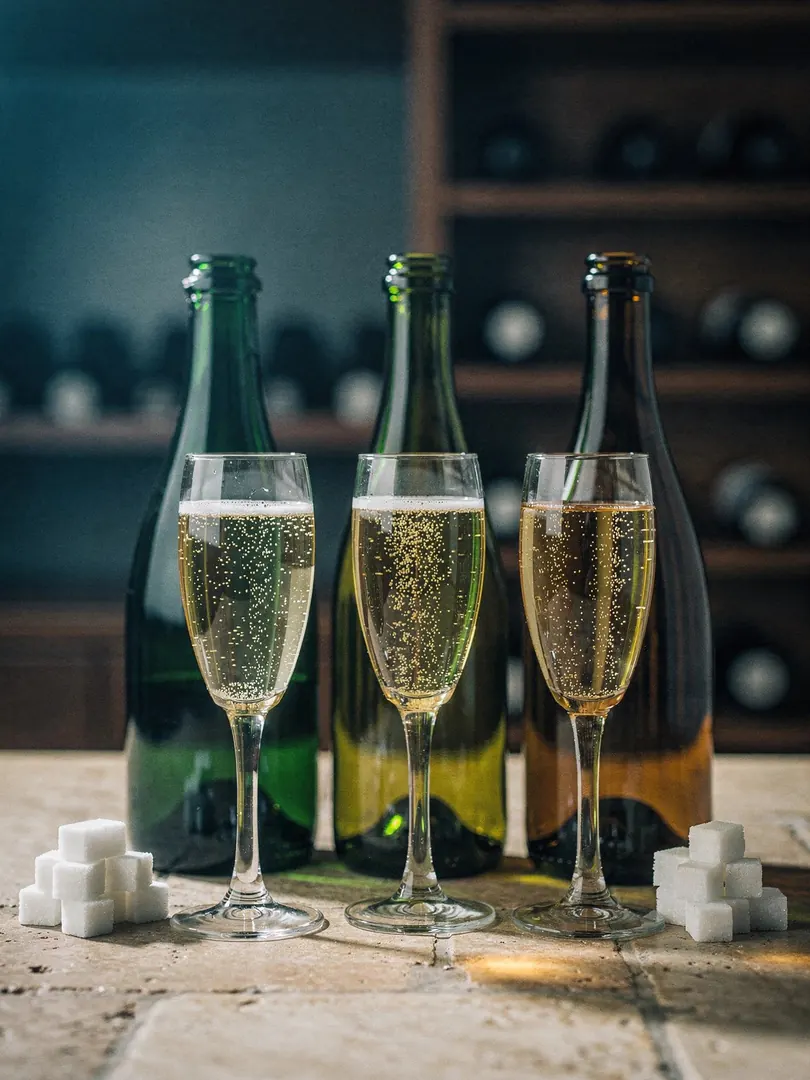
At the sweeter levels, the figures rise noticeably. An off-dry sparkling wine (Demi-Sec) delivers 3.2 to 5 grams per glass, and a sweet one (Doux) more than 5 grams. For comparison, a sugar cube weighs about 3 grams. A glass of Brut therefore contains less than half a cube, while a glass of off-dry sparkling wine contains one to nearly two cubes. The permitted tolerance of 3 grams per liter shifts these figures by at most 0.3 grams per glass.
This calculation applies to sugar content alone. It says little about perceived taste, since acidity and carbonation both influence how sweet a glass seems. An Extra Dry with 1.5 grams in the glass can taste sharper than a low-acid Brut. Still, for pure sugar content, these figures offer a useful point of reference.
How much sugar does Champagne have?
Champagne comes in all seven sweetness levels, from Brut Nature to Doux. The vast majority, however, is labeled Brut and therefore contains under 12 grams per liter. Many houses stay well below that threshold. The exact amount in the bottle is only revealed through the sweetness level on the label—some producers voluntarily state the dosage in grams on the back label.
Those seeking very low sugar levels should look for Extra Brut or Brut Nature. These styles are well represented in Champagne, partly because the required minimum aging period of 15 months gives the wines plenty of inherent richness. A Champagne Demi-Sec, with 32 to 50 grams, is by contrast the exception.
The same sweetness levels apply to rosé Champagne. A rosé is therefore not automatically sweeter than a white Champagne, even though its color and aromas of red berries might suggest otherwise. The label's stated sweetness level is what matters.
How much sugar does Prosecco have?
According to the consortium, Prosecco DOC Spumante now comes in six sweetness levels, from Brut Nature to Demi-Sec. The traditional style is Extra Dry, with 12 to 17 grams of sugar per liter. Brut is also common, described by the consortium as the more modern style. A Prosecco Extra Dry therefore contains more sugar than a Champagne Brut, even though the difference per glass amounts to only a few tenths of a gram.
Different rules apply to Prosecco Frizzante. With 1 to 2.5 bar of pressure, it's classified as a semi-sparkling wine and follows the still-wine sweetness scale. A dry Frizzante contains at most 4 grams per liter, or up to 9 grams with sufficient acidity. Shoppers comparing Spumante and Frizzante on the shelf are actually looking at two different sweetness systems that sometimes share the same terms.
The sheer volume involved shows how often this question arises. The Prosecco DOC consortium reported around 667 million bottles sold in 2025, while Champagne recorded shipments of 266 million bottles in the same year. Accordingly, a Prosecco Extra Dry often sits right next to a Champagne Brut on the shelf.
Sugar in sparkling wine, Cava, and Crémant
German Sekt has the widest range of all. Every sweetness level is permitted, and dry grower Sekts sit alongside off-dry branded ones on store shelves. Because many well-known brands are labeled trocken (dry) or halbtrocken (off-dry), a glass of supermarket Sekt often contains between 2 and 5 grams of sugar. A Sekt labeled Brut, by contrast, contains at most 1.2 grams.
Cava is also permitted at all sweetness levels, though the long-aged categories Gran Reserva and Paraje are restricted to Brut and drier styles. Crémant must stay under 50 grams per liter, meaning it can never be classified as sweet. The type of sparkling wine, then, reveals little about its sugar content—only the sweetness level on the label makes bottles truly comparable. How alcohol and calories relate is a separate question, covered under the topic of health.