The sweet categories
Sweet sparkling wine: Mild, Doux, and Demi-Sec
Sweet sparkling wine is labeled Demi-Sec (medium-dry, 32 to 50 g/l sugar) or Doux (sweet, over 50 g/l). The word lieblich doesn't exist for sparkling wine—it belongs to the scale for still wine. The sweetest sparkling wine category is called mild in German, dolce in Italian, and sweet in English.
Lieblich sparkling wine? Why the sweetest category is called mild
Many shoppers look on the shelf for lieblich sparkling wine and don't find it. This comes down to Regulation (EU) 2019/33. Lieblich appears only in Part B of Annex III, the scale for still and semi-sparkling wine, and means at most 45 grams of sugar per liter. For sparkling wine, Part A applies. There, the sweetest category is called mild, or doux in French.
The two terms aren't exactly equivalent in substance either. Mild only starts above 50 grams, and there's no upper limit. A wine with 40 grams of sugar would be lieblich as a still wine, but medium-dry (halbtrocken) as a sparkling wine. Anyone looking for a sweet sparkling wine should therefore look for halbtrocken or mild on the label. If lieblich appears on a bottle with bubbles, it's usually a semi-sparkling wine like a Secco.
It's similar in other languages. The Italian dolce and the English sweet refer to the same category, above 50 grams. The French moelleux, familiar from sweet still wines, isn't part of the sparkling wine scale, though.
Demi-Sec and Doux in Champagne and Crémant
Champagne also has its sweet categories. A Demi-Sec has 32 to 50 grams of sugar, a Doux more than 50. Both are rare today. The vast majority of Champagne is sold as Brut; Demi-Sec is a small niche and Doux an even smaller one. Some houses still produce a Demi-Sec, often explicitly intended as a dessert pairing.
For Crémant, the Doux category is excluded. EU law only permits the term Crémant for wines with less than 50 grams of sugar per liter. A Crémant can therefore be medium-dry, but never mild. Cava and Sekt, on the other hand, may use all categories, even though sweet versions are the exception for Cava. For German Sekt, medium-dry bottles are quite common, by contrast.
Anyone who tries a Champagne Demi-Sec quickly notices it comes across differently from a simple medium-dry sparkling wine. Long lees aging and the fresh acidity of Champagne carry the sugar, making the result feel lush rather than cloying. Something similar applies to good medium-dry Riesling-based grower sparkling wines.
Sweet without Dosage: Asti and Moscato d'Asti
Asti from Piedmont is a special case. It's made from Moscato bianco, and its sweetness comes from the grapes themselves. The must is stored cold and fermented in a pressure tank. Fermentation is halted while sugar is still present. So there's only a single, interrupted fermentation instead of two, and the carbon dioxide from that very fermentation stays in the wine.
Legally, Asti is classified as an aromatic quality sparkling wine. For this category, EU law prohibits dosage liqueur, and fermentation may only be controlled by cooling or other physical means. The sweetness here is natural residual sugar from the grape must. Moscato d'Asti follows a similar path but remains only lightly sparkling and has around 5.5% alcohol by volume.
The difference from Demi-Sec is therefore fundamental. With Demi-Sec, sweetness is added afterward via the dosage to a wine that has already fermented nearly dry. With Asti, part of the grape sugar was never fermented at all. That's why Asti has less alcohol than most sparkling wines and tastes intensely of fresh grapes.
Classifying Sweet Sparkling Wine: Acidity, Aroma, and Occasion
Whether a sweet sparkling wine delights or comes across as cloying depends on acidity. A Demi-Sec made from an acid-forward base wine tastes fresh and juicy, while one from a low-acid wine quickly feels flabby. Aromatic varieties like Muscat intensify the sweet impression with their grapey perfume. With these, less sugar is often enough for the same effect, so even an off-dry Muscat sparkling wine can taste almost medium-sweet.
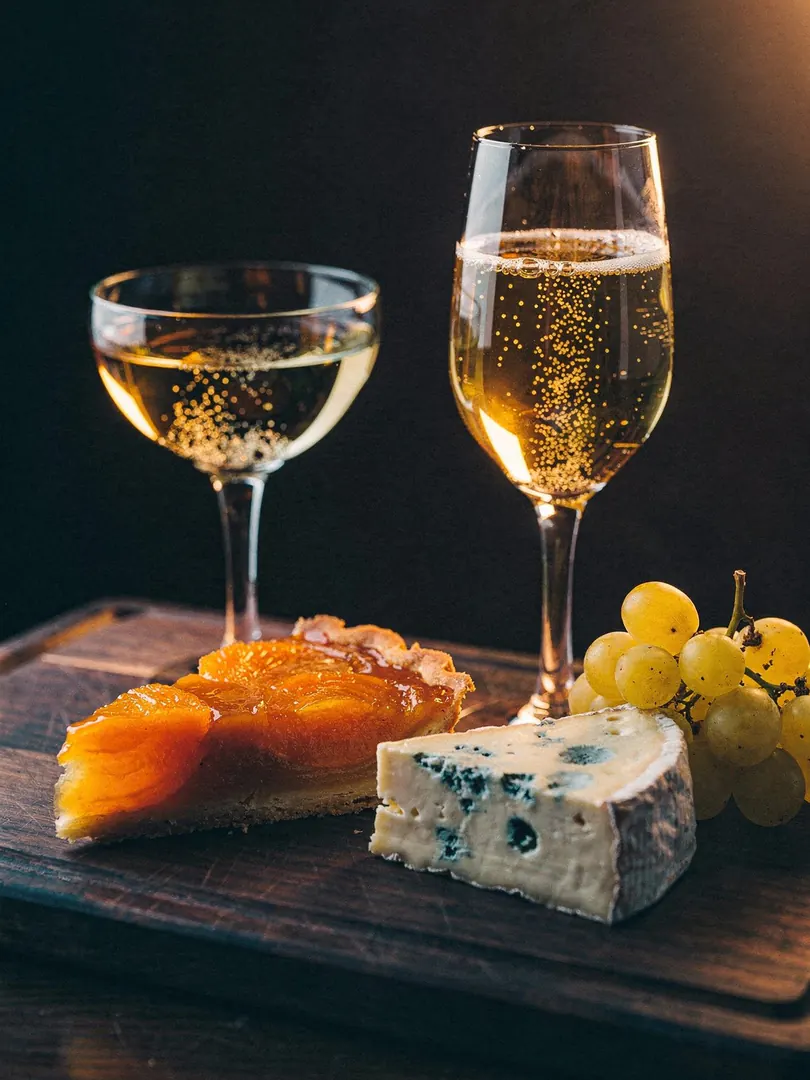
Sweet sparkling wines work best with food when the dish itself brings sweetness to the table. A dessert should never be sweeter than the wine, or the wine will taste thin and sour by comparison. With fruit tart, panna cotta, or a mild blue cheese, a Demi-Sec therefore pairs better than a Brut. A bone-dry sparkling wine served alongside a sweet cake, on the other hand, almost always loses out.