Copper or Bamboo
Fermenting & Distilling
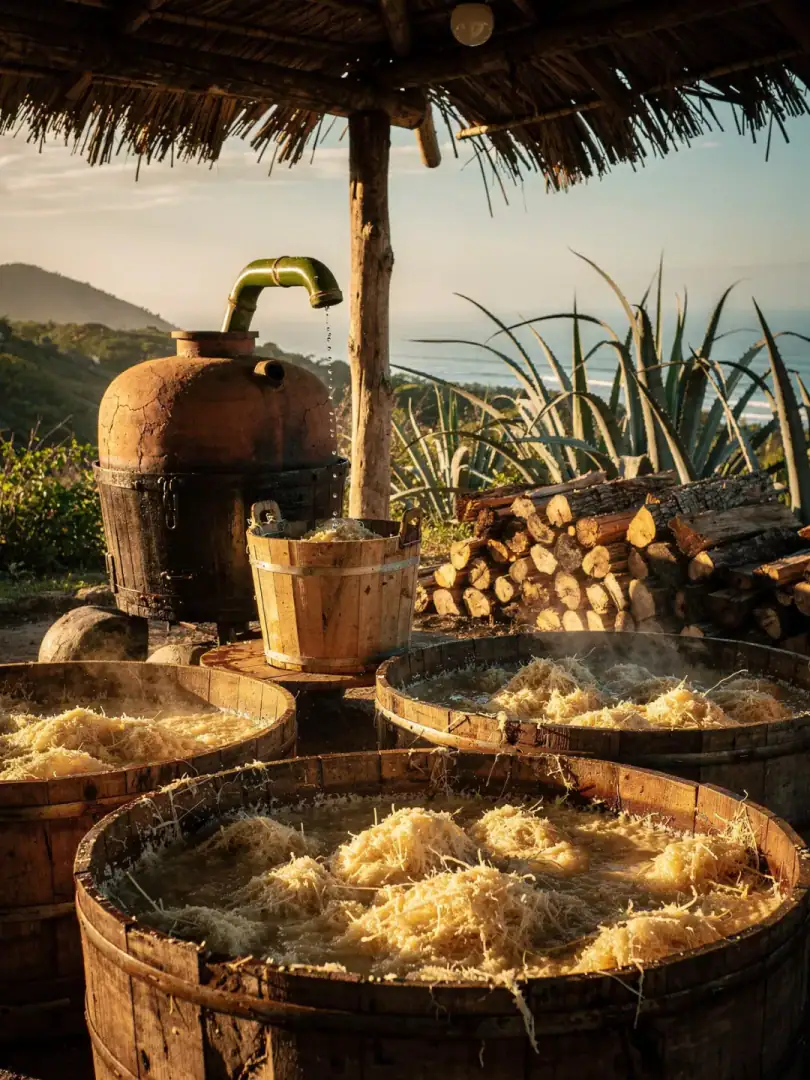
Fermentation in this region relies mostly on wild yeasts. They find their way into the mash on their own, from the air and from the agave itself, often together with the fibers of the crushed piña. The vats used vary by operation, made of wood or hollowed-out tree trunks, depending on what was traditionally at hand in each community.
When it comes to distilling, the clearest difference between Sierra and coast emerges. In the mountains, the classic copper alembic is most common, a legacy of Spanish colonial times. It resembles the still used for tequila and mezcal. On the coast near Cabo Corrientes, though, the destilador filipino has survived in many places, a simpler apparatus made of clay and wood. Its outlet, called the "spoon," is fashioned from wood, agave fiber, or bamboo.
This device didn't come from Spain but crossed the Pacific. Starting in 1565, galleons from Manila docked in Acapulco. Aboard were Filipino sailors who brought their own simple distilling technique for coconut wine. On the coast of Jalisco, this method was at some point transferred from the coconut palm to the agave. That's how the destilador filipino became part of Raicilla de la Costa.
Distillation is usually done twice, without the strict rules of tequila, following instead the taste of each individual maestro raicillero. What determines the final strength of the distillate is mainly the cut. The heads and tails, meaning the beginning and end of the run, are discarded or set aside for the next batch. Only the clear heart in the middle, the corazón, makes it into the bottle.