Tax, Smuggling, Protection
Region & History
Long before anyone in these mountains had heard the word tequila, people were cooking agave hearts for pulque, the mild, fermented sap of the plant. The Sierra and coast between Mascota, Talpa de Allende, and Cabo Corrientes were agave country even before the Spanish conquest. The Spanish brought distillation, and cooked agave became a distilled spirit.
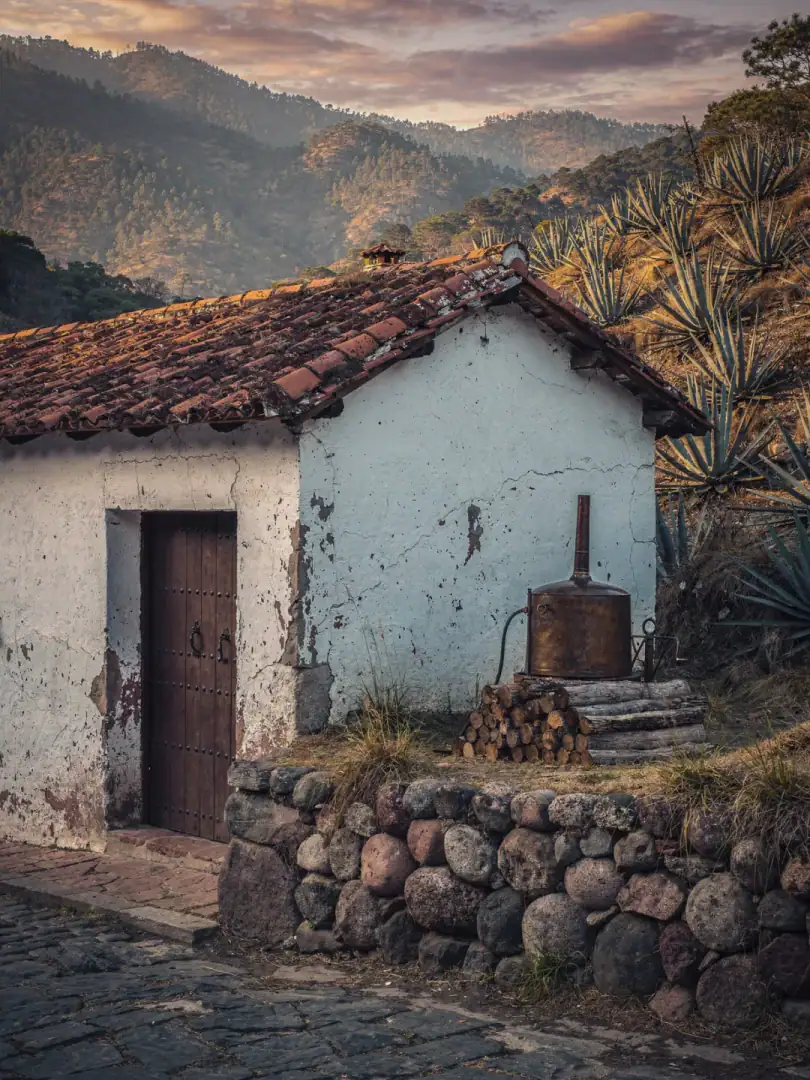
The Crown in Madrid saw every independent distiller as a threat to its own tax revenue and repeatedly banned private agave distilling. In the Sierra and along the coast, this was nearly impossible to enforce, so people distilled in secret, in pits dug into the earth and behind rocks. The name dates from this period: "Raicilla," little root. One story holds that it was named this way to dodge the mezcal tax. There's no proof, just the tale passed down.
Anyone distilling in large quantities in the 19th century usually belonged to a hacienda family. Mascota still wears the facades of that era today, narrow colonial houses with thick walls. Even so, the distilleries stayed small, often just a single copper still behind the house.
It wasn't until 1997 that the Consejo Mexicano Promotor de la Raicilla was founded, the first organization of its kind. On June 28, 2019, Mexico declared the Denominación de Origen Raicilla. Seventeen municipalities have been allowed to carry the name since, sixteen of them in Jalisco, including Mascota, San Sebastián del Oeste, Talpa de Allende, Atenguillo, Cabo Corrientes, Puerto Vallarta, and Tomatlán. The sole exception is Bahía de Banderas in the neighboring state of Nayarit.
At first glance this seems odd, since the tequila region covers all of Jalisco, these municipalities included. Anyone growing Blue Weber Agave here and working to the tequila standard could indeed call their distillate tequila. The trouble is, almost no Blue Agave grows here. The Sierra carries Agave maximiliana and Agave inaequidens, the coast Agave angustifolia and Agave rhodacantha. Mezcal is ruled out for a different reason: Jalisco simply isn't among the states covered by the mezcal standard. So distillers were left with only their own name, protected since 2019: Raicilla, made from exactly these agave species, with Blue Weber Agave explicitly excluded.
Today the protection mainly benefits the small family distilleries, who can now sell their Raicilla legally and with a stated origin.