Four Wild Agaves
Agave & Soil
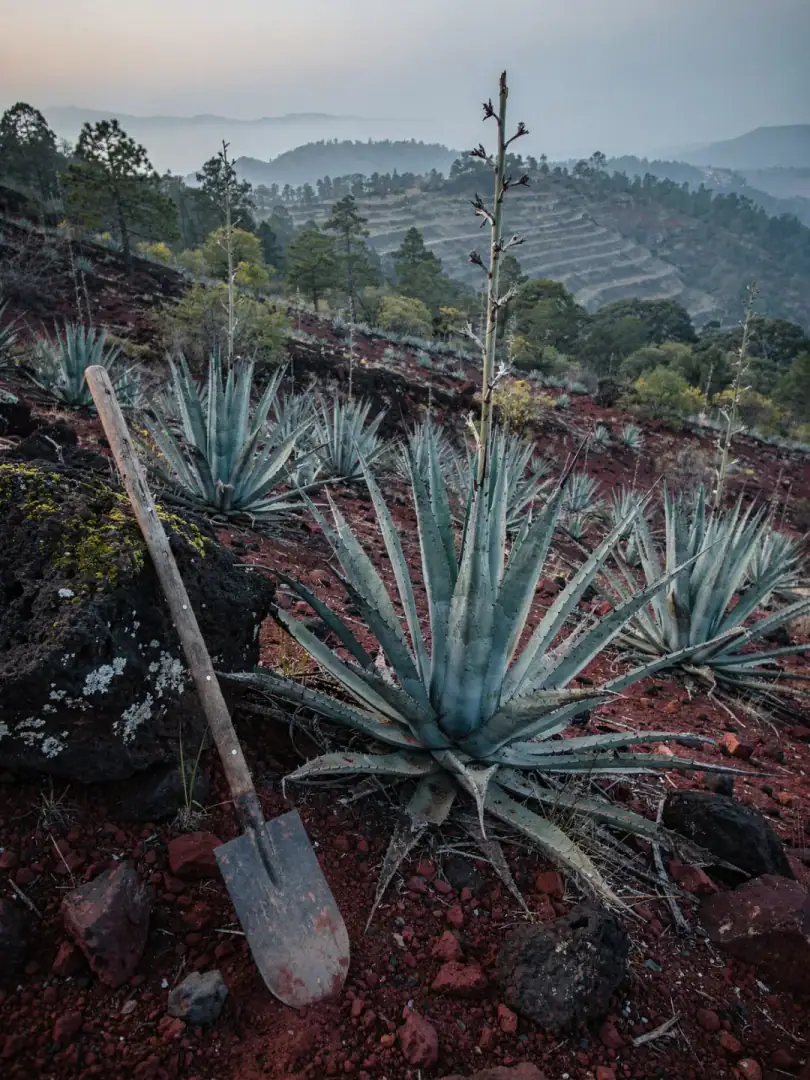
In the Sierra around Mascota and San Sebastián del Oeste, Agave maximiliana grows above all, often called lechuguilla locally. Agave inaequidens joins it. Along the coast around Cabo Corrientes and Tomatlán, Agave angustifolia and Agave rhodacantha dominate, usually just called mexicano there. All four species are approved for Raicilla. The Blue Weber Agave used in tequila, however, is explicitly not.
Maximiliana is now grown mostly under cultivation. According to Mexican agricultural research, it makes up a good three-quarters of current plantings. Inaequidens, angustifolia, and rhodacantha, by contrast, still often grow wild in forest and scrubland, gathered rather than planted. Wild agaves take noticeably longer to mature than the cultivated Blue Agave used for tequila. Exactly how many years depends heavily on the species, elevation, and soil.
Harvesting, as everywhere in agave country, is done with the coa, a broad, sharp blade on a long handle. The jimador cuts away the spiny leaves of the mature plant until only the heart remains, the piña. Along the coast, Agave rhodacantha often grows tall and slender rather than round like a classic piña. The harvest there looks correspondingly different from that in the Sierra.
The soils of the Sierra are volcanic, reddish-brown earth over weathered andesite and rhyolite, typical of the Sierra Madre Occidental. Toward the coast, the soils turn sandier and paler, shaped by the Río Ameca valley and proximity to the Pacific. Both soil types drain quickly. That's exactly what agaves like, since they tolerate standing water poorly.
A dark, loose top layer of decomposed leaf litter and fine volcanic ash.
The root: Here the young agave draws its first nutrients, still close to the surface.