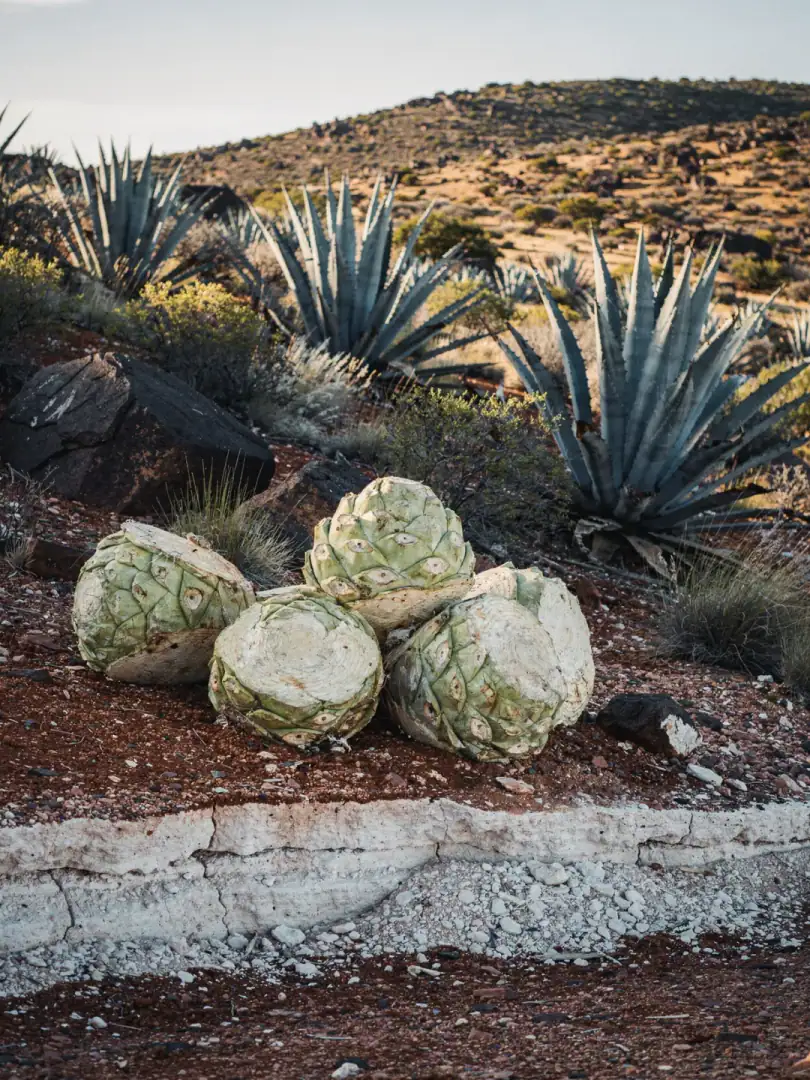
A Giant on Limestone Crust
Agave & Soil
Anyone driving through the Karoo often spots it first as a gray-green hedge by the roadside, Agave americana, commonly known as the Century Plant or simply Karoo agave. The plant originally comes from Mexico, but it has grown so naturally in the Karoo for over a century and a half that many now consider it native.
Rocco Torro from Graaff-Reinet advertises that Karoo specimens grow up to five times larger than the blue Weber agave from Jalisco. The stress of the semi-desert, they say, forces the plant into this particularly vigorous growth. That's a claim from the distillery itself, not an independently measured figure. Sango also uses the related species Agave salmiana alongside Agave americana.
The agave still spreads wild along old fences and grazing land edges to this day, while for the distilleries it's cultivated on dedicated fields. A plant reaches maturity at the earliest after ten years, often only after twenty to twenty-five, depending on soil and rainfall. That's how long it takes to store enough sugar in its heart, the piña.
Harvesting is done by hand: an experienced farmer can tell from the leaf arrangement when a plant is ripe, and cuts away the outer leaves until only the heart remains. A single piña weighs between 35 and 90 kilograms. For every plant harvested, Leonista says it plants three new ones, so that stocks don't shrink.
Beneath the agave fields lies typical Karoo soil, a stony, reddish-brown crust over a clay subsoil, often with a hard limestone layer underneath and remnants of weathered dolerite, the dark volcanic rock that shapes the Karoo landscape into flat hills. The agave roots spread shallow but wide, to capture every rare rain shower immediately.
Weathered, gravelly topsoil with a reddish-brown color, interspersed with Karoo scrub.
The root: Here the agave's shallow roots spread out to absorb rain immediately.