Farms and Law
Region & History
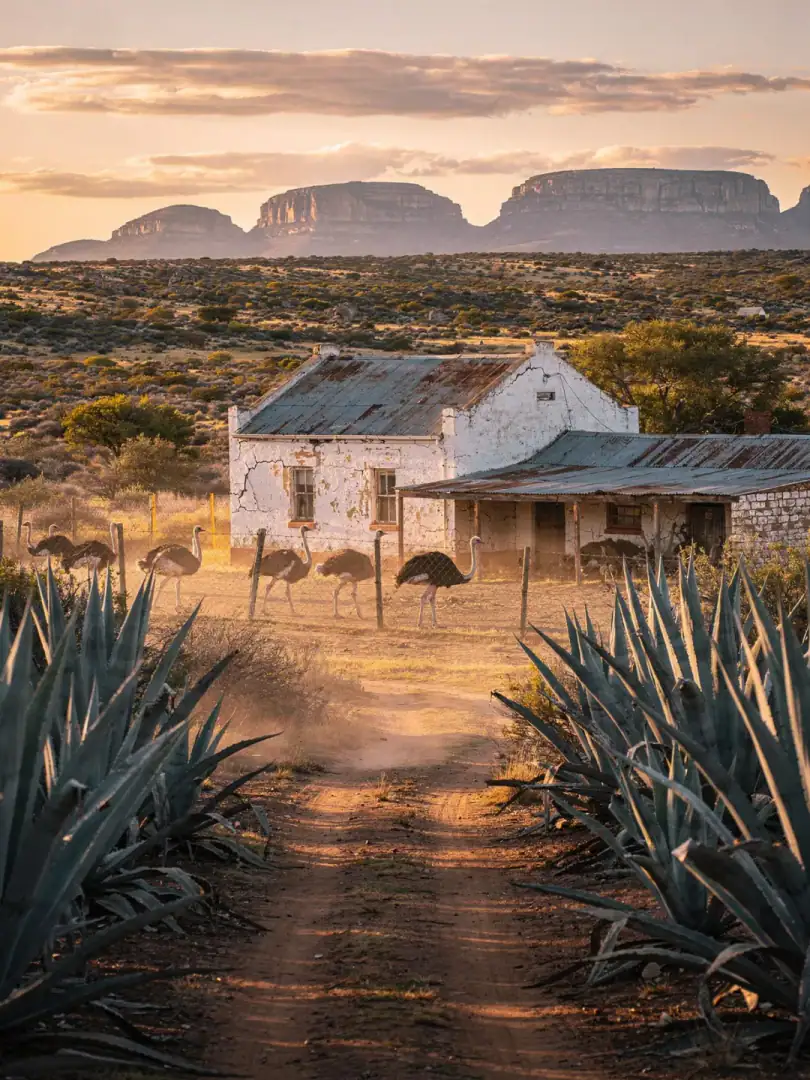
In the 1830s or 1840s, a child from the Rubidge family brought three small agave offshoots from the Wild Coast in the Eastern Cape to Bloemhof farm. Goats and sheep had eaten the spiny leaves during a drought, which had prompted the journey in the first place. This chance observation grew into a farming tradition, since Agave americana withstood dryness where grass had long since withered.
In the Great Karoo, the Rubidge, Southey, and Murray families soon planted agave on a large scale, when the ostrich boom began in the 1860s. The leaves served the feathered giants as winter feed, while the plants themselves grew into living hedges against wind and livestock. When the ostrich market collapsed in 1914, entire stretches of land were left with mature agave fields for which there was suddenly no use.
Syrup was later extracted from the leaves, before the idea of an agave spirit emerged. In 1997, Harvey Venter founded "Tequila and Mezcal Distillers Ltd" with 15 million rand in venture capital. In 2000, Keith McLachlan took over the factory and renamed it Agave Distillers. In 2006 he lost control to Jan Terblanche, and in 2008, after Terblanche's death, the company was liquidated. This first wave failed before it really gained momentum.
Since the 2010s, smaller operations have made a second attempt. Tim Murray distills his "Three Agaves" on Roode Bloem farm near Graaff-Reinet, Leigh Lisk and Lucy Beard have been building the Hope Distillery with Esperanza Agave since 2016, and Sarah Kennan founded Leonista in 2017. Jonathan Roche followed with Rocco Torro, also based in Graaff-Reinet, the town that today owes its reputation as the center of South African agave distilling to these pioneers.
South Africa has no protected designation of origin like Tequila or Mezcal. Instead, the Liquor Products Act of 1989 regulates the category "Agave Spirit" with its own requirements, including a minimum alcohol content of 35% ABV. No one here may write Tequila or Mezcal on the label, since both names are protected internationally, among other things through the agreement between the EU and Mexico. Those distilling in the Karoo therefore openly call their drink by its own name.