Double Distilled, Pure
Fermentation & Distillation
Agave sugar consists largely of inulin, a long chain of fructose molecules, not simple grape sugar. Ordinary brewer's yeast struggles with this, so Karoo distilleries work instead with yeast strains specialized in fermenting agave juice. Only this adaptation turns the viscous agave juice into a fermentable mash.
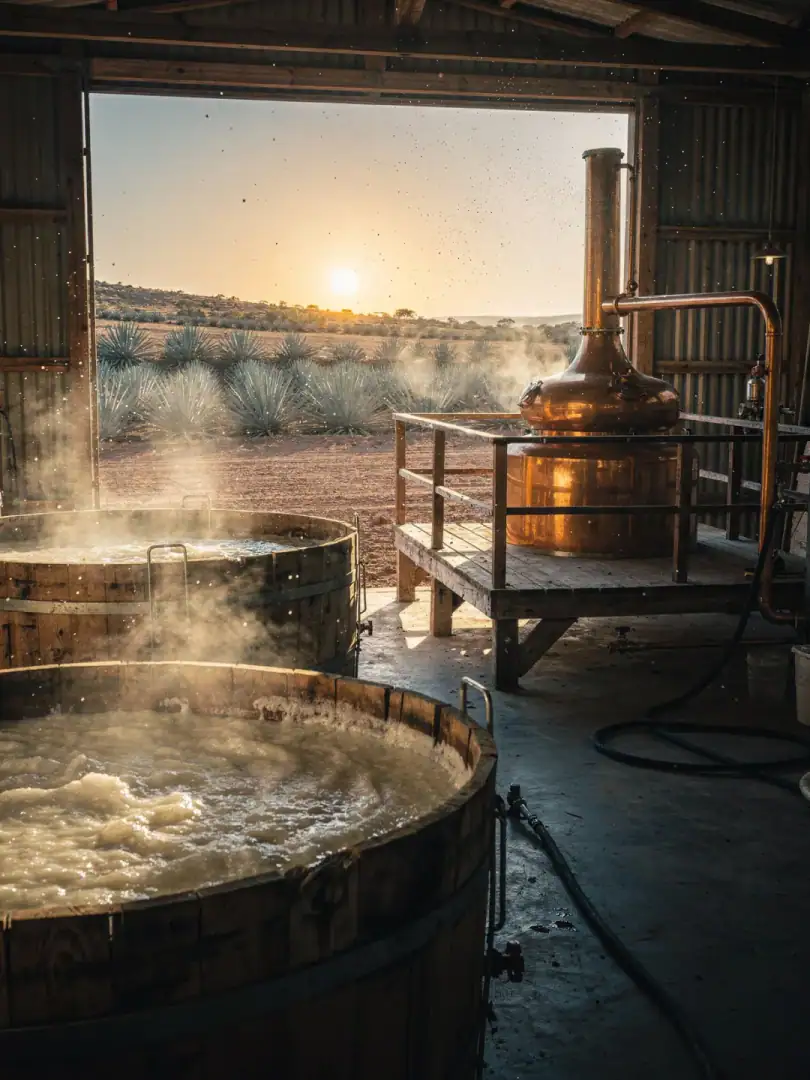
Everywhere, distillation is done twice, as is also customary in Mexico. La Tierra Agave uses a purpose-built hybrid column for this: in the first pass, the still separates heads, hearts, and tails; in the second, the distillate is refined for texture and aroma.
Sango has its agave spirit bottled additive-free in KwaZulu-Natal and explicitly advertises that nothing is added afterward. The brand name derives from Shango, the Yoruba god of thunder, and is meant to mark out a distinctly African agave spirit. Tequila, by contrast, permits caramel or sugar syrup up to a small percentage without requiring it on the label.
South Africa's Liquor Products Act of 1989 requires a minimum alcohol content of 35% ABV for the "Agave Spirit" category. As in Jalisco or Oaxaca, the choice of still is left up to producers, as long as the final product in the bottle is an agave distillate meeting this minimum strength.
Copper, stainless steel, or a modern hybrid column: in the Karoo, it's not a rulebook but budget and the flavor a distiller wants to achieve that decides. What remains is the requirement for double distillation, which practically every brand in the region has adopted. In this sense, the young Karoo scene resembles the early years of Mexico's highland distilling tradition.