The botany of the agave
Not a cactus
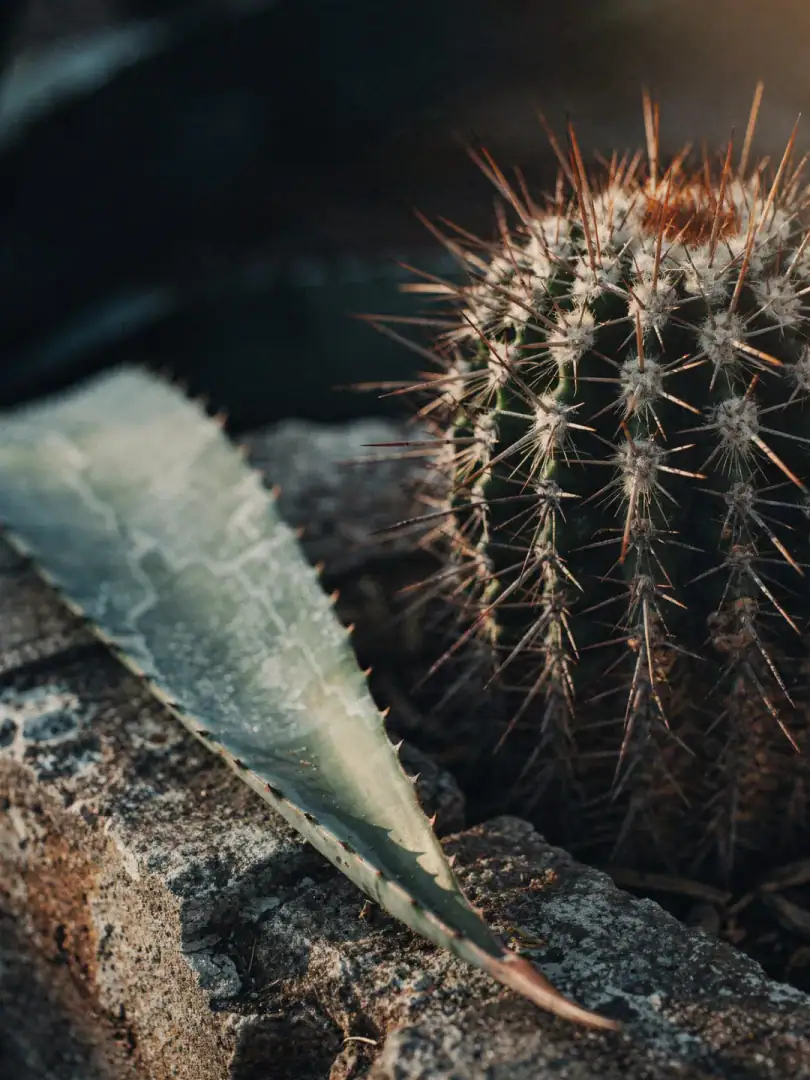
An agave looks like a spiny boulder plucked from the desert, but it has nothing to do with the cactus growing next to it. It belongs to the asparagus family. Anyone who wants to understand why tequila permits only a single agave and mezcal dozens must first understand how this plant grows, flowers, and dies.
Why the agave isn't a cactus
Anyone seeing an agave for the first time often mistakes it for a cactus. Both store water in thick, fleshy parts and grow where it's hot and dry. Botanically, though, an entire lineage separates the two plants. Agaves belong to the asparagus family, more precisely to the subfamily Agavoideae, alongside yucca and similar desert plants. Cacti form their own, completely separate family, botanically far removed.
The fact that both look similar comes down to a trick of evolution: two unrelated plant groups independently arrived at the same solution for the same desert. Look closely, though, and the difference becomes obvious at once. Cacti carry their spines in small clusters that grow from tiny cushions called areoles. On an agave, by contrast, each leaf tip carries just a single hard spike, often with serrated edges running along the entire leaf.
The structure of a rosette
Everything about an agave is built toward one goal: gathering water and nutrients over a very long time. The leaves grow in a circle from a central point, tightly packed like the scales of a pinecone. Inside, they're fibrous and water-storing; outside, leathery and coated in a waxy layer that minimizes moisture loss. This is how the plant survives dry spells that would kill other species.
At the center, where all the leaves converge, a firm, round core develops over years. This core later becomes the piña, the heart that harvesters expose and distillers cook. The longer an agave grows, the more sugar it stores there, in the form of long chain molecules. Some species also yield sturdy leaf fibers used for rope or textiles, but for spirits, only what's inside the core ultimately matters.
One bloom, one death
An agave flowers exactly once in its lifetime, and then it dies. This isn't the exception but the rule for the entire genus. When the time comes, the plant sends a tall stalk skyward from its center, the quiote, sometimes reaching several meters in just a few weeks. Doing so consumes nearly all the reserves it has gathered over years.
At the top, hundreds of small flowers open, attracting bats and insects, getting pollinated, and forming seeds. Afterward, the reserves are spent, and the mother plant withers. In English, the agave is sometimes called the "century plant" because people once believed it flowered only once every hundred years. That's not true: even the slowest species needs roughly 20 to 30 years, many considerably less. To ensure the species survives reliably regardless, many agaves send up offshoots from the base well before flowering.
Over 200 species, one homeland
The genus Agave counts more than two hundred species worldwide, and most of them grow nowhere else but Mexico. From the desert in the north to the tropical dry forests in the south, nearly every region has produced its own species, adapted to local elevation, soil, and rainfall. A handful of species reach into the southwestern United States, Central America, or the northern Caribbean.
This very diversity explains why tequila and mezcal are regulated so differently. Tequila permits only a single species, while mezcal allows many. Both rules only make sense once you understand just how large the family really is from which they were chosen, and how differently its members grow, mature, and taste.