The tequila agave
Blue Weber Agave
Only a single agave may become tequila: the Blue Weber Agave, named after the botanist who described it in 1902. Nearly every plant in the fields of Jalisco is genetically an identical clone of its neighbor. That makes the harvest predictable, but also vulnerable.
One plant for one agave
Under Mexican law, tequila may only be made from a single plant: Agave tequilana Weber, usually known simply as the Blue Weber Agave or Blue Agave. It owes its name to Franz Weber, the botanist who scientifically described the species in 1902. Of the more than two hundred agave species, this is the only one approved as a raw material in the growing region of Jalisco and the surrounding areas.
Anyone planting a different agave there can make mezcal, raicilla, or another drink from it, but never tequila. Conversely, if the same Blue Weber Agave grows outside the protected communities, say in California or South Africa, the result still can't be called tequila. The name is tied to the territory, not just the plant.
Clones of clones: the hijuelos
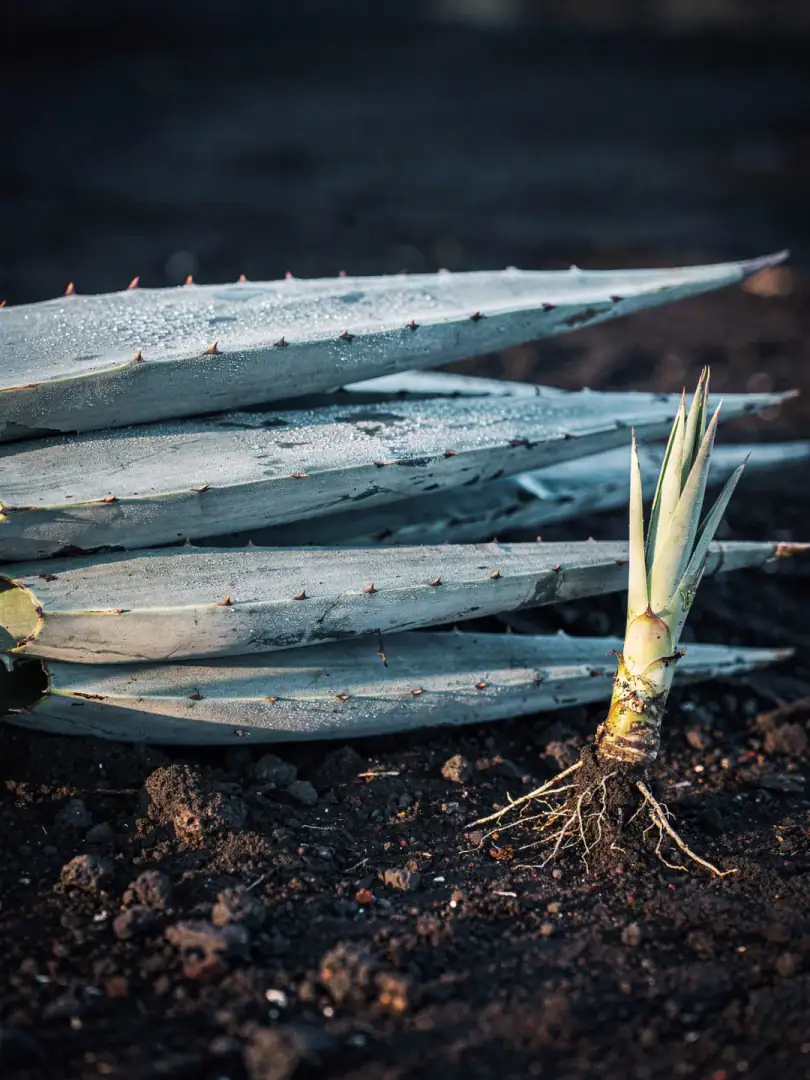
In practice, farmers almost never propagate the Blue Agave from seed. Instead, they separate young offshoots, the hijuelos, from the base of a mature plant and replant them. Every hijuelo is a genetic clone of the mother plant, not an offspring with its own mix of genetic material. After roughly six to eight years, the offshoot has grown into a plant ready for harvest.
This has a clear advantage: growth, sugar content, and ripening time become highly predictable, since practically every plant in the field is genetically identical. Over decades, this has produced vast expanses where essentially a single agave grows, copied again and again, row after row, field after field.
The price of monoculture
Genetic uniformity has a downside. When thousands of plants on the same field are practically identical, a single pest or disease strikes them all with equal force. That's exactly what happened in the 1990s, when bacteria, fungi, and a weevil together weakened entire growing regions and killed off many fields.
Because there was barely any genetic diversity, there were no more resistant plants that could have better withstood the infestation. The risk remains to this day, the moment a pathogen finds a gap in the variety's defenses. Some producers have therefore begun mixing in a few seed-propagated plants among the clones again, even though this makes the harvest less predictable.
Blue, but why
The agave owes its name to a fine, waxy layer on the leaves that reflects sunlight in a bluish-gray hue while also retaining moisture within the leaf. Rub off this layer, and rich green appears underneath. Botanically, the plant carries the epithet "azul," Spanish for blue.
On the red volcanic soils of Jalisco, the blue-gray rosettes create a striking contrast that has become one of Mexico's most iconic landscapes. Rows of Blue Agave stretch across hills and plains there, as far as the eye can see, and have even been part of a UNESCO World Heritage Site since 2006.
What helps against monoculture
Since the risk of genetic uniformity has been known for years, research institutions in Jalisco and individual producers are working together on countermeasures. Some are testing agaves grown from seed instead of hijuelos, to bring genetic diversity back into the field. Others maintain collections of wild forms and older lineages of the Blue Agave, so that more resilient plants can be drawn on if needed. Laboratories that propagate plants in test tubes have also become part of the industry's toolkit.
Such approaches remain the exception for now, because seed-propagated plants grow more slowly and unevenly than clones. For the broader industry, predictability still outweighs genetic security, not least because it makes yields easier to plan. Still, many experts consider this approach one of the few long-term answers to a problem that could grow larger with every new plant generation.