Fermented, not distilled
Pulque: the same plant, no distillation
At the end of this journey stands a drink that doesn't belong in the same category at all. Pulque is not distilled, only fermented. The plant behind it is the same one that turns into a spirit at every other stop along the way.
The sap, not the heart
Tequila and Mezcal need the piña, the cooked heart of the agave. Pulque, by contrast, comes from the raw sap. It's called Aguamiel, honey water. To get it, the heart of a mature agave is hollowed out. The sap collects inside and is scooped out daily over the course of several weeks.
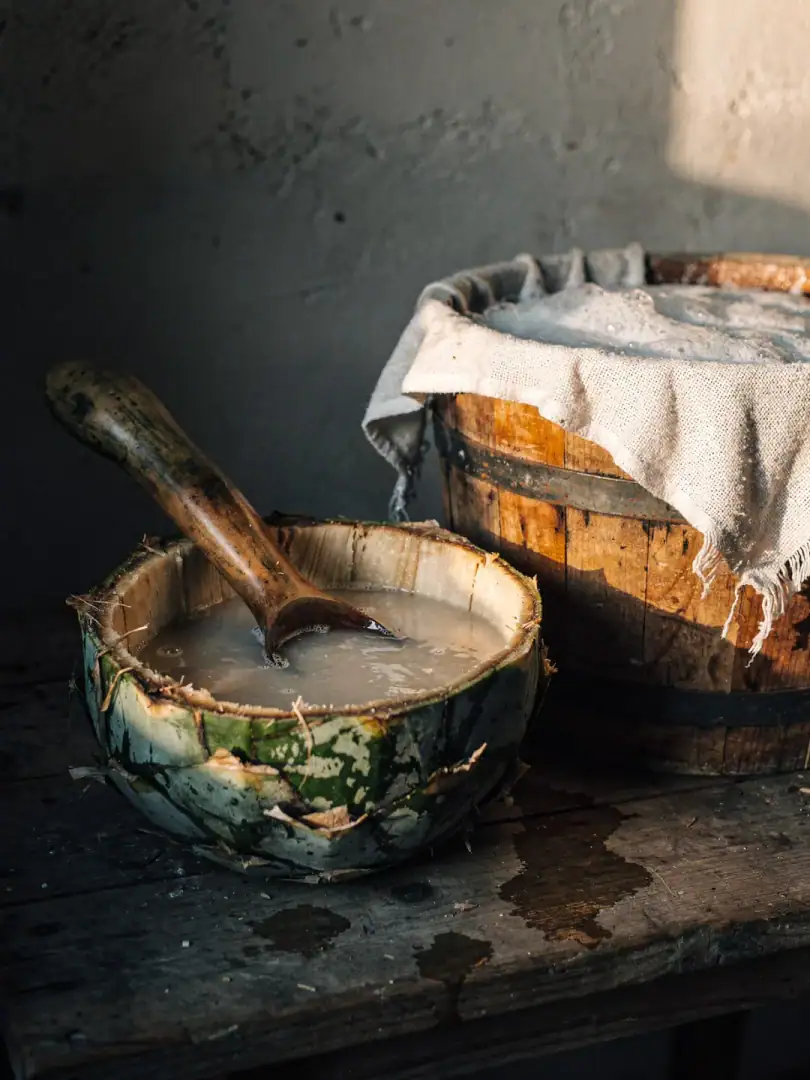
This sap ferments on its own within a few days. It's driven by wild yeasts and bacteria from the air and from old fermentation vessels. Nothing is distilled in the process. Pulque remains a fermented drink with just a few percent alcohol, similar to a mild beer.
Older than Tequila and Mezcal combined
Pulque has pre-Hispanic roots. Long before the Spanish arrived, it was a central drink in central Mexico, often carrying religious significance. It was the Spanish who brought distillation to Mexico. Without them, neither Tequila nor Mezcal would exist in their present form.
In this sense, Pulque is the shared root of the whole family. Every stop shown earlier on this journey draws on the same plant. The only difference is an additional, Spanish-influenced step: distillation.
Why Pulque fits none of these standards
Because Pulque isn't distilled, it falls under none of the designations covered on this journey. There's no NOM-006 for it, no NOM-070, no dedicated appellation of origin as with Bacanora or Sotol. It's simply its own drink with its own tradition. It just happens to come from the same botanical world.
Anyone wanting to understand the whole family could still do worse than start and end with Pulque. It shows most clearly that region, plant, and process only come together to form one of the protected names when combined. At the beginning of every name on this journey stood, simply, an agave.
Different agaves, different tools
For Pulque, distillers usually tap different agave species than for Tequila or Mezcal, chiefly Agave salmiana, Agave mapisaga, and Agave atrovirens. These often grow larger than the Blue Weber agave and form a considerably larger cavity in the heart for the sap. The same plant family thus yields, across different species, entirely different drinks. Fresh Pulque's alcohol content usually falls between two and eight percent, depending on fermentation time and recipe.
The person who draws off the sap each day is called a Tlachiquero. Traditionally they use a hollowed-out gourd tube called an acocote, though today a plastic hose is sometimes used instead. To keep the agave supplying sap for weeks on end, the Tlachiquero must regularly scrape the opening clean, otherwise the flow of Aguamiel dries up within just a few days.
Old myths surround Pulque. In Aztec tradition, the goddess Mayahuel protected the drink, while the four hundred rabbit gods, the Centzon Totochtin, represented the many kinds of drunkenness Pulque was said to induce. What's historically documented is mainly the drink's religious significance; the number of forms of drunkenness remains pure mythology.
These stories show how deeply rooted Pulque was in the culture of central Mexico, long before Tequila or Mezcal even existed. This is exactly what sets it apart from every distilled name on this journey: Pulque tells the older story of the same plant.
A drink in transition
For a long time, Pulque was seen as an old-fashioned drink, mostly consumed in the countryside. In recent years it's enjoyed a small comeback in Mexican cities. Young pulquerías today often serve it flavored with fruit or herbs, known as curados.
This changes nothing about the basic principle. Whether plain or fruit-flavored, Pulque remains fermented and undistilled. That's exactly what separates it from every other drink on this journey, however closely the shared plant may bring them together.