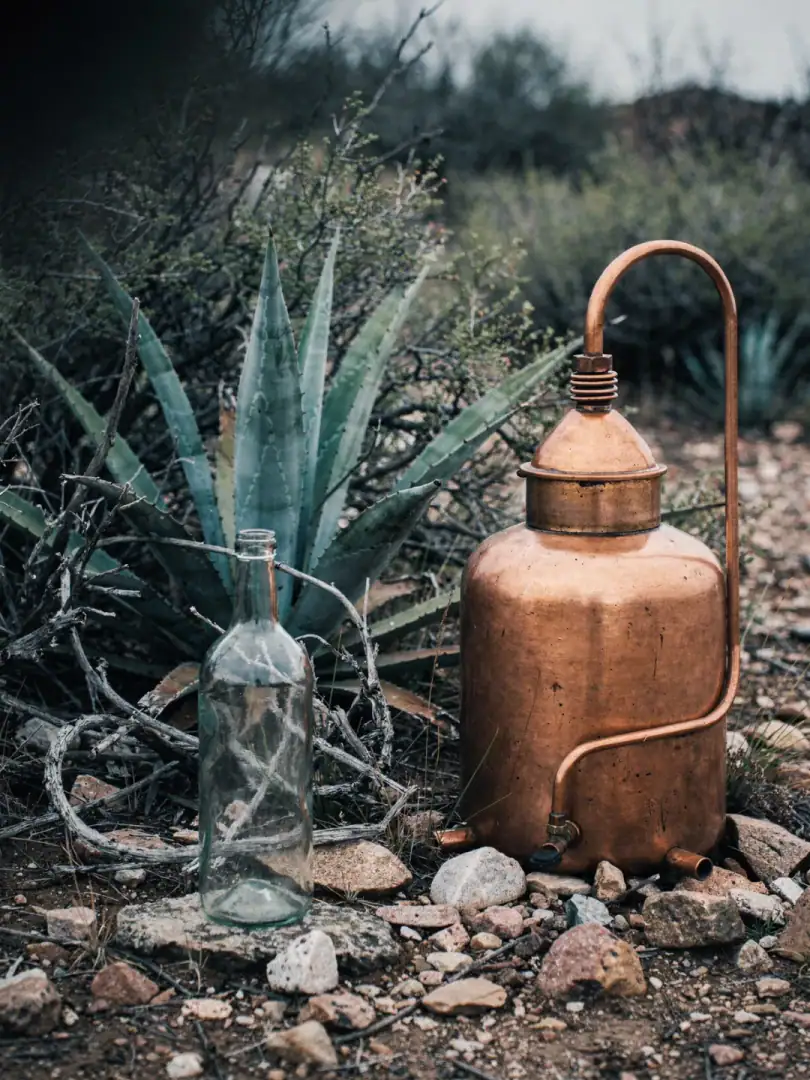
Voluntary renunciation
Destilado de Agave: the voluntary renunciation
Not every agave distiller wants to be called Tequila or Mezcal, even when they're entitled to. "Destilado de Agave" is the catch-all name for everything outside the protected designations. Often it's chosen quite deliberately.
A name for the rest
Anyone distilling agave in Mexico outside the five protected regions has a naming problem. The same applies if they use an agave species not approved there. This refers to the regions of Tequila, Mezcal, Raicilla, Bacanora, and Sotol. In both cases, none of these five names may be used.
Destilado de Agave has become the established umbrella term for all of this. There's no dedicated appellation of origin for it. There's no dedicated regulatory council. There's no fixed procedure. That freedom is precisely the point: a producer sets their own process instead of subjecting it to a standard like NOM-070.
Why some choose the name voluntarily
Not every distiller without a DO name would be forced into it. Some choose it deliberately. One reason is wild agave. Anyone using a rare, slow-growing species far removed from the approved varieties often doesn't fit the strict Mezcal standard at all, even though the process is nearly identical.
A second reason is old family methods. Some don't correspond to any existing standard, such as a particular fermentation approach or a still that no NOM provides for. A third reason is simply cost. Membership in a regulatory council and mandatory inspections cost money. Small operations would rather put that money into the bottle itself.
No protection, but no constraints either
The price of this freedom is a lack of legal protection. Destilado de Agave is not a protected name. No producer can claim it exclusively, unlike Tequila or Mezcal. Anyone may use the term. The only limit: it must not falsely claim one of the five protected names.
For fans of agave spirits, it's still worth seeking out these bottles. Some of the most exciting new wild agave spirits from Mexico deliberately avoid any of the big names. In cocktail bars, such bottles are often showcased neat or in very simple drinks. The idea is to let the raw material in the glass take center stage.
Where the name Destilado de Agave becomes necessary
Map out the five protected regions and you'll quickly see where Destilado de Agave inevitably becomes the only available name. States like Chiapas, Veracruz, or Quintana Roo belong to neither the Tequila region nor those of Mezcal, Raicilla, Bacanora, or Sotol. Any agave spirit from these regions must therefore automatically be sold as Destilado de Agave, regardless of the process behind it.
A similar logic applies internationally. Only Tequila and Mezcal enjoy protection in the European Union under the 1997 agreement between the EU and Mexico. The term Agave Spirit itself, by contrast, is not a protected designation. Any producer worldwide may use it, as long as they don't falsely label it Tequila or Mezcal.
Within this open category, a small but noticeable craft movement has emerged in recent years. It often focuses on individual wild agave species that appear in no existing standard, and on processes that recall old family recipes more than industrial specifications. For these producers, the open name is a deliberately chosen freedom, not a drawback.
Outside Mexico, agave now also grows in regions that originally had nothing to do with it, such as parts of Australia, South Africa, or California, where it was often introduced as a hardy garden or plantation plant. Individual small distilleries there are now experimenting with their own agave spirit. Legally, this has nothing to do with the Mexican family on this journey, but botanically, it has everything to do with it.
How to recognize these bottles
The label often simply reads Destilado de Agave, sometimes with the name of the agave species used added. A place of origin may be included, but doesn't have to be. This openness makes the category confusing, but also exciting.
Those who are curious will find agave spirits here that either didn't want to, or couldn't, follow any of the well-known categories. That's no flaw. It's often exactly why these bottles are so sought after among connoisseurs.