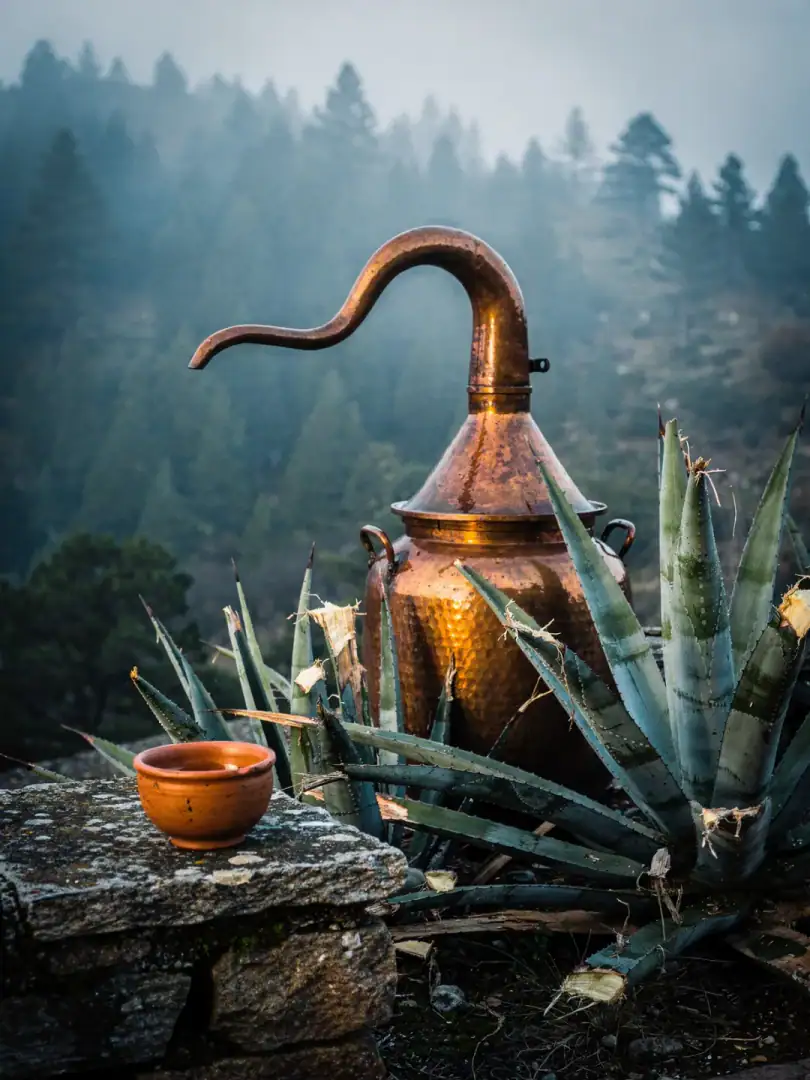
Jalisco's Mountain Spirit
Raicilla: The Mountain Spirit From Jalisco
Raicilla sounds like a small root, yet it's an independently protected agave spirit from the mountains of western Jalisco. It shares the state with Tequila, but neither the territory, nor the agave, nor the name are the same.
Where the Name Comes From
On first hearing the name, you might think of a tea rather than something high-proof. Raicilla literally means little root. A widespread legend explains the name this way: distillers in the 19th and early 20th centuries are said to have deliberately given their clear agave spirit an unassuming name to dodge the Mezcal tax of the time. The story isn't fully documented, but it does a good job of explaining why a drink from the same plant family carries such an inconspicuous name.
What's certain, though, is the territory. Raicilla comes from 17 municipalities. Sixteen of them lie in Jalisco, including Mascota, Talpa, Puerto Vallarta, Cabo Corrientes, and Tomatlán. The seventeenth is Bahía de Banderas in the neighboring state of Nayarit.
Five Agaves, But Never the Blue Weber
Unlike Tequila, Raicilla draws on five agave species: Agave maximiliana, Agave inaequidens, Agave valenciana, Agave angustifolia, and Agave rhodacantha. The Blue Weber Agave, the source of Tequila, is explicitly excluded. Anyone using it can't call their drink Raicilla, even if they're distilling right next to the Tequila territory.
Since 2019, a dedicated denomination of origin has protected this name, filed by the Consejo Mexicano Promotor de la Raicilla. A fully developed regulatory council with its own process standard exists so far only in early form, making Raicilla the youngest of the denominations of origin featured here.
From Earthen Pit to Copper Still
The agave is cooked in an earthen pit, a masonry oven, or an autoclave, a pressure-driven cooking vessel. Here, the standard allows more freedom than the strict Mezcal Ancestral tier. Distillation takes place in alambiques, the traditional stills, made of copper or stainless steel, either continuously or in batches.
Anyone wanting to call their spirit artesanal, however, must use open fire and a copper still. This blend of old and new methods makes Raicilla a spirit caught between two worlds: mountainous and traditional like Mezcal, but with a regulatory framework that's still taking shape.
Sierra and Costa: two styles under one name
Connoisseurs also distinguish two broad styles within Raicilla, even though the law doesn't mandate this division. Raicilla de la Sierra comes from the highlands around Mascota, Talpa, and San Sebastián del Oeste, usually made from Agave maximiliana. It often tastes mineral-driven, herbal, and floral, with noticeably less smoke than its coastal relative.
Raicilla de la Costa, by contrast, comes from the warmer, more humid municipalities near the Pacific, such as Cabo Corrientes, usually made from Agave angustifolia or Agave rhodacantha. It tends to be lighter, saltier, and more citrusy, with a subtle smokiness from the traditional earthen pit. Two bottles bearing the same word on the label can therefore taste completely different, depending on which landscape they come from.
This divide between mountain and coast is far older than the 2019 law. Throughout the 20th century, the growing tequila industry pushed countless small Raicilla distilleries out of the market, compounded by government crackdowns on unregistered operations. For decades, Raicilla remained primarily a drink for local sale in the mountain villages and coastal towns of Jalisco, barely known outside the region.
It took a growing number of connoisseurs to bring Raicilla back into public awareness in the decades before it earned its own denomination of origin, long before that protection arrived in 2019. Since then, exports to the US and Europe have grown slowly but steadily. Still, for many families in the Sierra, Raicilla remains first and foremost a heritage passed down from one generation to the next, and only afterward an export product.
A spirit for the cocktail bar
In Mexican cocktail bars, Raicilla has won many new fans in recent years. Bartenders value its herbal, often lightly smoky character for well-balanced drinks. For a long time, only connoisseurs knew the name. Today it increasingly appears alongside Tequila and Mezcal on the menu.
None of this changes anything about the name itself. Even the most famous cocktail made with Raicilla can't suddenly call it Mezcal. Territory, agave, and process remain the only criteria that count.