Three Production Tiers
The Three Tiers of Mezcal
The Mezcal standard NOM-070 distinguishes three production tiers: Ancestral, Artesanal, and the unnamed industrial category. The difference lies in the oven, the mill, and the still. The more old-fashioned the equipment, the stricter the tier.
Mezcal Ancestral: The Strictest Tier
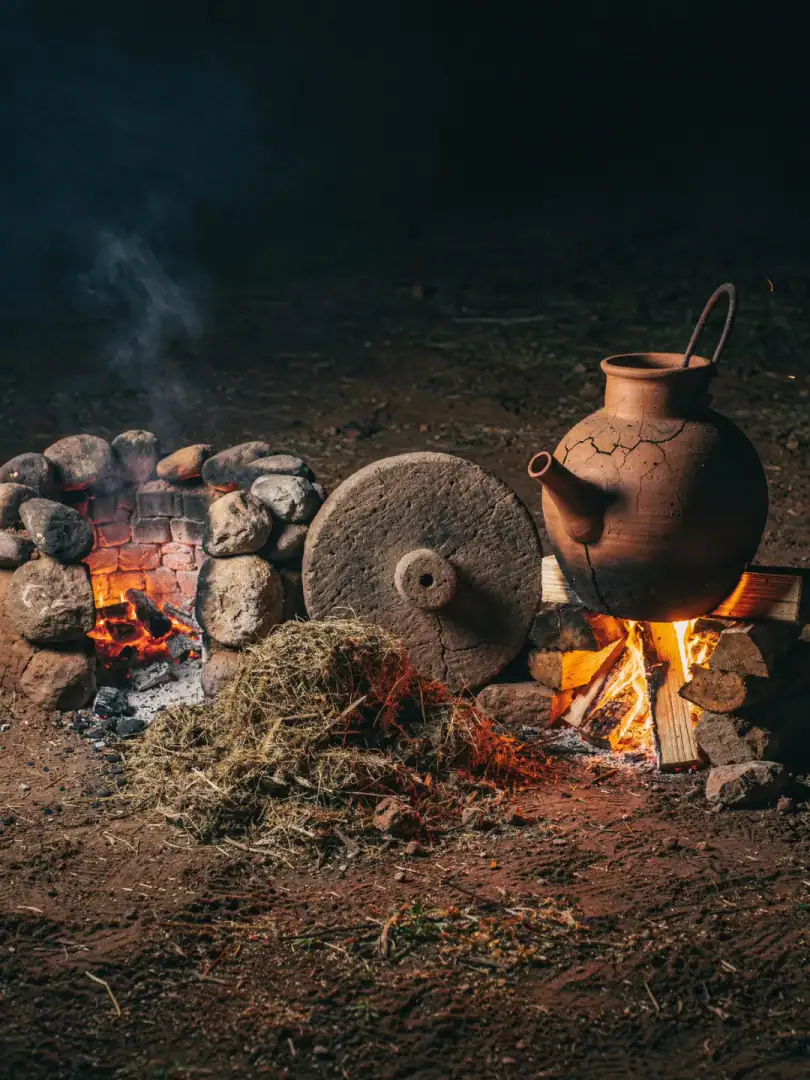
Anyone making Mezcal Ancestral follows the oldest known method. Cooking happens exclusively in an earthen pit, a hole in the ground lined with hot stones and covered with earth and agave fibers. Grinding is done by hand with the mazo, a heavy wooden mallet, or alternatively with the tahona, a stone wheel pulled over the cooked agave by an animal or a person.
Distillation must take place exclusively in clay stills over direct fire. Copper or stainless steel aren't permitted at this tier. This category is rare and expensive—every step is done by hand, and a distiller often yields only a few liters per batch.
Mezcal Artesanal: Craftsmanship With Some Flexibility
Mezcal Artesanal also typically cooks the agave in an earthen pit or a masonry oven. For grinding, the standard allows more tools: the tahona, the mazo, a Chilean or Egyptian mill. A trapiche is also permitted, a roller mill similar to those used in sugarcane processing. Even a mechanical shredder is allowed.
Distillation takes place over direct fire. The still may be made of copper or clay, with a head made of clay, wood, copper, or stainless steel. This makes Artesanal by far the largest category on the shelf—traditional enough to earn the name, practical enough for larger volumes.
Mezcal Without Additional Designation: The Industrial Tier
If neither Ancestral nor Artesanal appears on the label, the third, most open tier applies. Cooking takes place in ovens, autoclaves, or diffusers. These systems break down the agave using pressure or chemistry rather than heat alone. Grinding is done purely mechanically. Distillation happens in any type of equipment, often in continuous columns as used in industrial spirits production.
The agave content still remains one hundred percent at all times. That still sets even the simplest Mezcal tier apart from standard mixto Tequila.
Why the Tier Shows Up in the Price
When you buy a bottle of Mezcal, the word Ancestral or Artesanal on the label also means you're paying for the labor behind it. An Ancestral Mezcal made entirely by hand often takes days to produce a single batch. A diffuser-equipped operation can produce the same volume in just a few hours.
The standard doesn't force anyone into the most expensive tier—it simply describes what must genuinely lie behind each term on the label. Once you know these three terms, you stop buying purely on price or a pretty label.
How to Spot the Tier in the Store
In the store, checking the label helps. If it says Ancestral or Artesanal, you immediately know which method was used. If neither appears, it's usually the open industrial tier.
Price often offers a second clue. Because of the labor involved, Ancestral bottles are almost always pricier than comparable Artesanal or industrial products. If you're paying little, you're rarely getting pure handcraft.
Why These Three Tiers Exist at All
The three-tier system exists because Mezcal has seen a genuine boom in recent decades. Without such a distinction, large industrial operations could have carried the exact same name as a family still grinding by hand and distilling over an open fire. That would have hurt traditional producers. Critics warned early on that the name Mezcal risked becoming a pure marketing term, stripped of any real connection to traditional craft.
The standard thus protects both the name Mezcal and the distinctions behind it. Anyone who writes Ancestral or Artesanal on the bottle is making a promise about specific craftsmanship. That promise is exactly what turns these three tiers into more than mere formality. Buyers who understand this pay more consciously for what's actually in the bottle.
The distinction also has consequences for distillers themselves. Anyone seeking Ancestral certification must forgo modern shortcuts, even ones that would boost yield. Many small producers see this choice as part of their identity.