Harvest and standard
Harvesting and quartering the piñas
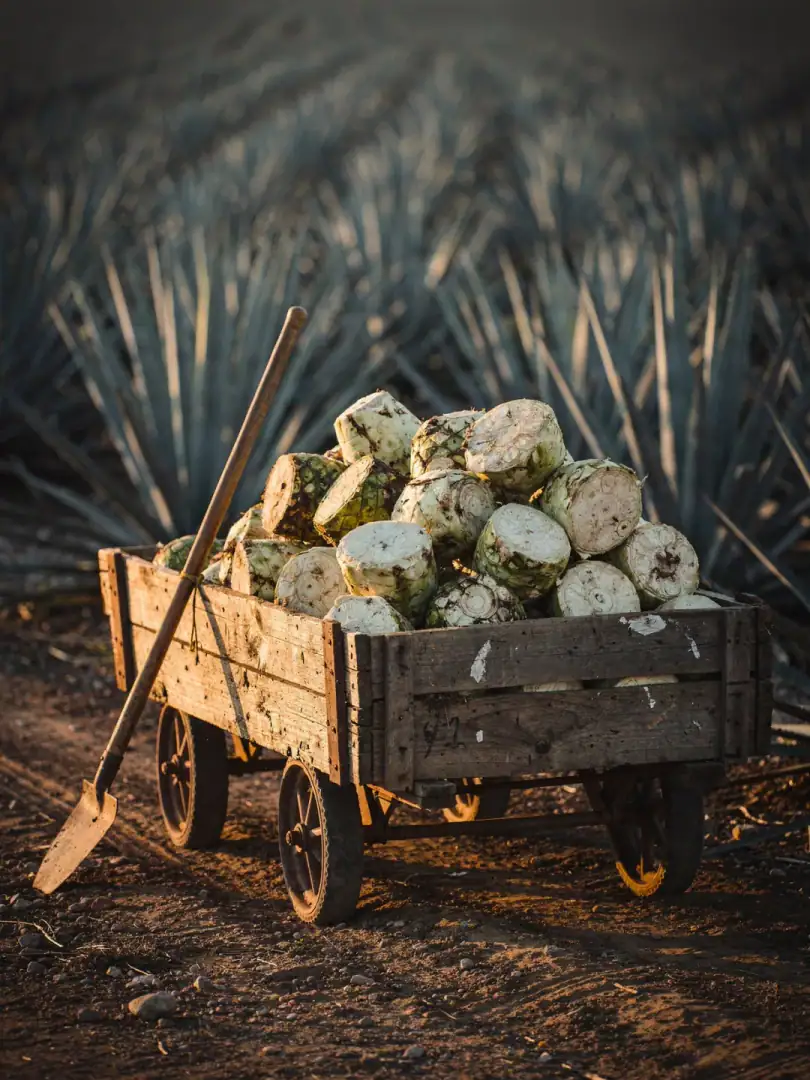
Every bottle begins with a cut of the coa, a long-handled blade. The jimador strips the spiky leaves from the agave to expose the piña, the cone-shaped heart of the plant. Even this first step helps determine which standard will later apply: Tequila or Mezcal.
What a piña is and who cuts it
Depending on the species, an agave takes six to more than twelve years to mature. At the end of this long wait, it forms a dense, fibrous core at its center: the piña, named for its shape, which vaguely resembles a pineapple. This work falls to the jimador, an experienced field worker. Using the coa, a broad blade mounted on a long pole, he hacks away the hard, spiky leaves all around until only this round core remains.
How much a finished piña weighs in the end depends heavily on species and age. For the Blue Weber agave, mandatory for Tequila, thirty to ninety kilograms is common, and some specimens weigh even more. Wild agaves used for Mezcal often grow more slowly in poorer soil and yield smaller hearts that are richer in sugar and aroma, one reason for Mezcal's wide range of flavors.
Why the agave species already matters here
Since standard NOM-006-SCFI-2012, only one plant counts for Tequila: Agave tequilana Weber, variety Azul. The Consejo Regulador del Tequila, or CRT, has enforced this requirement since its founding in 1994. Anyone processing a different agave may not call the finished drink Tequila later, even if the oven, mill and still all look identical in the end.
Mezcal takes the opposite approach when it comes to plant selection. Standard NOM-070-SCFI-2016 permits dozens of species. The range extends from the widely grown Espadín to the rarer Tobalá and on to regional wild agaves that almost no one outside Mexico could name. This diversity of plants is one of the main reasons for Mezcal's broad range of flavors. It tastes noticeably different from region to region, and even from vintage to vintage.
Signs of maturity: when an agave is ready
Whether an agave is ripe is usually shown by the flower stalk bud at the center of the rosette: as soon as it becomes visible, sugar content in the core is at its highest, and harvesting begins. Some experienced jimadores also check with a small refractometer how much sugar is actually present in the outer leaves before they even start cutting.
If an agave is harvested too early, sugar content stays low, and the later fermentation yields noticeably less alcohol. If it's cut too late, the piña becomes woody from the inside, and yield drops noticeably as well. Experience often counts for more here than any fixed formula, which is why many family operations pass this knowledge down orally through generations rather than writing it down.
Quartered for the next step
Before cooking, the piñas are usually halved or quartered with a machete or axe. This lets heat and moisture penetrate the hard core much faster, whether in a closed stone oven, an autoclave, or an open earthen pit. With very large specimens, workers cut the pieces even smaller so that nothing stays raw inside.
Transport also has practical effects: large, industrial operations truck the harvest to a central distillery, while small palenques, the traditional Mezcal distilleries, often cook right next to the field. The journey from the ground to the first cooking step can therefore take hours depending on the operation, or span just a few hundred meters.
Who verifies the origin in the end
Every Tequila distillery must fully document its agave deliveries. The CRT carries out spot checks to confirm that the delivered piñas really do come from registered fields growing the correct agave species. Without this proof, the batch may not be bottled as Tequila.
For Mezcal, oversight is looser, because many families harvest small, often wild stands rather than farming large plantations. The CRM therefore tends to check the finished product and the region of origin rather than individual fields. This difference in the depth of oversight helps explain why Mezcal prices can fluctuate more than Tequila prices.