When the Rules Diverge
Special Paths: Pechuga, Miske, and Sotol
Not every agave spirit follows the same path from field to bottle. Some methods diverge so dramatically that they require their own names and their own rules, from chicken breast suspended over the still to spirits distilled from pure agave juice.
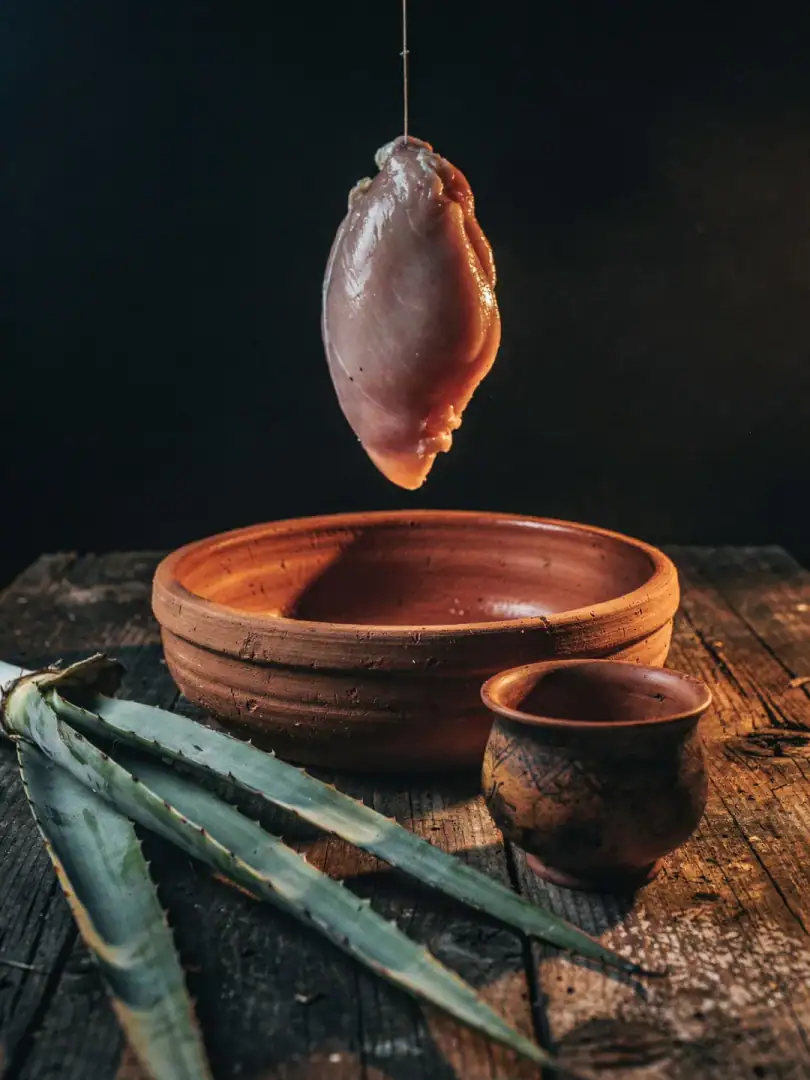
Pechuga: A Chicken Suspended Over the Still
For a Mezcal Pechuga, a raw chicken or turkey breast, and sometimes fruit as well, hangs over the rising alcohol vapors inside the still during a third distillation. Fat and juices drip into the vapor, giving the distillate a savory, almost meaty depth.
The NOM-070 standard groups this method under its own class, "Destilado con," literally "distilled with." Traditionally, Pechuga is made for special occasions like family celebrations or holidays, not as an everyday drink.
Miske: Distilled From Juice, Not From the Piña
Miske from the Ecuadorian Andes takes a completely different path. Instead of cooking the piña, producers tap the raw juice directly from mature agaves, known as "Tzawarmishky," and ferment it using local microorganisms.
Cooking and milling are skipped entirely, since the sugar is already in liquid form. This makes Miske the counterexample to everything Tequila and Mezcal otherwise have in common: both of those always start with a cooked, solid piña.
Sotol: A Different Plant, a Similar Path
Sotol doesn't come from agave at all, but from the Dasylirion plant, which belongs to the same plant family but is botanically classified in a different subfamily. Even so, the journey from field to bottle closely resembles that of Mezcal.
It's harvested, cooked in an earthen pit, and milled much like traditional Mezcal, just using a different plant. Its own standard and its own designated region spanning Chihuahua, Coahuila, and Durango ensure that the name remains protected.
Why These Special Paths Need Their Own Names
Pechuga, Miske, and Sotol show just how differently the journey from agave, or a related plant, to finished spirit can unfold. Every departure from the standard process either shifts the category within a given standard or requires an entirely separate designation of origin.
That's the common thread running through this journey into production: it isn't flavor alone that determines the name on the label, but the exact path that plant and craftsmanship have traveled together.
Bacanora and Cocuy: Forbidden and Rediscovered Names
Bacanora from the Mexican state of Sonora has a particularly turbulent history. From 1915 to 1992, distilling it was officially banned, meaning Bacanora was produced almost exclusively in secret in the mountains for decades. Distilling was finally legalized again in 1992, and in 2000 Bacanora was granted its own protected designation of origin.
Cocuy from Venezuela also carries its own protected name, specifically Cocuy Pecayero. It's made from Agave cocui and traditionally distilled in the region around Pecaya. As with Bacanora, Raicilla, or Sotol, the same rule applies: the name is tied to a specific region and a specific plant, so it can't simply be applied to an agave spirit from elsewhere.
In terms of production, Bacanora closely resembles Mezcal: the agaves, usually Agave angustifolia or related wild species, are cooked, milled, fermented in the open, and distilled in copper stills. The key difference lies solely in the protected region of Sonora and in the name itself, made especially valuable by decades of illegality.
Special cases like these show how strongly history and politics, alongside botany and craftsmanship, shape naming. A spirit distilled in secret for decades can later still receive its own full-fledged designation of origin, once legislation and the market open up to it.