Material Matters Too
Distilling: Copper, Clay, and the Column
After fermentation, the agave wine is ready but not yet strong enough. Only distillation separates alcohol from water, and the material of the still, whether copper, clay, or a steel column, decisively shapes both flavor and which category it's allowed to belong to.
Copper: the Classic Alambique
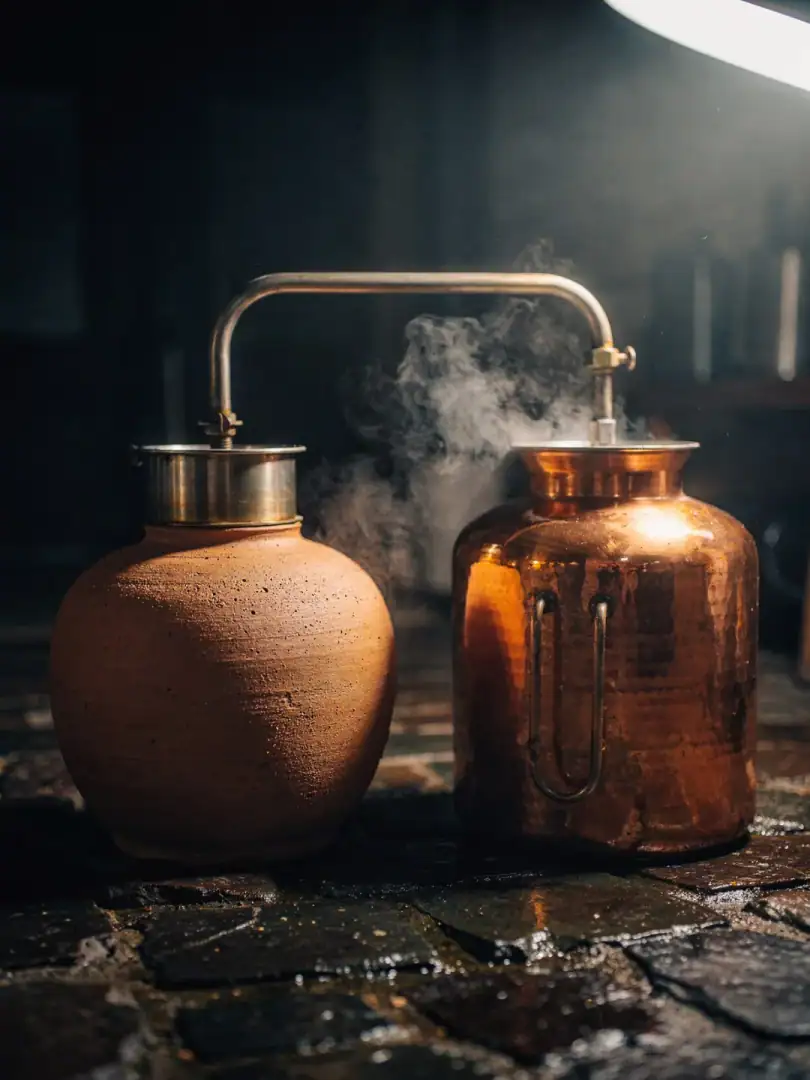
The alambique, a classic pot still, is usually made of copper, because the metal binds unwanted sulfur compounds and thereby purifies the flavor. Tequila and much of Mezcal Artesanal still rely on this material today.
In practice, tequila is almost always distilled twice: the first pass, called destrozamiento, yields a weak raw distillate of about twenty to thirty percent alcohol. The second pass, the rectificación, refines this raw distillate to drinking strength.
Clay: the Only Option for Ancestral
Mezcal Ancestral forgoes metal entirely. Distillation happens exclusively in clay vessels over an open wood fire, a method that yields lower output but imparts earthy, sometimes slightly smoky notes to the distillate.
For Mezcal Artesanal, too, clay is a recognized option alongside copper, while tequila knows no clay still at all. The material is therefore one of the clearest identifying markers distinguishing the three mezcal categories.
The Column: Fast, but Without These Rules
Working continuously rather than in separate batches, the column still, colloquially called simply the column, produces large quantities of very pure alcohol in a short time. It's permitted for tequila and also for simple, industrial mezcal.
For Mezcal Artesanal and Ancestral, however, the column still is off-limits. Both categories explicitly require discontinuous pot stills made of copper or clay, since it's precisely these slower methods that are meant to preserve the traditional character.
How Often It's Distilled and What Ends Up in the Glass
The raw distillate coming out of the still often exceeds sixty percent alcohol and is subsequently diluted with water to drinking strength, usually thirty-eight to forty percent for tequila. Many mezcals, by contrast, are deliberately bottled stronger and less diluted.
Traditional mezcaleros still test the strength using the pearl test: they shake the distillate in a jícara, a small gourd bowl, and read off the approximate alcohol content from the size and persistence of the bubbles, entirely without a measuring device.
Head, Heart, and Tail: The Cuts During Distillation
During the second distillation run, the master distiller divides the resulting alcohol into three parts: the heads, the heart, and the tails. The heads, called cabeza in Spanish, come out of the still first and contain a particularly high concentration of methanol and other harsh, sometimes harmful compounds. They are therefore separated out and usually discarded or redirected for another distillation run.
Next comes the heart, called corazón, the clean middle portion from which the finished tequila or mezcal is eventually bottled. Finally comes the tails, the cola, with declining alcohol content and heavier, oilier aromas. Whether a master distiller determines the cut by smell, taste, an alcohol meter, or the traditional pearl test plays a role in how pure or how full of character the finished spirit ultimately tastes.
How Cooling Shapes the Flavor Too
After evaporation, the alcohol must be cooled again so it turns back into liquid. Traditionally, this is done using a worm tub, a long, spiral-coiled copper pipe submerged in a vat of cold water. The vapor travels through this pipe and slowly condenses into liquid.
Modern distilleries often rely instead on more compact shell-and-tube condensers made of stainless steel or copper, which work faster and are easier to clean. Some traditional producers nevertheless stick with the old worm tub, believing that the extended copper contact during slower condensation helps bind additional sulfur compounds. Whether this difference is actually detectable in the finished spirit remains debated, and largely comes down to each producer's own tradition.
For both Tequila and Mezcal, the cooling method itself isn't regulated: neither standard mandates a specific condensation process. Whether a worm tub or a modern tube condenser is used doesn't change the legal category, though it may affect subtle nuances in the finished distillate. The temperature of the cooling water also influences how quickly the vapor condenses. Very cold water shortens condensation time, while warmer water lengthens it and, according to some master distillers, can allow additional aromas to develop that faster cooling would otherwise lose.