Name only
"Mezcal gets you high"
Mescaline sounds like mezcal, so many believe the drink acts like peyote. Botanically the two have nothing to do with each other. This stop explains where the confusion comes from and what's actually active in a glass of mezcal.
Where does the confusion with mescaline come from?
Two words that sound similar are often enough to create a myth. Mescaline is an alkaloid from the peyote cactus, Lophophora williamsii, which grows mainly in the deserts of northern Mexico and the southern United States and has been used for centuries by indigenous peoples such as the Huichol in religious ceremonies. Because both names sound alike and both are associated with Mexican drinking and ritual culture, the confusion persists stubbornly, reinforced by films and music that like to lump mezcal and mescaline together.
The word origins also add to the confusion. Mezcal comes from the Nahuatl word mexcalli, meaning cooked agave. Mescaline was also derived linguistically from this, because early researchers mistakenly believed the dried peyote buttons to be some kind of agave product. Both terms therefore genuinely share a linguistic root, but not a botanical substance, a detail that feeds the myth further.
What kind of plant is agave really?
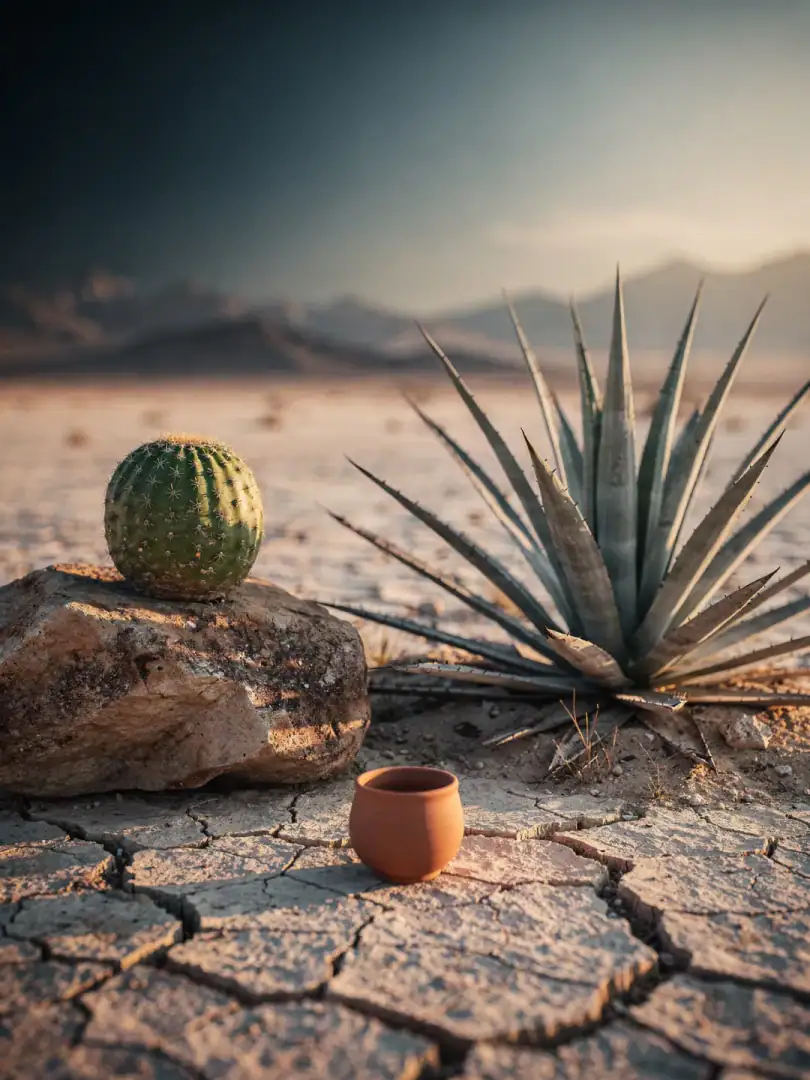
The confusion clears up quickly once you compare the plant families. Agaves, from which mezcal and tequila are made, belong to the asparagus family and contain no hallucinogenic alkaloids. The buzz a glass of mezcal produces comes exclusively from ethanol, the same active ingredient as in beer, wine or whisky. Peyote, by contrast, is a small, spherical cactus, botanically not related to agave in any way, even though both plants grow in similarly arid regions.
Geographically, the two species barely overlap. Peyote grows mainly on barren limestone soils of northern Mexico and south Texas, often in locations unsuitable for large-scale agave cultivation. Agaves for mezcal and tequila, by contrast, mostly grow on the more fertile highlands of central and southern Mexico. In practice, a field of Blue Weber agave and a stand of wild peyote cacti almost never sit side by side.
What does mescaline actually do, and who uses it?
Mescaline is a hallucinogenic alkaloid found exclusively in certain cacti, above all peyote. Several indigenous peoples of Mexico and the American Southwest have used peyote for centuries in religious ceremonies, far removed from the distilling and drinking of agave spirits. This use has no connection to mezcal or tequila, neither botanically nor culturally, except that both customs originate in Mexico and both are tied to indigenous knowledge.
Possession and consumption of peyote are strictly regulated in most countries; in the US, for example, it's expressly permitted only for recognized religious practices of certain indigenous communities. Mezcal, by contrast, is an entirely ordinary, legally sold spirit like tequila or whisky, without special legal restrictions beyond the usual alcohol laws. This legal difference alone shows how far apart the two substances really are.
Why does the myth persist anyway?
One reason lies in the sheer similarity of the words: anyone who hears mezcal and knows mescaline instinctively links the two, even though there's no actual connection. A second reason is mezcal's image as a particularly wild, primal drink, often marketed with smoke, earthen pits and rural craftsmanship. This image invites people to attribute extra, mysterious effects to the drink that it demonstrably doesn't have.
The misconception is reinforced by travel accounts that mix mezcal tastings in remote villages with shamanic rituals, even though the two rarely coincide in practice. Anyone who takes these images at face value easily transfers the aura of the ritual onto the effect of the drink itself. In the end, what remains is simply a high-proof but ordinary distillate, with no additional psychoactive effect.