Related, not identical
"Mezcal is just smokier tequila"
Some people consider mezcal simply a smokier version of tequila, while others insist tequila is really just a type of mezcal. This station clarifies what's true in both statements and what actually separates the law, the plant and the process.
What's true about the claim "tequila is a mezcal"?
In Mexico, people sometimes colloquially use the word 'mezcal', lowercase, as a general term for any distilled agave drink, much like the way Germans use 'Schnaps' to cover many different spirits. In this broad, historical sense, the statement holds up: tequila is an agave spirit from the same large family as mezcal, raicilla, bacanora or sotol, all ultimately tracing back to the same pre-Hispanic tradition of cooking, fermenting and distilling agave.
This double meaning regularly causes confusion internationally, for instance when a bar lists tequila under a "Mezcal Varieties" heading because staff are thinking of the broad, colloquial sense of the word. Anyone who understands both layers, the historical umbrella term and today's narrower legal meaning, can correctly interpret such lists.
Why is the statement still legally incorrect?
Legally, tequila and mezcal have been two separate, independently protected designations of origin for decades. Tequila received its protection in 1974, governed by standard NOM-006 and overseen by the Consejo Regulador del Tequila. Mezcal got its own designation of origin in 1994, governed by NOM-070 and overseen by the Consejo Regulador del Mezcal. A producer in the mezcal zone today isn't allowed to call their product tequila, and conversely a tequila producer can't sell their product as mezcal, even though both are ultimately agave spirits.
This separation is more than legal fine print, it also has economic consequences: only businesses within the respective designated regions are allowed to label their goods accordingly and benefit from the international reputation of the name. An agave spirit from Puebla falls under the mezcal zone, while an agave spirit from parts of Nayarit can belong to the tequila zone, depending on exactly which municipality it's distilled in.
Is it true that mezcal simply tastes smokier?
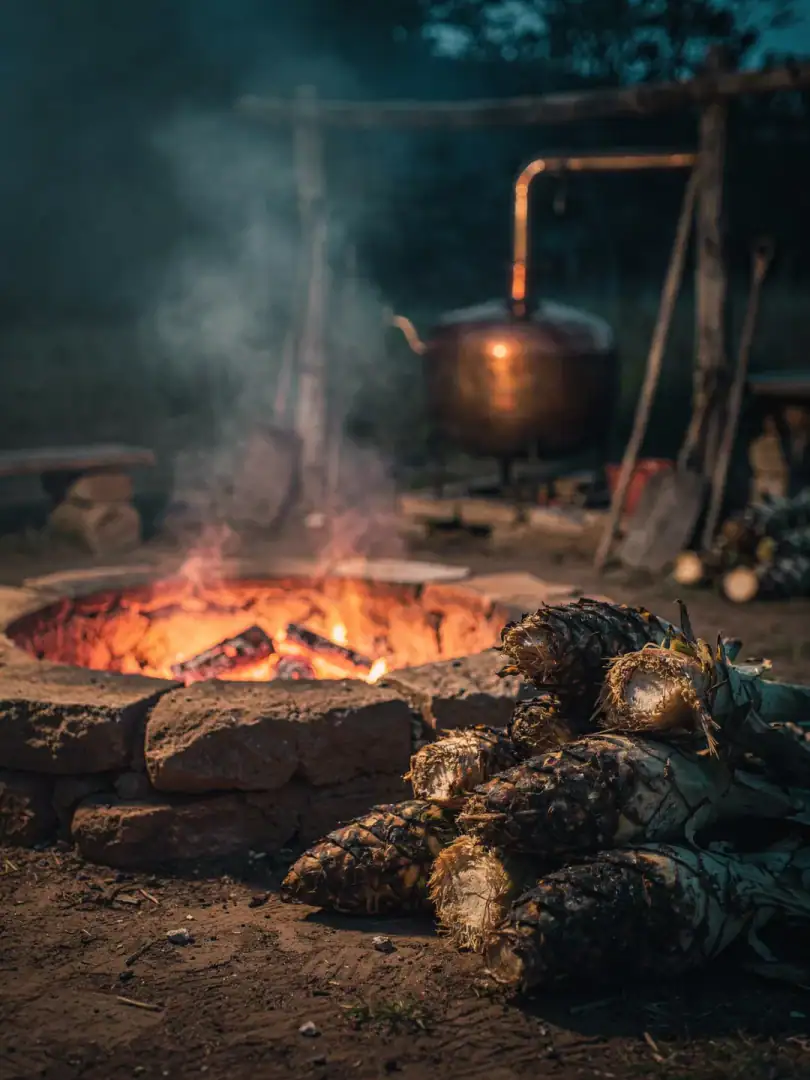
The smoky flavour many people associate with mezcal doesn't come from an added ingredient but from the cooking method. With traditional mezcal, especially in the Artesanal and Ancestral categories, the piña, the agave heart, is cooked in an earthen pit over hot stones, often using firewood, which imparts smoke and roasted aromas directly to the plant. Tequila, by contrast, is nowadays mostly cooked in brick steam ovens or in autoclaves, sealed pressure vessels that keep smoke away from the agave entirely. The difference lies in the process, not in mezcal fundamentally being a smoked version of tequila.
Within the world of mezcal itself there are therefore huge flavour differences: a mezcal cooked industrially in autoclaves often tastes noticeably milder and less smoky than a handcrafted Artesanal or Ancestral mezcal cooked in an earthen pit. Anyone claiming mezcal is inherently smoky overlooks just how wide the range already is within the category itself.
What else fundamentally separates the two?
Tequila is made from a single agave species, the Blue Weber agave, within a clearly defined region of 181 municipalities, and as a standard tequila may contain up to 49 percent non-agave sugar, known as Mixto. Mezcal, on the other hand, may come from many different agave species depending on the region, but must always consist of 100 percent agave sugar, there is no such thing as a Mixto mezcal. Both drinks are closely related, then, but today clearly separated by plant, region, process and standard.
Historically, today's separation dates back to 1974, when tequila became the first agave drink to receive its own designation of origin, two decades before mezcal followed in 1994. This chronology helps explain why tequila has been known internationally as a distinct product for far longer, while mezcal has only built its current reputation as its own category over the past few decades.