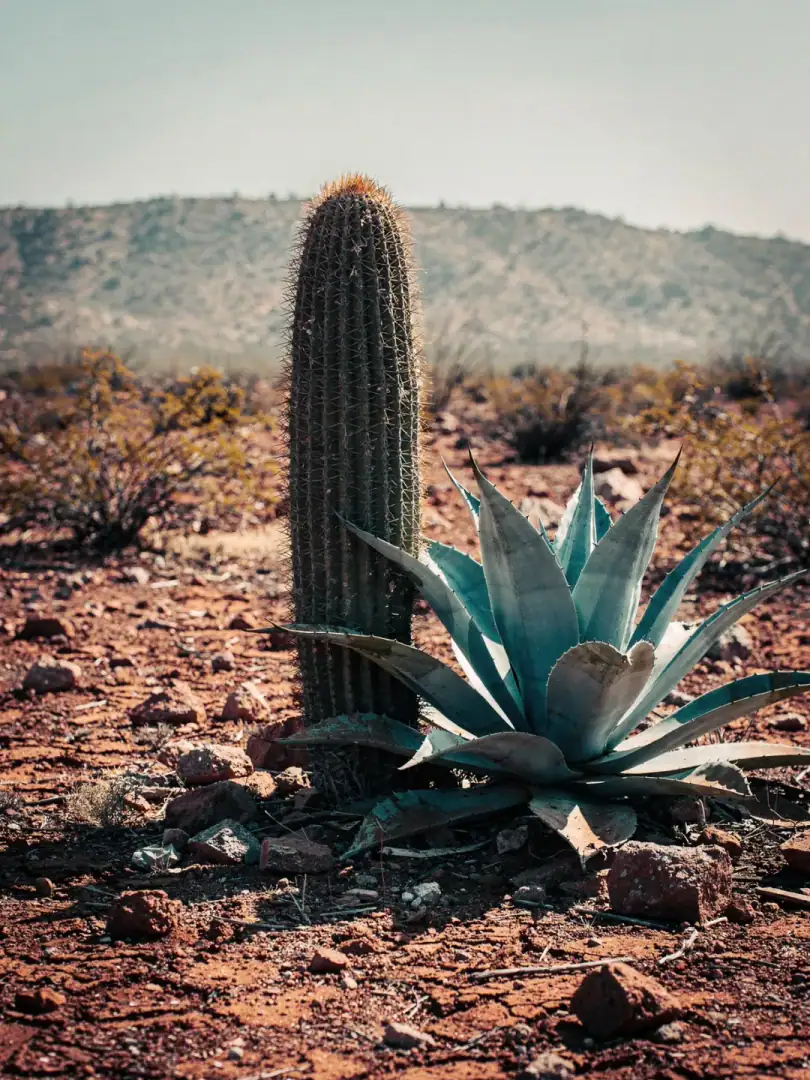
Agave, not cactus
"Tequila is made from cactus"
Sombrero, sun, spiky cactus: that's often what tequila advertising looks like, leading many to assume the drink comes from a cactus. Botanically, the agave is something entirely different, as this station shows.
Why does the agave look like a cactus to so many people?
The same image keeps appearing on tequila billboards: a desert landscape, a sombrero, a spiky cactus. No wonder many people believe tequila is distilled from cactus. Agaves do in fact grow in similarly dry, sun-baked landscapes as many cactus species, and in Jalisco they sometimes stand right next to prickly pears and columnar cacti in the very same fields. Both plant groups have thick, water-storing parts and sharp points that protect against grazing animals.
Even everyday language reinforces the mix-up: in English, many spiky desert plants are casually called 'cactus,' regardless of their actual botanical family. Anyone seeing an agave for the first time intuitively files its thick, pointed leaves into the same rough category as a real cactus, even though the two plants arrived at similar shapes through completely separate evolutionary paths.
What botanically separates an agave from a cactus?
Botanically, an entire lineage separates the two plants. Cacti belong to the family Cactaceae and store water in thick, often leafless stems with characteristic spine cushions called areoles. The agave, by contrast, is a member of the asparagus family, botanically Asparagaceae, making it more closely related to asparagus, yucca and lilies than to any cactus. It forms a rosette of thick, fleshy leaves ending in a hard point, stores water differently, and produces a completely different flower.
Reproduction also differs fundamentally. Many agave species flower only once in their lifetime, often after many years, and then die, a strategy botanists call semelparity. Cacti, on the other hand, typically flower repeatedly over many decades. This difference in life cycle further shows just how far apart the two plant groups really are botanically, even though their outer form looks similar.
What is tequila actually distilled from instead?
Tequila comes exclusively from a single agave species, Agave tequilana Weber, variety Azul, also known as the Blue Weber agave. After six to eight years of growth, jimadores, the harvest workers, cut out the heart of the plant, the piña, named for its shape, which resembles a large pineapple. This piña is cooked to convert its starch into fermentable sugar, then milled, fermented and distilled at least twice. A cactus never enters this process at any point.
The same principle applies to mezcal made from other species: Espadín, Tobalá and Karwinskii are all agaves, not cacti, even though their leaves can vary in width, breadth and colour depending on the species. The sheer diversity of shapes within the agave family itself makes it easy for non-experts to confuse them with other spiky desert plants.
Is there any connection at all between agave and cactus?
No, not a botanical one. The only plant genuinely close to the agave, without being one itself, is sotol, botanically Dasylirion. Both belong to the large asparagus family, but to different subfamilies, agaves to Agavoideae, sotol to Nolinoideae. That's why sotol is traditionally processed in a way similar to mezcal, cooked in an earthen pit, even though strictly speaking it comes from a different plant group. A cactus still plays no part in any of this.
Real cacti do occasionally turn up in the world of agave spirits, but only as decoration or as a cocktail ingredient, never as the raw material for distillation itself. So anyone who finds a piece of cactus fruit in a tequila cocktail is still drinking a pure agave spirit that has simply had another flavour added to it. That changes nothing about the raw material itself; the plant behind it remains an agave, never a cactus.