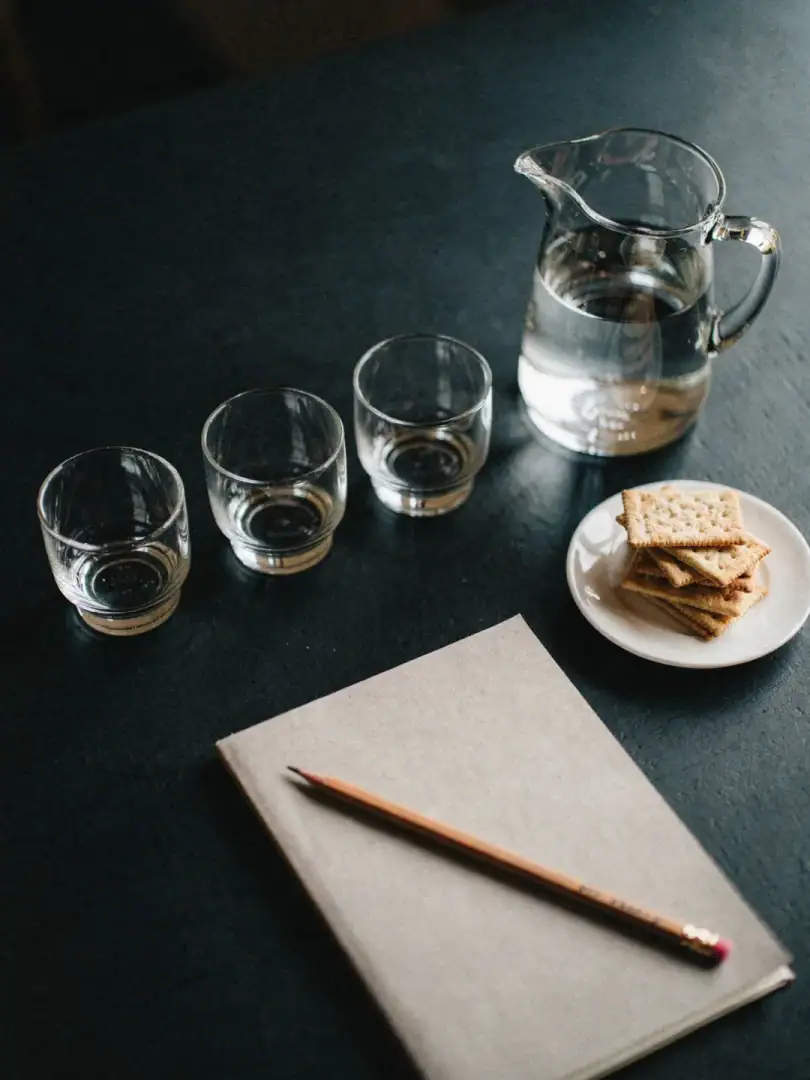
Comparing Four Glasses
Blind Tasting at Home
All the knowledge from this journey shows itself most clearly when several glasses stand side by side. A small blind tasting with four or five agave spirits reveals differences that a single bottle could never show.
Choosing the Lineup for Comparison
For a first round, four to five Blanco expressions work well, since without barrel aging, only agave, origin, and process remain. A sensible selection might include a Tequila from Los Altos and one from the Valle de Tequila. Alongside these, an Espadín Mezcal and a Mezcal made from a rarer agave variety like Tobalá make a fitting pair.
Anyone wanting to go further can add a simple, diffuser-produced Tequila as a contrast. A direct comparison with a spirit traditionally roasted in an oven makes the difference described in the seventh stop clearest, and fastest, to grasp.
Setup and Order
Each glass gets a small, equal measure, ideally in identical, tapered glasses, so that shape itself makes no difference. Numbers instead of labels on the glasses ensure that expectations tied to a familiar brand don't influence the judgment beforehand.
It's best to start the sequence with the lightest, most delicate spirit and end with the most intense. That usually means: from mild Tequila through Espadín Mezcal to a bold, possibly smoky Tobalá Mezcal. Starting in reverse order overwhelms the nose with the strongest impression first, leaving little sensitivity left to catch finer nuances afterward.
How Many Glasses the Nose Can Really Handle
After about six to eight different high-proof samples, the nose's ability to distinguish noticeably declines, even for experienced tasters. The sense of smell tires much like a muscle and responds more weakly to new nuances after repeated stimulation. Anyone wanting to test a larger selection is better off splitting the round across two evenings, rather than working through ten or more glasses in a single sitting.
Breaks between individual glasses also help combat this fatigue, alongside water and neutral bread or crackers. A short walk outside for fresh air, or a few minutes without any glass in hand, gives the nose time to recover. For your own blind tasting at home, the rule is: better to compare a few glasses thoroughly than many only superficially.
What Helps Between Glasses
Between glasses, still water and a neutral piece of bread or an unseasoned cracker help reset the tongue and palate. Without this brief pause, impressions blend together, especially when a smoky Mezcal follows a delicate Blanco.
Brief notes on each glass are entirely sufficient: one word for sweetness, one for smoke or herbs, one for the length of the finish. More important than literary descriptions is using the same terms for every glass, so the notes can be compared at the end.
What the Nose Alone Can't Prove
As much as a blind tasting reveals about your own perception, it doesn't prove a legal category. Whether a bottle is truly registered as Mezcal Artesanal, or whether a Tequila really contains 100 percent agave, can't be reliably determined by taste alone. For that, the label with its designation of origin remains the only reliable source.
Your own nose and the label complement each other rather than replace one another. The nose shows what actually comes through in the glass, regardless of price or brand name. The label shows which rules a producer had to follow to be allowed to carry that exact name. Reading both together is ultimately the best way to understand a glass of agave spirit.
Revealing the Labels at the End
Only once every glass has been tasted and noted are the labels revealed. The result often surprises: a supposedly simple Tequila sometimes scores better in your own notes than expected. An expensive Mezcal, on the other hand, may go unnoticed under neutral numbering.
This is exactly the point of the exercise. It shows whether your own nose has come to recognize what this journey has described: soil, agave variety, process, and aging. And that holds true regardless of what ends up printed on an expensive bottle.