Where Wood Meets Agave
Aging in the Glass
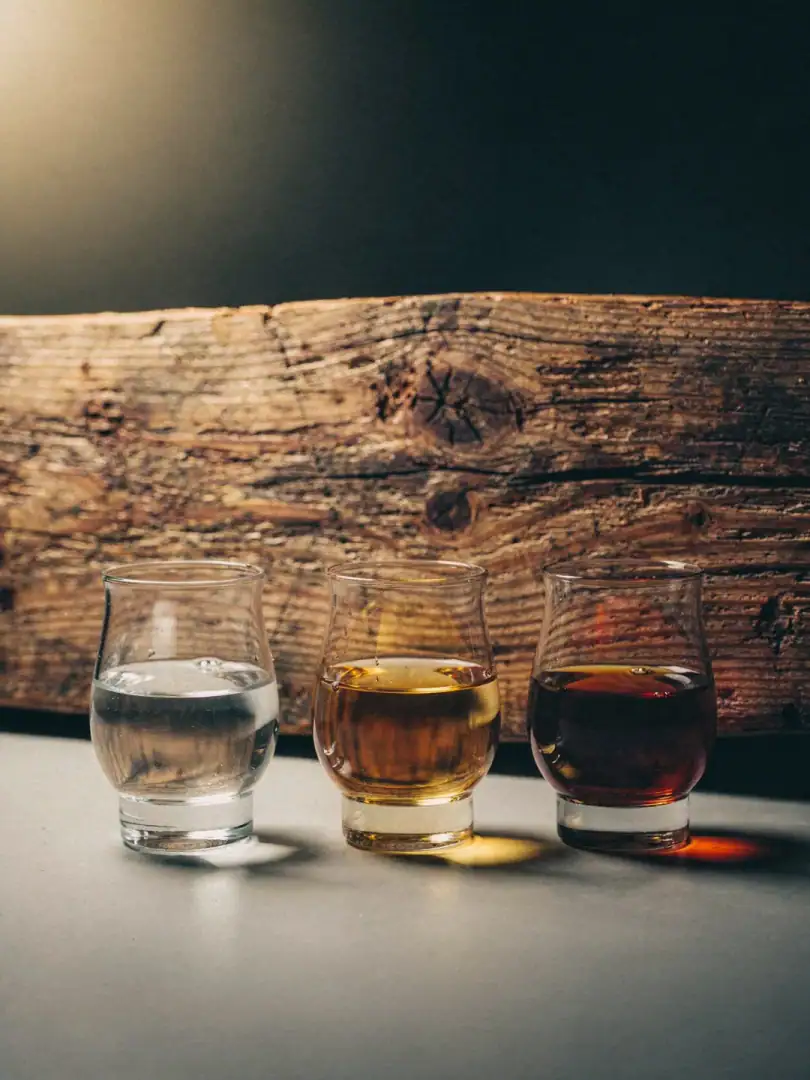
Blanco, Reposado, and Añejo don't differ in raw material, but solely in time spent in the barrel. The longer the wood works its magic, the more vanilla and caramel notes emerge, and the more easily the agave itself fades into the background.
Blanco: Agave Without Detour
Blanco, sometimes also called Plata, goes straight into the glass right after distillation. There's no meaningful wood contact involved: the standard allows a maximum of two months in barrel, though most stay in no barrel at all. What you taste here is practically pure agave, shaped only by soil and distillation method.
That's exactly why Blanco is best suited for identifying the base aromas from the third stop. The signature of a particular agave variety from the sixth stop also shows most clearly here. No barrel overlays anything that actually comes from the plant itself.
Reposado: First Contact with Wood
Reposado rests for at least two months in direct contact with oak, often in used whiskey or bourbon barrels. In this comparatively short time, the spirit takes on a light golden color. Delicate vanilla and caramel notes join in, without the agave disappearing behind them.
A well-made Reposado therefore shows both at once: the sweet, earthy base of the agave and a first, restrained hint of wood on top. This exact balance makes it a good middle ground. Here you can practice telling wood and agave apart within the same sip.
Añejo and Extra Añejo: The Barrel Takes Over
Añejo ages for at least one year, Extra Añejo for at least three years, each in barrels holding no more than six hundred liters. The longer this period lasts, the more tannins, vanilla, caramel, and sometimes spice notes migrate from the wood into the agave spirit.
With very long aging, the barrel can nearly obscure the original agave entirely. An Extra Añejo may then taste more like a mild brandy or whiskey than an agave spirit. Whether that counts as a mark of quality or a loss is an open matter of taste among connoisseurs, not a matter of regulation.
Cristalino: Filtered, Not Reclassified
Cristalino isn't its own aging category under the standard. It's a trade name for a filtered Añejo or Extra Añejo that has had its color stripped back out through activated charcoal. In the glass, it looks like a Blanco, but inside it carries the aged aromas of a matured Tequila.
This very contrast makes Cristalino a great test for your own nose. Anyone unfamiliar with the filtering expects pure agave on sight. Instead, they find vanilla and caramel. This proves that color alone never reveals how long an agave spirit has actually aged.
Madurado en Vidrio: Aging Without Any Wood
Beyond Joven, Reposado, and Añejo, Mezcal also has a fourth, very distinctive form of aging: Madurado en Vidrio. Here, the finished Mezcal matures not in a wooden barrel but in large glass demijohns, often left outdoors or buried in clay vessels, for at least one year. Without contact with wood, the Mezcal picks up neither color nor vanilla or caramel notes.
What changes instead is the texture and the interplay of the existing aromas, as temperature swings between day and night slowly transform the Mezcal over the months. This form of aging shows just how differently "aging" can be understood between Tequila and Mezcal. With Tequila, aging almost always means wood contact. With Mezcal, it can also mean that time alone does the work, with no barrel involved at all.
Does Tequila Keep Aging in a Sealed Bottle?
Unlike a good wine, Tequila or Mezcal essentially stops changing once the bottle is sealed. As soon as the agave spirit is bottled, all further aging ends, because no oxygen and no wood can act on the liquid anymore. A ten-year-old, unopened bottle should therefore taste, in principle, exactly the same as it did on the day it was filled.
What can still change over time is the storage itself. Direct sunlight and warmth slowly fade delicate aromas, especially in Blanco expressions. An already opened bottle also loses intensity over many months, since some of the volatile aroma compounds escape through contact with air in the neck of the bottle. Anyone wanting to keep a bottle for a long time should therefore store it upright, cool, and dark, with no expectation of further maturation.