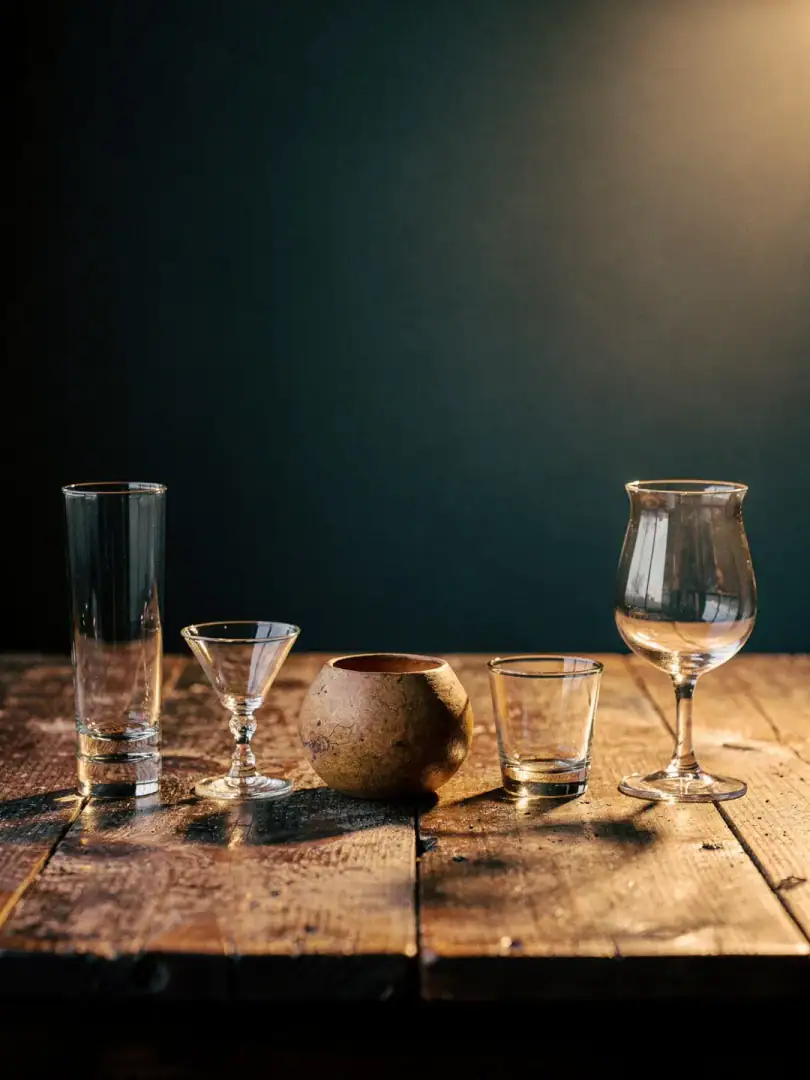
Shape shows aroma
The glasses
With agave spirits, the glass is no accident: the narrow caballito, the bulbous copita, the dried jícara from Oaxaca, or a modern Riedel tequila glass all guide nose and tongue toward quite different aromas of the same drink.
The caballito: fast, narrow, traditional
The caballito is a narrow, usually stemless little glass, barely bigger than a thimble. It's the traditional way tequila is served in Jalisco. Its narrow shape hardly concentrates aromas at all. But its tiny capacity fits perfectly with the idea that tequila should be drunk in small sips rather than large glasses.
Some caballitos are carved from horn or made of clay, others from plain glass. What matters less is the material than the tiny size. It's barely suited to a careful nosing. But with every sip it's a reminder that tequila isn't a drink for grand gestures.
Copita and Riedel glass: concentrating aroma
A copita is a small glass that tapers toward the top, similar to those used for sherry or wine tasting. The narrow opening gathers the aromatic compounds above the liquid before they reach the nose. Riedel adapted exactly this shape for its own bulbous, narrow-necked tequila glass. It was designed specifically for the nose, not for a quick shot.
Both glasses follow the same principle. A wider bowl at the bottom collects aromas, a narrow opening channels them together toward the nose. Anyone wanting to slowly taste a high-quality 100% agave expression will find far more nuance in a copita or Riedel glass than in a narrow caballito.
Jícara and veladora: the mezcal tradition
In Oaxaca's mezcal villages, people often drink from a jícara, a bowl made from a dried, hollowed-out gourd. It has neither a stem nor a narrow opening and hardly concentrates aromas at all. Its value lies in tradition. The jícara has accompanied mezcal at festivals and gatherings for generations.
In many urban mezcalerías, the veladora has become common instead, originally a small glass meant for votive candles. Its wide opening lets alcohol vapors escape quickly, which softens the initial ethanol punch. At the same time, though, finer aromatic notes escape too, before the nose can catch them.
Which glass for what
Anyone asking which glass is the right one won't get a single answer. It depends on the goal. Caballito and jícara stand for speed and tradition. Copita and Riedel glass serve precise aroma analysis. The veladora represents everyday life in the mezcalería.
For a first comparison at home, a simple, tapering glass like a small wine-tasting copita works perfectly well. Shape matters more than origin. The opening should be narrower than the base. Only that turns a drinking vessel into a tool for smelling.
Improvising at home: the wine glass as a substitute
Not everyone owns a caballito or a Riedel tequila glass at home. A regular small red wine glass with a slightly tapered opening does almost the same job. What matters is the shape, not the name on the packaging. A water glass with a straight rim, on the other hand, simply lets most aromas escape upward without concentrating them.
Anyone with two or three different glasses at home can simply test them side by side. The same tequila smells different out of a wide water glass than out of a narrow wine glass. This small experiment shows, faster than any explanation, just how much shape alone can change the result. An expensive glass isn't necessary for this, just the right taper toward the top.
Why a clean glass makes all the difference
Even the best glass is of little use if it smells of dish soap. Many dishwashing detergents, and especially rinse aids, leave a paper-thin, scented film on the glass surface. With a high-proof agave spirit, this film stands out immediately, even if it barely bothers a water glass. Anyone serious about tasting is best off washing glasses by hand, using only hot water, without dish soap or with a fragrance-neutral agent in the smallest possible amount.
Storage plays a role too. A glass that sits for a long time in a kitchen cupboard made of fresh wood or next to spices picks up foreign odors and releases them again the next time it's used. That's why a quick test before any tasting is worthwhile: breathe lightly into the empty glass and smell it. If it smells of nothing, it's ready. If it smells of dish soap, cardboard, or old wood, it will alter every nosing before the agave spirit has even been poured.