Sandstone & Gorge
Soils
West of Cafayate, the Río de las Conchas cuts seventy kilometers through red rock — the Quebrada de las Conchas, also known as the Quebrada de Cafayate. Wind and water have carved bizarre shapes out of the soft sandstone. They bear names like Garganta del Diablo, El Anfiteatro, or La Yesera — the latter named after the gypsum once mined there. This stone formed under the sea sixty to ninety million years ago. The gorge itself is geologically young: only in the last two million years have tectonic movement and erosion shaped it into its current form.
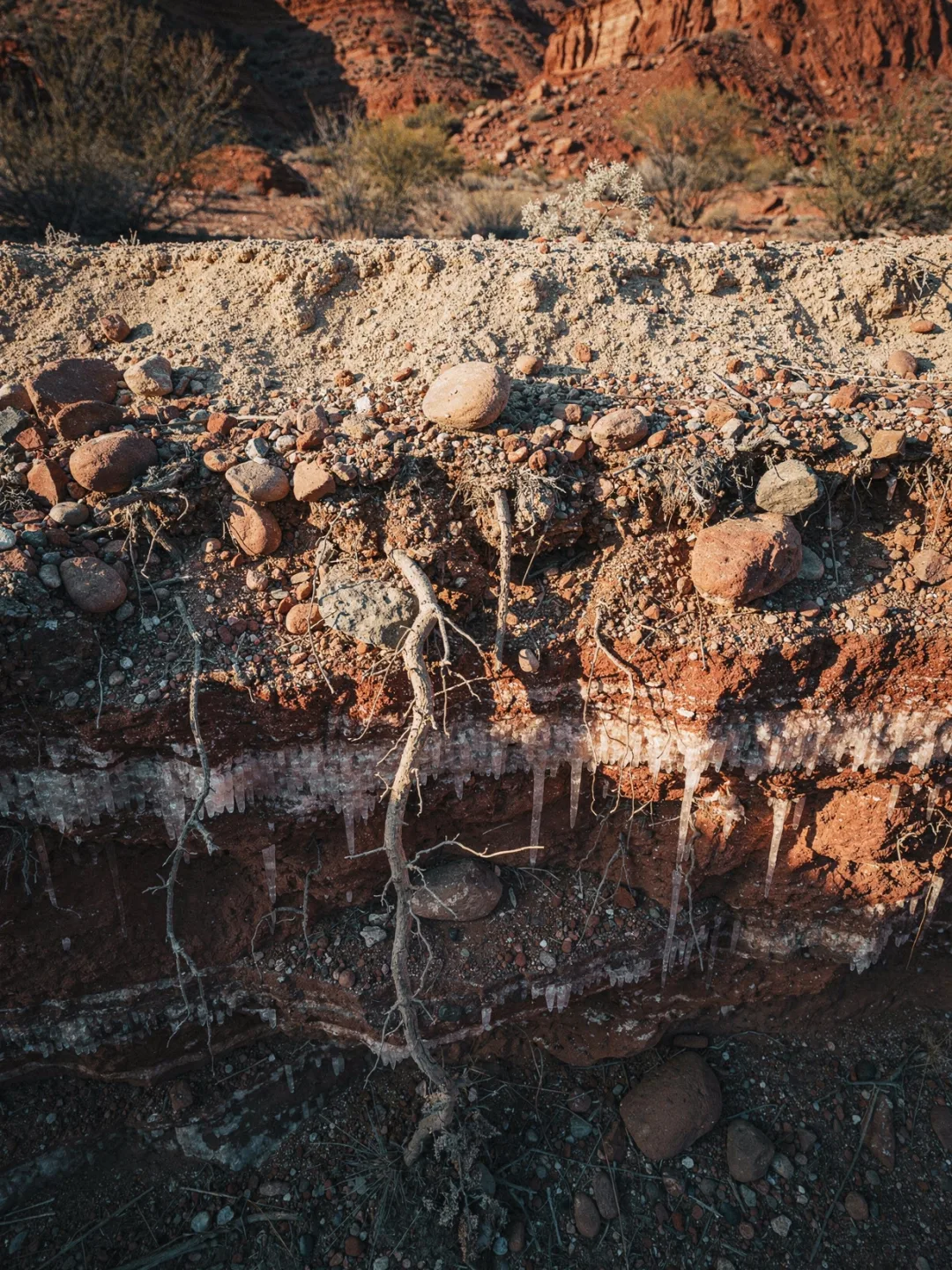
This exact rock also lies beneath the vineyards. Right at the surface is sandy loam, pale and low in humus. Beneath it follows a layer of sand and gravel, washed down by streams from the Andes. Only further down lies the solid red sandstone that also makes up the cliffs of the gorge, in places threaded with white veins of gypsum.
For the vine, this means one thing above all. Water drains away quickly, and nutrients are scarce. The roots have to go deep just to find anything at all. Small, thick-skinned berries are the result — and it's precisely these berries that give Malbec from Cafayate its deep color.
Not every vineyard in the valley resembles the next. At Finca Alto Los Cuises, for instance, fifty centimeters of sandy loam gives way suddenly to shale rich in limestone, while just a few kilometers away, on an old alluvial fan, granite and gravel instead lie stacked in several distinct bands. So anyone speaking of "the soil" in Cafayate is oversimplifying considerably. One word rarely fits here: uniform.
What the soil cannot do is send minerals into the wine, no matter how often you hear that claim about the red sandstone. What it really does is hold water or let it drain, store heat or release it, and force the roots down to certain depths. The red color of the Quebrada ends up in tourists' photos, not in the glass.
A pale, sandy topsoil low in humus — in the dryness of Cafayate, hardly any organic matter decomposes.
The root: This is where the fine roots sit, yet after just a few rainless weeks, this layer is already bone dry.