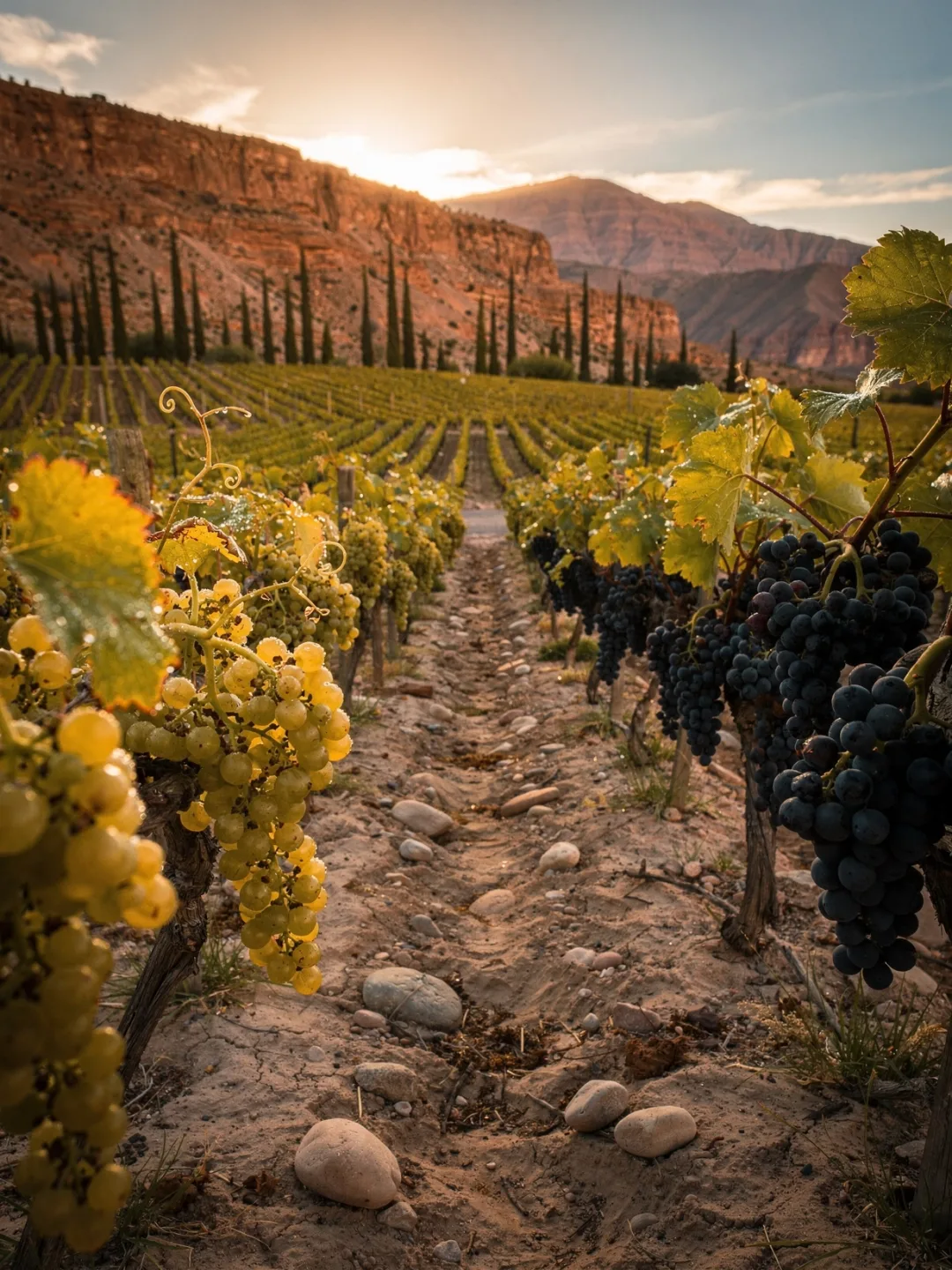
Torrontés & Malbec
Grape Varieties
A single white grape defines Cafayate more than any other: Torrontés Riojano. It grows almost everywhere in the valley alongside rows of red Malbec, sometimes on sandy flatland, sometimes on steep terraces. Its aroma of rose blossom and jasmine makes it seem like a sweet grape, even though it almost always yields dry wine.
Genetically, the story is complicated. A 2003 DNA study published in the American Journal of Enology and Viticulture clarified its origins. Torrontés Riojano is a natural cross between Moscatel de Alejandría and Criolla Chica, the grape Spanish settlers had already brought over in the sixteenth century. This likely happened by chance, somewhere in one of the early vineyards where both varieties grew side by side. Two sibling varieties carry almost the same name: Torrontés Sanjuanino and Torrontés Mendocino. Both are considered less refined and are rarely grown in Salta.
The name itself is a source of confusion. It comes from Galicia and derives from the Galician-Portuguese word terrantés, roughly meaning "vine of one's own soil." A variety called Torrontés does in fact grow there too. But it has nothing to do with the Argentine grape — a pure coincidence in naming by Spanish settlers.
Alongside the white star grows its red counterpart. Malbec, in its most extreme form, arrived at Colomé as early as 1854, brought from France by Isasmendi's daughter — before phylloxera wiped out the European mother vines. This means the vines in Salta descend from pre-phylloxera planting material. Today, Malbec climbs as high as 3,111 meters, at Colomé's Altura Máxima plot, one of the highest vineyards in the world.
Such extreme altitude transforms the berry itself. Thinner air lets more ultraviolet light through, and the vine protects itself with thicker, darker skin and more pigment. Malbec from Salta therefore shows deeper violet color and more tannin than its relative from the much lower-lying Mendoza. It also carries a note of violets, one that often fades in warmer sites.