Clay & Ironstone
Soils
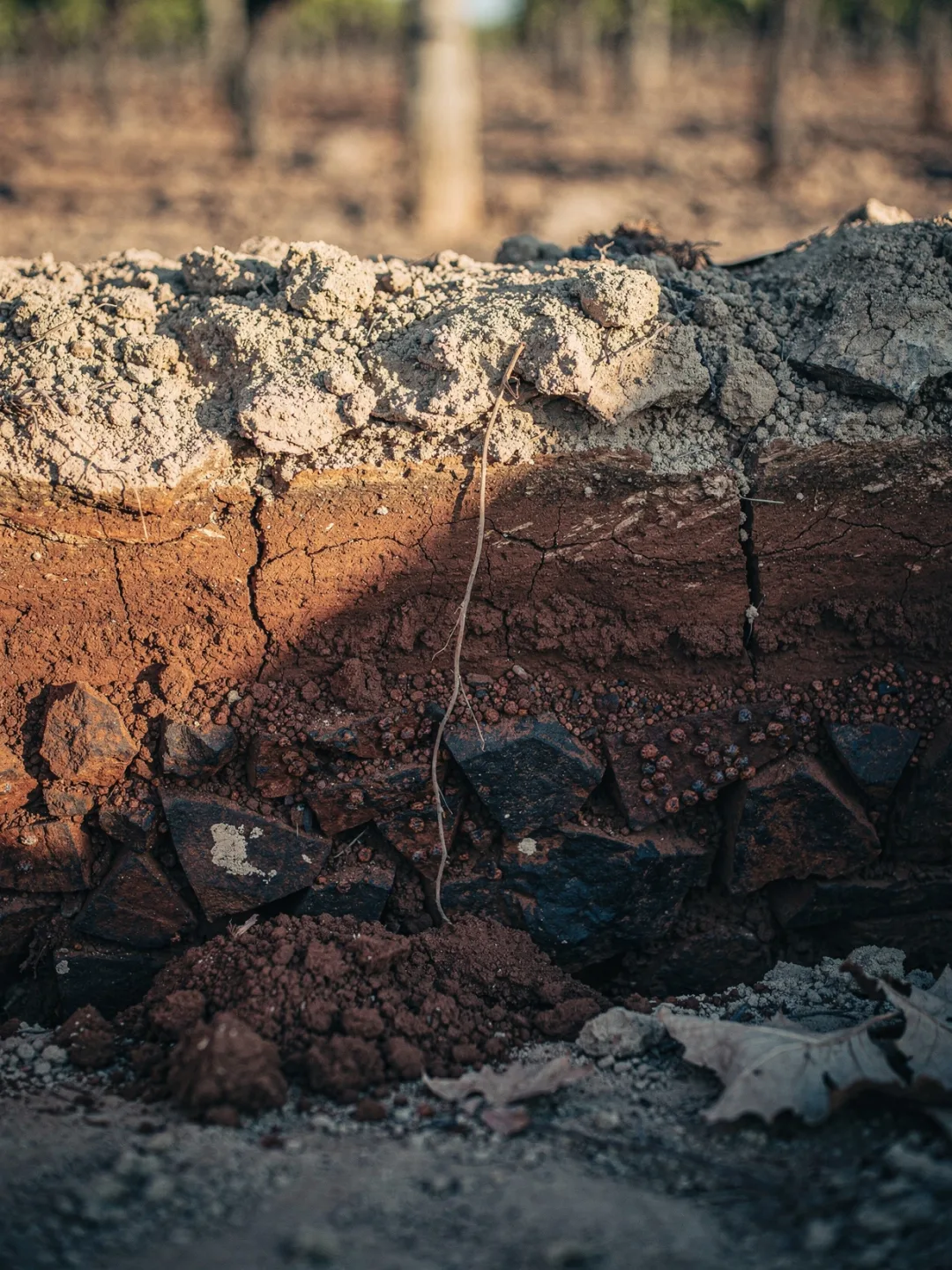
Dig a hole in the Barossa Valley and you'll first hit pale sand that crumbles between your fingers. Only after thirty or forty centimeters does it turn dense: reddish-brown clay, colored by the iron in the rock beneath. It's precisely this shift from loose to firm that gives the valley its character.
The valley's winegrowers' association has systematically mapped this shift. In the Barossa Grounds project, soil scientists dug test pits across the valley over several years. They divided it into zones with distinct soil profiles: the Northern Grounds with red-yellow clay over dense clay, the Central Grounds with sandy soils over black, cracking clay, and the Southern Grounds, where sand and clay soils alternate. Anyone buying a bottle with such an origin label today already knows roughly what type of soil produced the wine in their glass.
One of the oldest and most thoroughly documented plots lies in the Moppa district, on the edge of Penfolds' Kalimna vineyard. It's called Block 42: just under four hectares of Cabernet Sauvignon, planted around 1888, still ungrafted on its own roots today. This single vineyard has already produced more than 130 vintages. Its soil hasn't been turned over in nearly a century and a half.
Roots that have to force their way through red clay and ironstone develop differently than those in the loose sand next door. They grow slower and deeper. The vine channels part of its energy into this root system instead of into leaves and berry mass. The result is smaller berries with a higher skin-to-juice ratio. Color, tannin, and most of the aromas live in the skin. That's why a wine from this soil tastes denser than one from the loose sand nearby.
Such vineyards are rarely irrigated. Where clay deep in the soil holds moisture, the vine gets through dry summers without additional water. This scarcity is considered a hallmark of quality in the Barossa Valley. A wine from an irrigated plot on the valley floor rarely tastes as concentrated as one from an old, unirrigated vineyard on heavy clay.
Loose, pale sandy loam, found across much of the Central Grounds around Tanunda. Rainwater drains through quickly, and in high summer the layer turns dust-dry within days.
The root: Only the fine roots of the first few years sit here. An old vine has long since grown through this layer and searches for water further below.