Riesling & Shiraz
Grape Varieties
A single white grape variety shapes this valley's reputation more than all others combined. Riesling here is vinified dry, with cutting acidity and aromas of lime, sometimes green apple, and unlike in the Rheingau, almost no residual sugar remains. That wasn't always the consensus. As late as the seventies, sweetish blends were sold under the same name, until a handful of winemakers established the dry style.
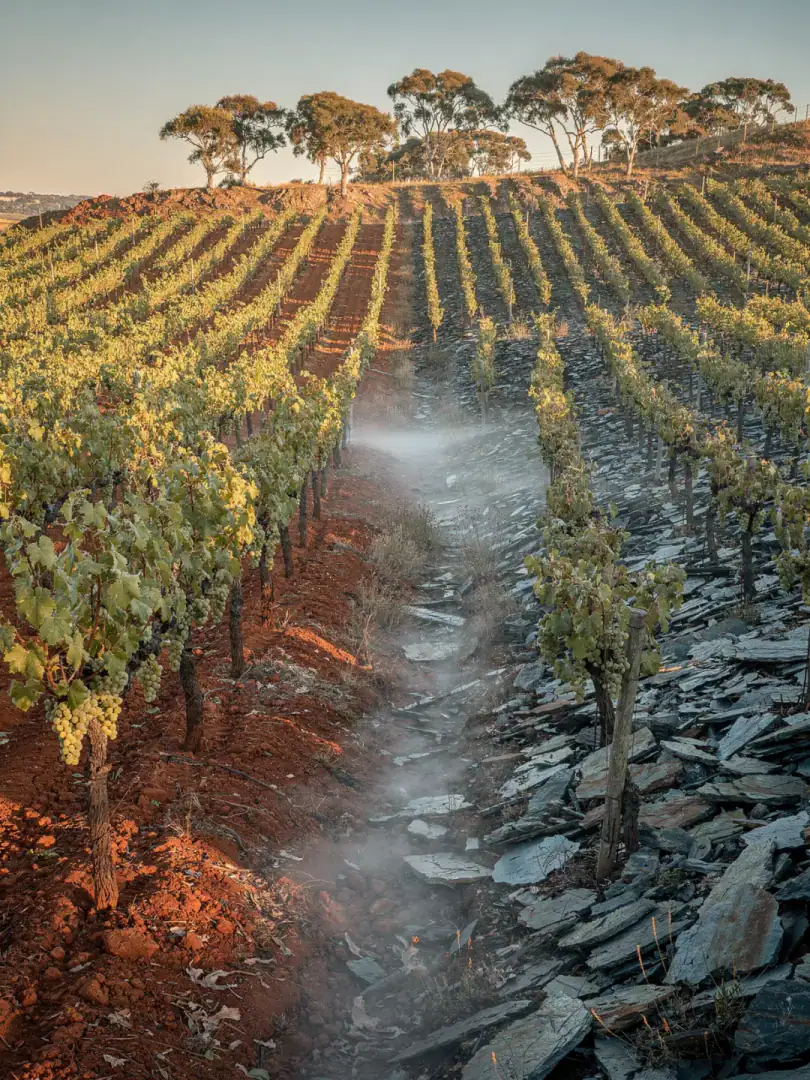
Two sub-regions shape completely different styles here. Watervale lies lower and warmer. Its wines taste of ripe lime and sometimes honey, often approachable even in their youth. Polish Hill, by contrast, sits higher, on thin slate soil, and yields tighter, more taut, almost saline-tasting Rieslings — and it's exactly this contrast that Jeffrey Grosset built his winery in Auburn around. One bottle has come from Watervale every year since 1981, another from Polish Hill.
Red wine is dominated by Shiraz, followed by Cabernet Sauvignon. Both ripen fully in the heat of the valley floor and produce dark, powerful wines with ripe fruit and firm tannin. That's the furry feeling in the mouth a young red wine often brings. Jim Barry planted a single vineyard called Armagh in 1968, Shiraz only, and waited seventeen years before releasing the first bottle in 1985. Today it ranks among the country's most expensive red wines.
One combination is considered typical of the old estates. Cabernet Sauvignon is planted alongside Malbec, a variety that has nearly disappeared elsewhere in Australia. At Wendouree, both grow next to Shiraz and Mataro in the same unirrigated rows, some over a hundred years old — and Mataro, incidentally, is the very same grape known in France as Mourvèdre — only the name changes, not the grape.
White wine still dominates, though. Across roughly five thousand hectares of vineyard in the whole valley, Riesling accounts for a large share of the white harvest, far ahead of Chardonnay and Sauvignon Blanc. Anyone tasting a bottle here blind rarely guesses Australia. The acidity is too high for that cliché, the climate seemingly too warm.