Grey & Red
Soils
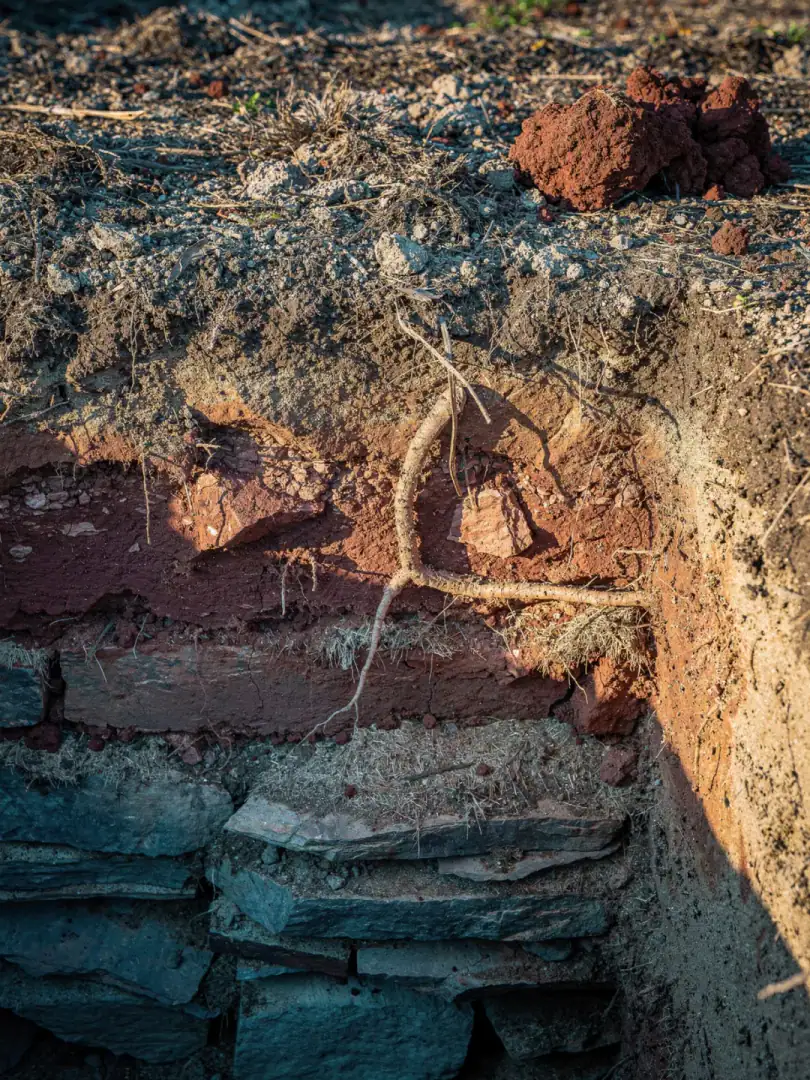
Dig a hole on the valley floor near Yering, and you'll first hit grey, sandy loam, barely a hand's width deep. Beneath it comes an abrupt layer of heavy red clay — a hard transition that soil scientists call a duplex soil, because two completely different layers sit directly on top of one another.
The grey comes from decomposed sandstone and shale. Both settled as marine mud on the floor of an ancient ocean more than 400 million years ago. A mountain-building event called the Tabberabberan Orogeny folded the rock roughly 380 million years ago. Since then, it has slowly weathered into the grey earth on which the Yarra Valley's oldest vineyards now stand, around Lilydale, Yarra Glen, and Healesville.
The red clay beneath holds water well, but roots can barely push through it. They pool at the boundary and spread sideways instead of downward, and that alone naturally limits yield. Some vineyards sit right on the boundary between the two. Further into the valley, toward Seville and Warburton, the picture changes completely: there, younger volcanic rock has weathered into a deep red, highly fertile soil.
Volcanic soils lack this natural yield cap. Winegrowers there need more discipline in the vineyard to keep the vines from growing too vigorously. Two soils, one valley, two entirely different wine styles: lean, low-yielding Pinot Noir and Chardonnay from the grey valley floor, and richer, more fruit-driven wines from the red soils higher up. Winegrowers in the Yarra Valley rarely speak of the valley as a whole. They speak of their slope.
A sandy to loamy topsoil of weathered sandstone and shale, barely a hand's width deep, grey and loose.
The root: This is where the fine roots sit. After every rain, they're the first to be nourished — and the first to dry out again.