Gravel and Granite
Soils
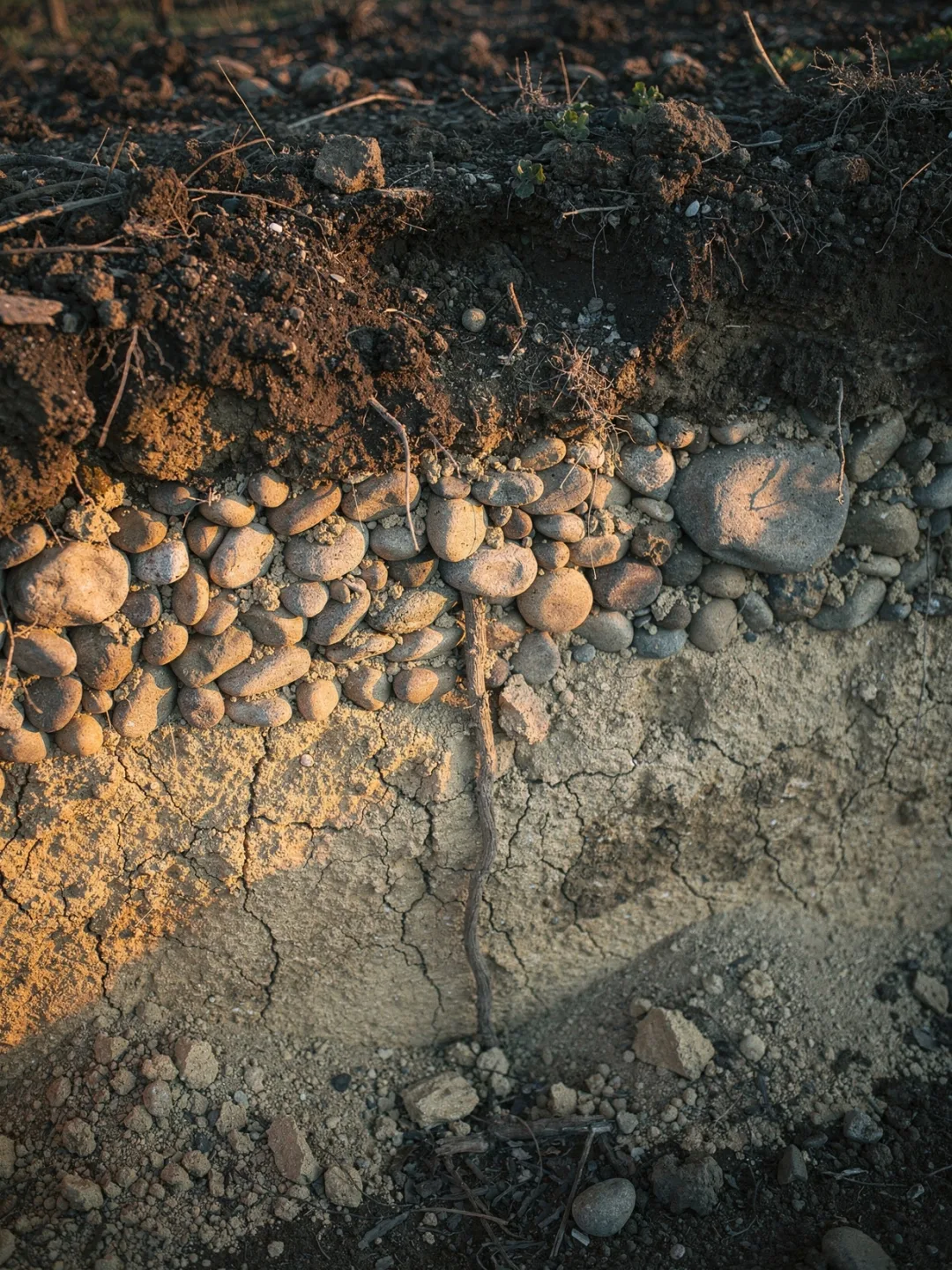
Dig a hole at the edge of a vineyard near Panquehue. The top thirty centimeters are loamy and dark, laced with fine clay. The Río Aconcagua has carried it down from the Andes over thousands of years. Below that, the picture changes almost instantly.
A thick layer of rounded river gravel follows, worn smooth by water that stopped flowing long ago. These stones store heat during the day and release it at night, which helps the vines the moment cold air begins rolling down from the Andes. Waterlogging is unknown here. Water drains through this gravel almost unimpeded, so roots never sit in standing moisture, even when drip irrigation runs generously.
Dig instead farther up the slope, closer to the Andes, and eventually you'll hit weathered granite instead of gravel. This rock breaks down into coarse, sandy crumbs that hold almost no nutrients or water. That scarcity forces the vines to root several meters deep. On these barren slopes grow the valley's most concentrated Cabernet Sauvignon grapes—small and thick-skinned, because the plant pours all its energy into fewer berries rather than many.
Farther west, in Aconcagua Costa, the rock changes again. There, beneath a thin layer of soil lies schist, a metamorphic rock that breaks into thin, brittle plates and holds on to almost nothing. White wine grapes actually favor this soil precisely because it forces the fruit to make do with little. So one single valley carries three completely different soils, and each one explains why a wine from here tastes different from one grown on the neighboring slope in Panquehue. The soil has its say too.
Fine-grained alluvial loam carried down from the Andes by the Río Aconcagua. Dark, nutrient-rich, holding moisture for a long time after rain.
The root: This is where the fine roots sit, drawing on whatever the drip irrigation delivers.