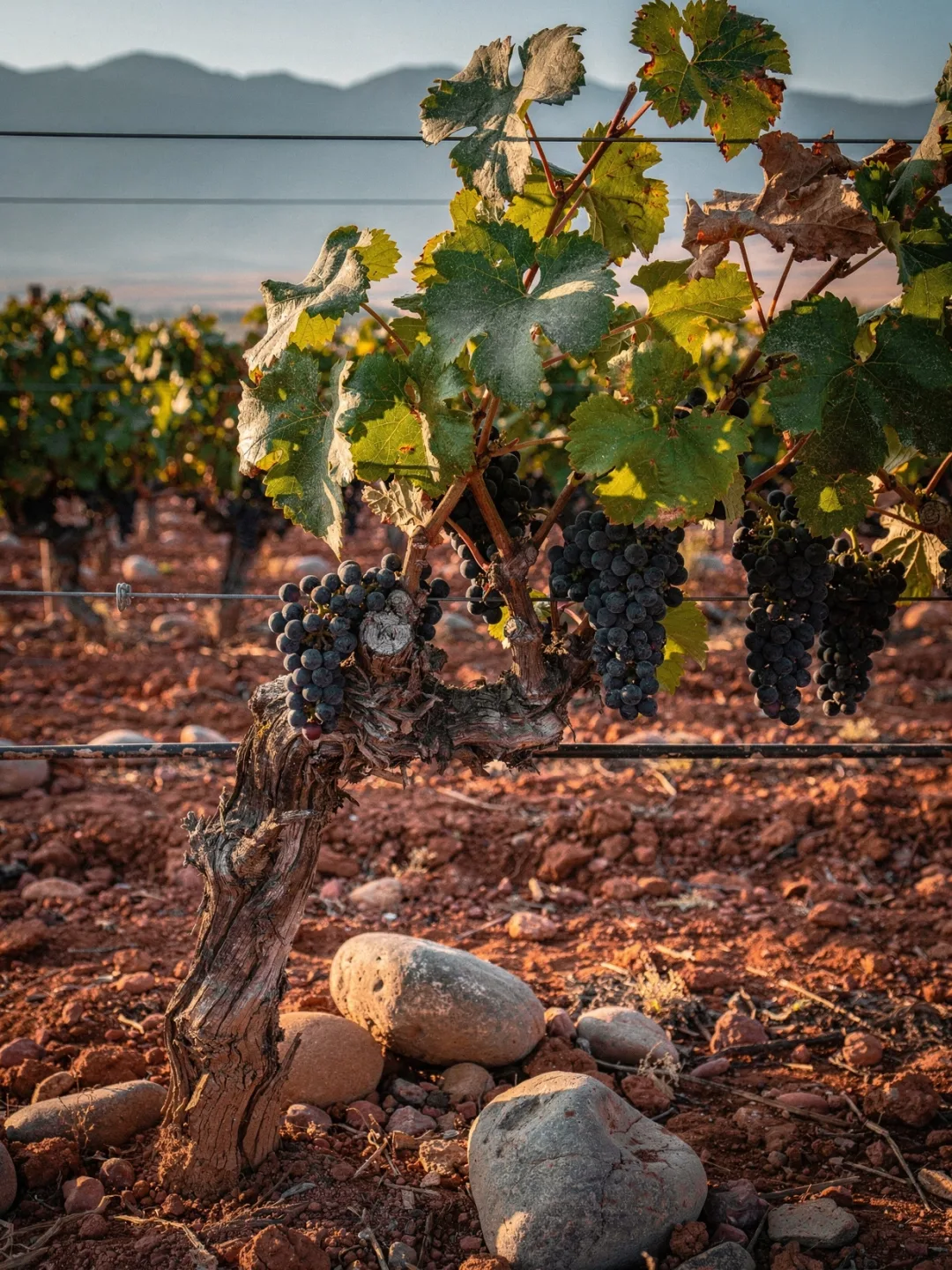
Cabernet and Carmenère
Grape Varieties
One variety carries the flag here, and its name sounds the same in every language: Cabernet Sauvignon. Nearly a third of the roughly one thousand hectares of vines in the Valle de Aconcagua are planted with this grape, more than any other. It loves the daytime heat and the cool nights that roll down from the Andes. That exact climate gives it what it needs: thick skins, firm tannins, and fruit that tastes of blackcurrant and cedar.
Almost as important is a grape that's nearly extinct in Europe. Carmenère arrived in Chile in the 19th century alongside the same Bordeaux cuttings as Cabernet, and for decades it was mistaken for Merlot because the two leaves look almost identical. Only in 1994 did research reveal that many supposed Chilean Merlot parcels were actually planted with the long-lost Bordeaux variety. It ripens late and needs warmth well into autumn. In the valley around Panquehue, it gets exactly that. In the glass, it smells of red bell pepper and dark chocolate.
A little closer to the Pacific, a very different picture emerges. In the late 1990s, Errázuriz began planting vineyards in Aconcagua Costa, near the coast and notably cooler than the core zone around Panquehue. There, Syrah ripens more slowly and retains more pepper and black olive on the nose, while in the warm interior it tends toward plum and licorice. On these same cool sites grow Sauvignon Blanc and Chardonnay, grapes that would stand little chance on the hot valley floor.
How seriously the Bordeaux heritage is taken here is shown by Seña, the joint venture between Errázuriz and Robert Mondavi launched in 1995. Its forty-two hectares of vines lie forty kilometers from the Pacific, in the hills above Ocoa. Its blend draws on six grape varieties, all originally from Bordeaux: Cabernet Sauvignon, Carmenère, Merlot, Cabernet Franc, Petit Verdot, and Malbec, each responsible for a different facet of flavor. No single variety dominates. Together they create a wine that can do more than any one grape alone.