Clay Over Granite
Soils
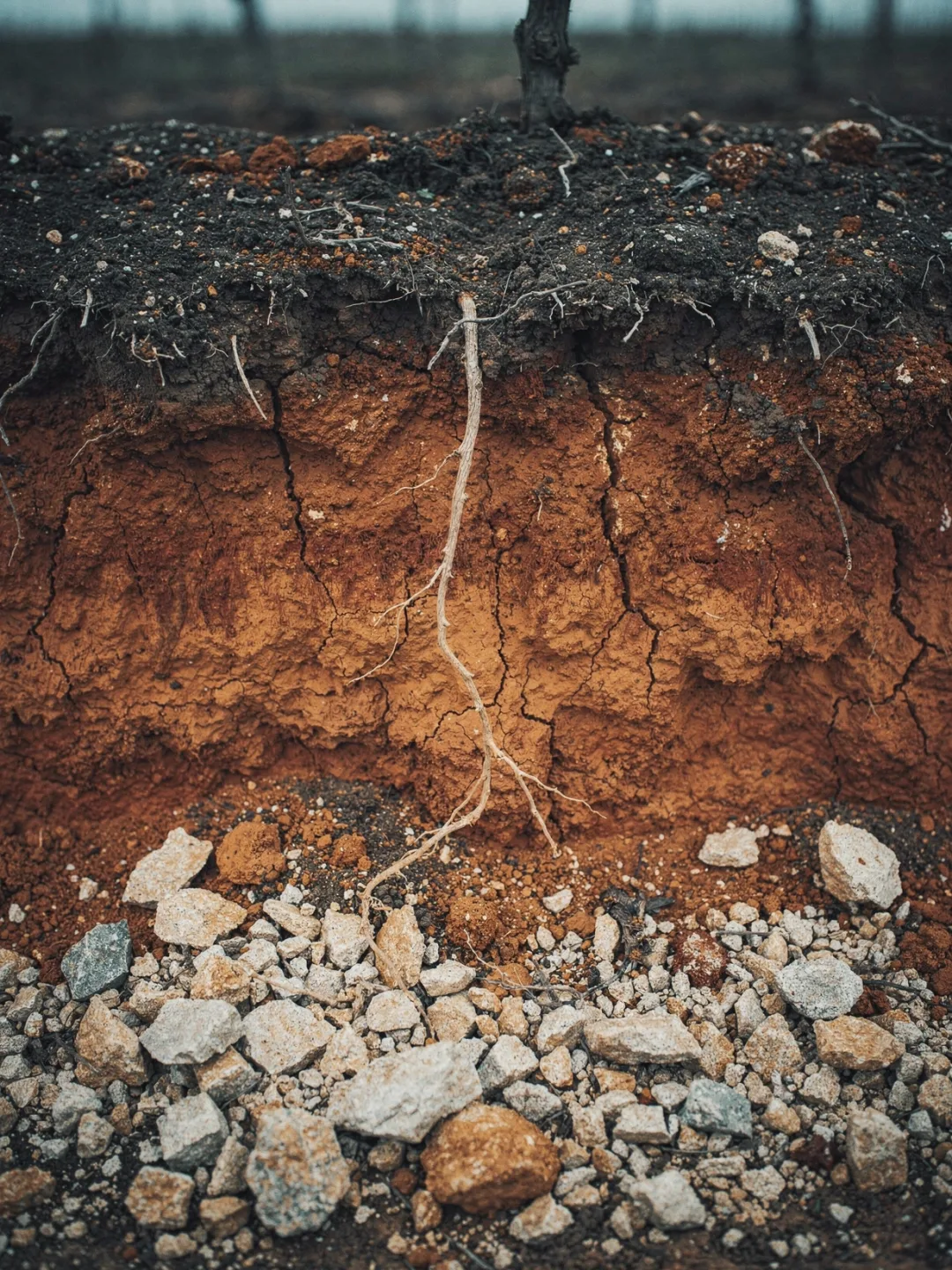
Dig a hole in a vineyard near Tapihue. The color changes twice before you're done. On top lies a thin, sandy layer, lean and almost devoid of humus, typical of the dry shrub vegetation that grew here before the vines. Just below comes red clay. Arcilla roja, as winemakers here call it, is heavy, water-retentive, and glowing rust-brown, because the iron in the weathered rock has oxidized.
This clay originates from the same granite that forms all of Chile's Coastal Range. Millions of years ago, it solidified deep underground. Since then, weathering has broken it down piece by piece into finer and finer components—first coarse fragments, then sand, and finally clay. Where this transformation is already far advanced, the vine's roots find dense, red clay. Where it has only just begun, they instead encounter granito descompuesto, decomposed granite full of coarse grains, through which water drains away quickly.
Both soil types often lie just a few meters apart. Sometimes even within the same row of vines. Clay retains water throughout the whole dry Chilean summer, while granite lets it drain away instantly, and winemakers use this difference deliberately. Vines grown on clay therefore often need less artificial irrigation, since the soil supplies their roots from below.
Down on the flat valley floor, the soil looks quite different. Closer to the little town of Casablanca lies loose sand. It's easy to work but holds almost no water and is prone to nematodes, threadworms that damage young roots. Anyone planting here faces different challenges than those working the stony slopes.
One misconception persists here too: that a wine tastes "mineral" because the root sucks minerals from the granite and passes them straight into the glass. That's not quite right. What the soil actually delivers is water in the right amount at the right time, and that's exactly what determines how small and how concentrated the berry ultimately becomes.
A thin, humus-poor layer of sand, formed beneath the dry shrub vegetation that grew here before the vines.
The root: Only the fine roots reside here. After a few rain-free weeks, this layer is the first to dry out.