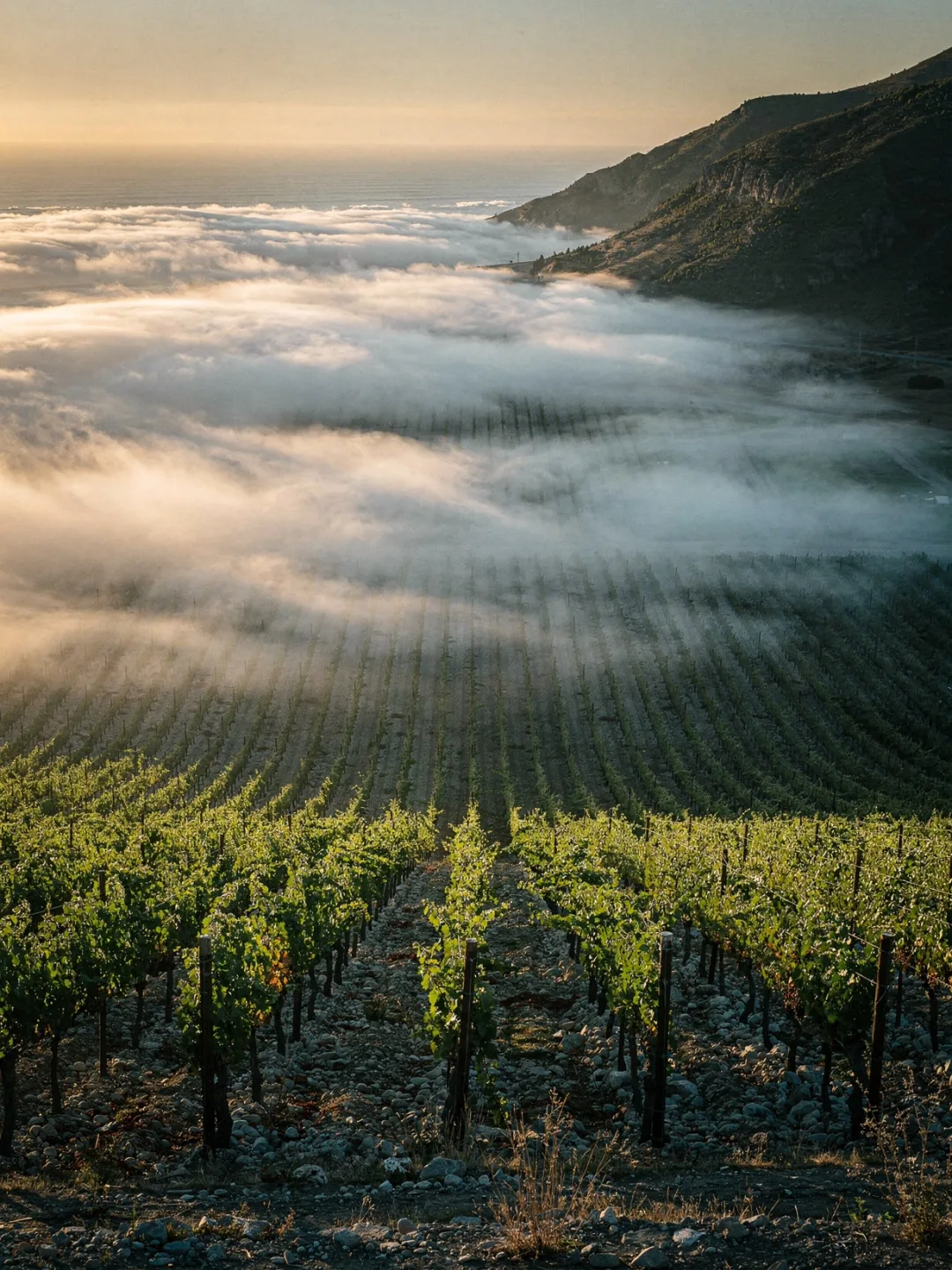
Fog Trumps Latitude
Climate
On the map, Casablanca sits at the same latitude as Sicily. By the logic that latitude equals climate, it should be hot and dry here like the Mediterranean—but it isn't, and the reason lies in the sea, not the sky. Despite its latitude, it stays cool here.
Off the coast, the Humboldt Current flows northward. This cold current from Antarctica keeps the water off Valparaíso at just twelve to fourteen degrees Celsius, and this cold evaporates at night into the dense fog known here as camanchaca. The fog needs a route inland. Casablanca provides exactly that route, because unlike most Chilean valleys, which run parallel to the coast and are shielded by the Coastal Range, this valley opens westward, straight toward the Pacific.
Every night, the camanchaca therefore rolls far inland. By morning it lies thick over the vines. Only around midday does the cloud cover break, the sun comes through, and on a summer day between January and April, the temperature can climb as high as twenty-seven degrees Celsius. At night it often drops back to fourteen degrees. This exact swing locks in the acidity in the berries, even as sugar levels continue to creep up during the day.
In spring, this very advantage becomes a danger. Historically, frosts as low as minus eight degrees Celsius have been recorded in Casablanca, and just such a frost nearly wiped out Pablo Morandé's very first planting in 1982. Harvest therefore begins late. Because of the slow, fog-shrouded ripening, picking often doesn't start until mid-April, long after the warmer inland valleys have finished their harvest.