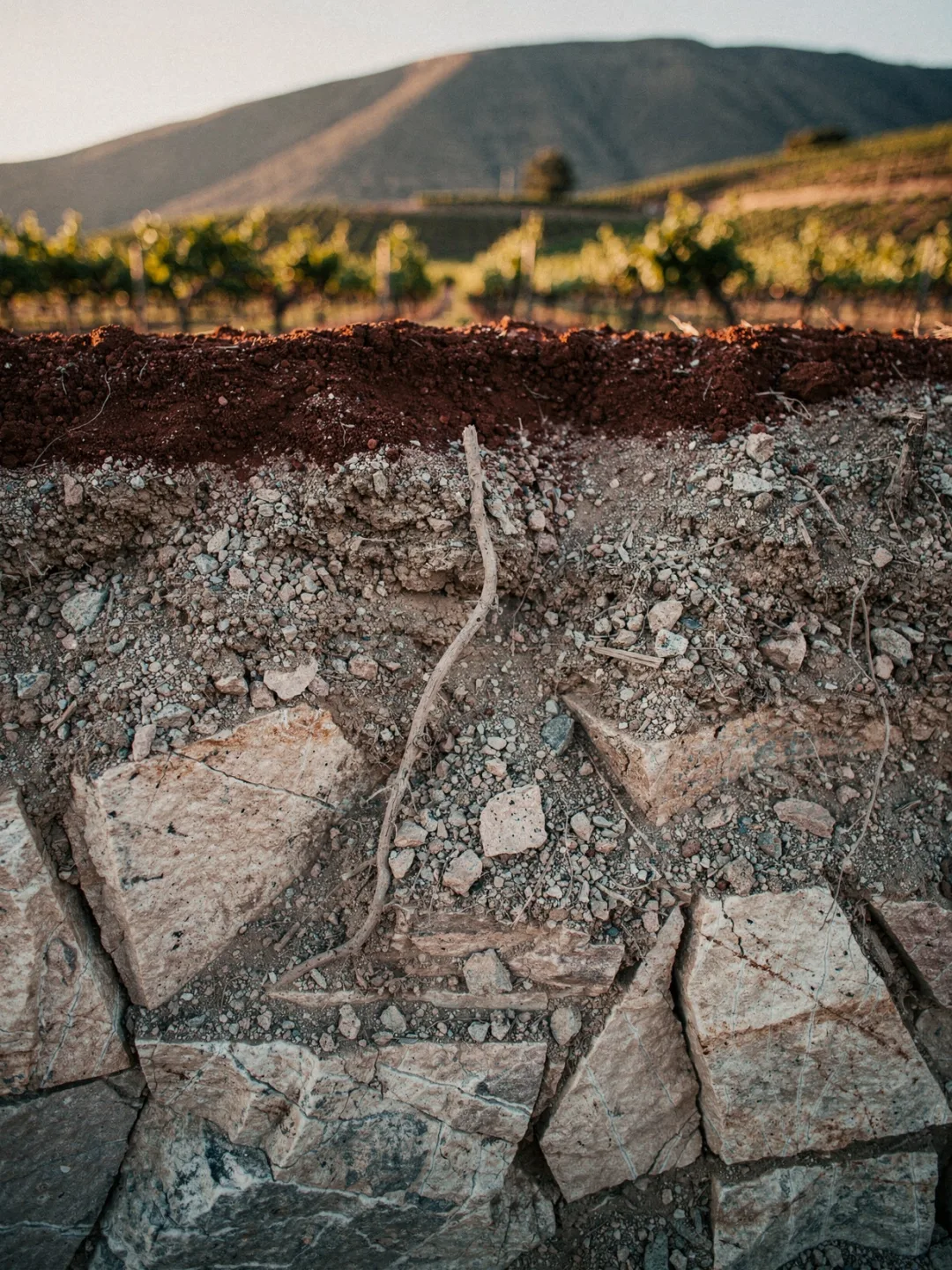
Apalta's Granite
Soils
Dig a hole in Apalta. Just a few shovelfuls down, you'll hit stone: weathered granite, gray to pink, in thick, fractured slabs, as old as the Cretaceous period.
This rock belongs to the Coastal Range, which juts partway into the valley here, forming a horseshoe-shaped amphitheater of hills around Apalta that traps heat and blocks wind. On the north-facing slopes of this basin, the granite slowly weathers into coarse, sandy rock known as grus. Water and roots move through it unimpeded.
Nutrients are scarce here, water even scarcer. So the vine roots push deep into the cracks of the rock, and the berries stay small: a high skin-to-juice ratio, and it's the skin that holds the color, tannin, and most of the aroma compounds. Cabernet Sauvignon and Carmenère from these granite slopes are considered the most concentrated wines in the entire valley.
About forty kilometers to the west, in Marchigüe, the soil looks completely different. A layer of reddish clay up to sixty centimeters thick, full of rounded river stones, sits over the bedrock and holds far more water than Apalta's granite. Vines crop more reliably here. The resulting wine feels rounder and more approachable in its youth.
In between lies the rest of the valley: sandy alluvial deposits along the Tinguiririca near Nancagua and Chimbarongo, plus scattered limestone veins in the hills around Peralillo. No other valley in Chile shifts its underlying geology so often over such a short distance. That's exactly why Colchagua produces several very different wine styles at once, not just one.
A thin, iron-red topsoil made of washed-down hillside debris with little humus. In Apalta, often only a hand's width deep.
The root: Only fine roots reach here. After rain, the little available water is used up quickly.