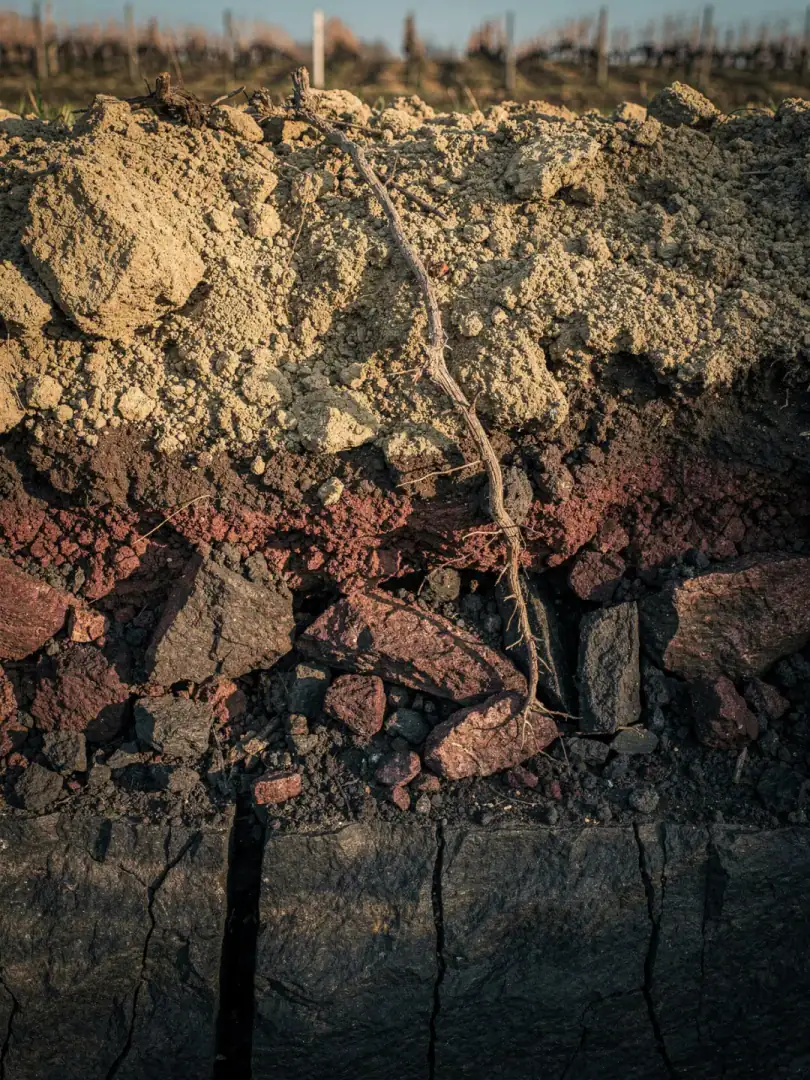
Volcano beneath Loess
Soils
Dig a hole in the Kaiserstuhl, and you dig through two entirely different geological ages. On top lies loess, a pale, fine-grained rock made of dust. Ice-age storms blew it out of the dry Rhine bed and deposited it on the slopes over millennia. In some spots on the Kaiserstuhl, this loess layer is up to thirty meters thick, one of the deepest deposits in all of Central Europe.
Beneath it begins volcanic rock. Roughly fifteen to eighteen million years ago, in the Tertiary period, a chain of volcanoes erupted here from the Upper Rhine Rift, with today's Totenkopf as the highest point at 557 meters. What now sits as a gentle hill in the Rhine Valley was once a fiery mountain. Its cone has long since fallen victim to erosion. What remains are the hard rocks from its interior, with names found almost nowhere else in the world: tuff, limburgite on the Limberg, carbonatite near Schelingen.
The two layers work differently. Loess is loose and warm, it lets water drain through quickly and warms up fast in spring, good for budbreak. The volcanic rock beneath is much denser, storing warmth through the day and releasing it again at night. A vine root that pushes through the loess into the rock literally changes the climate it's exposed to.
Because the Kaiserstuhl is too steep for machinery in many spots, generations of winegrowers built dry stone walls and terraces from this very volcanic rock. The stones store warmth during the day and pass it on to the vines at night. On the Kaiserstuhl and the neighboring Tuniberg, this is also one of the last refuges in Germany for the emerald lizard. Soil, climate, and landscape are so tightly interwoven here that they can hardly be explained separately.
Fine, pale wind-blown dust from the last Ice Age, calcareous and loose. Up to thirty meters thick at the deepest points on the Kaiserstuhl.
The root: Here the vine finds plenty of water, but it drains quickly. The fine roots tap into the loess first, since it offers little resistance.