At a Steinkopf
Tasting
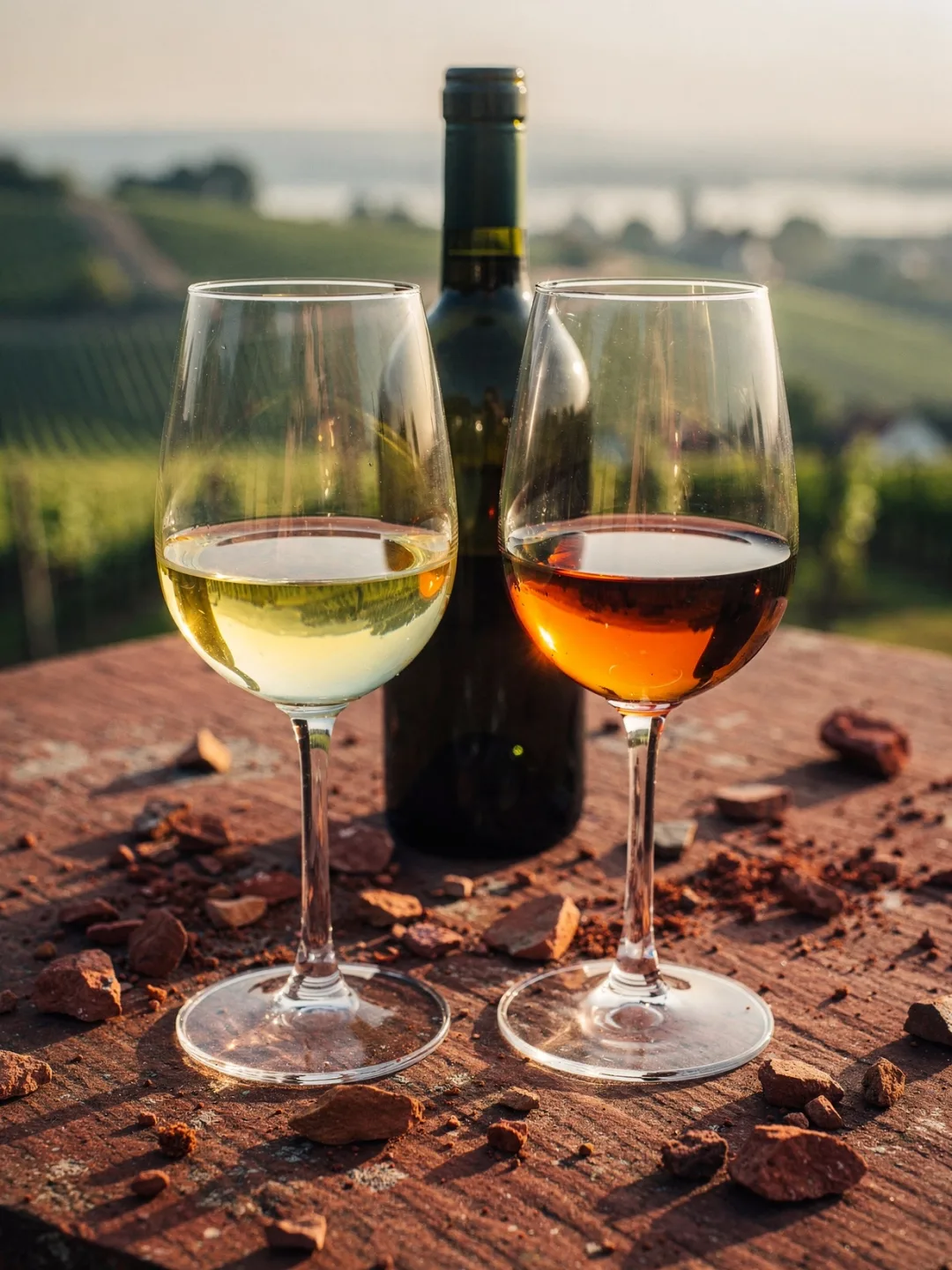
A Steinkopf Riesling gives away its age the moment you hold it up against a white sheet of paper. Young, it shows a pale green-gold, almost like unripe gooseberries. Over the years, the color shifts through straw yellow toward a deep amber. In a mature Auslese or an Eiswein, it can even turn a deep gold, almost like liquid honey.
Smell it twice: once with the glass still, and once after swirling. In the still glass, fruit comes first: green apple, citrus peel, and in riper vintages, yellow peach too. After swirling, what follows is heavier and takes longer to rise: a hint of flint or wet stone, which experienced tasters like to link to the Buntsandstein. This aroma, however, actually originates from fermentation itself, not directly from the soil.
On the palate, pay attention to the acidity. It sits along the sides of the tongue, running almost like a wire. In a Bergsträßer Riesling it's usually more pronounced than in comparable wines from warmer sites further south, and it's precisely this freshness that explains why Riesling performs so well here, even though the region ranks among the warmest in Germany.
Place a Roter Riesling next to it, and the difference is immediately obvious. Despite its name, it's golden yellow in the glass, not pink. On the palate it feels noticeably denser and more full-bodied, with a note reminiscent of ripe pear and a hint of spice. The acidity comes from the same grape, but here it feels softer and more integrated, almost as if the wine had more substance to carry it.
In the end, count along: how long does the flavor linger after you swallow? With a simple Kabinett, it might be five or six seconds. With a wine from the VDP.Erste Lage Steinkopf, that can stretch to twenty, and it's precisely this length that ultimately distinguishes a good vineyard site from an exceptional one.