Blue Slate & Greywacke
Soils
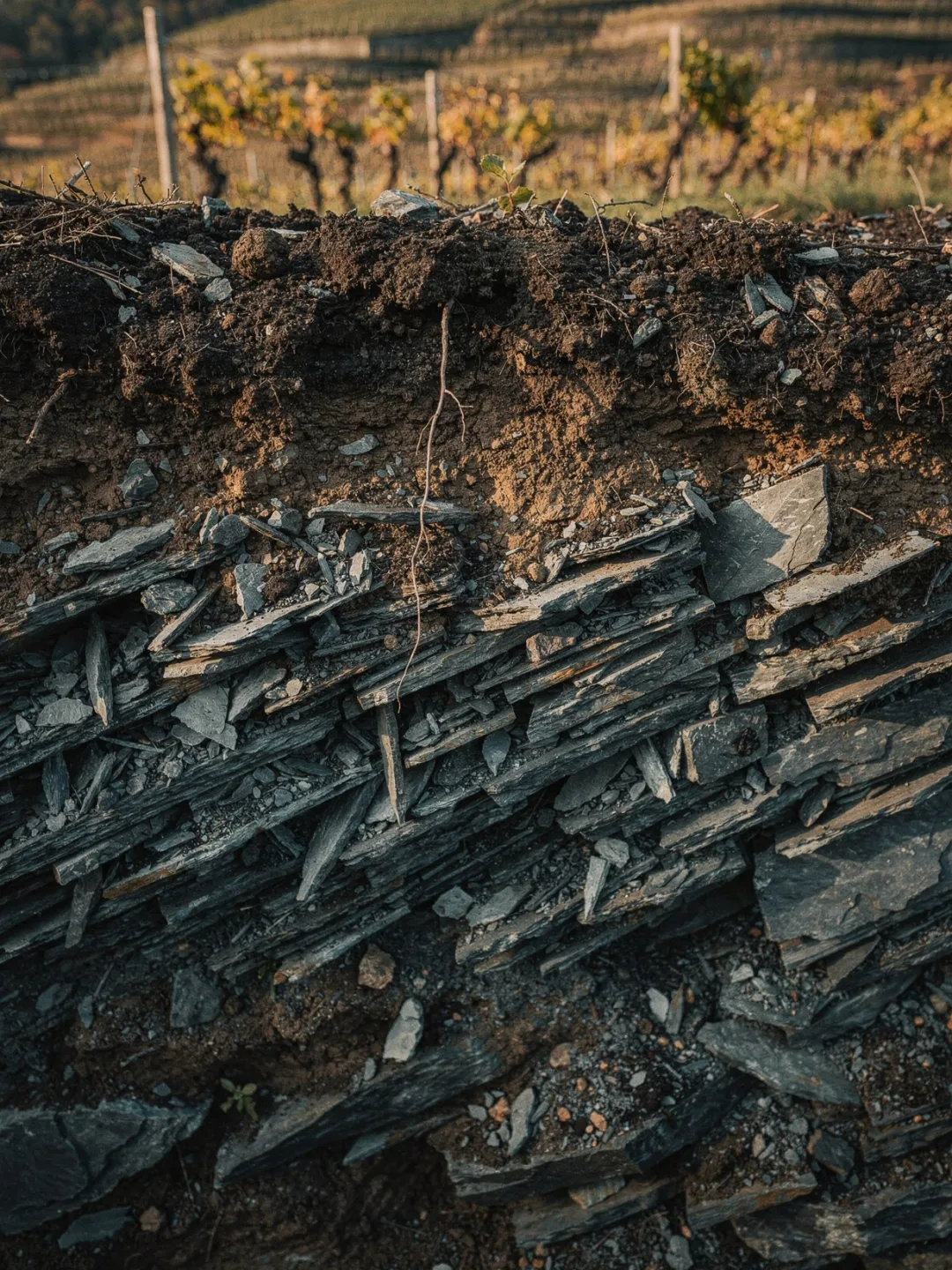
Dig a hole into a steep slope of the Middle Mosel. Within a few centimeters, you'll hit rock: thin, blue-gray plates that ring clear when tapped and can be pried apart by hand. This is Devonian slate, laid down as mud on a seabed some 400 million years ago and compressed into stone ever since.
For the vine, this slate is both obstacle and gift. It holds almost no nutrients, and water drains quickly between the plates. So the root drives deep, often several meters, in search of what's missing above. This very stress produces small, concentrated berries. A small berry has proportionally more skin than juice, and aromatic compounds sit mainly in the skin.
The slate's second role plays out above ground. The dark plates soak up sunlight during the day and release it back to the lowest rows of vines at night — a simple trick with a powerful effect. In a region that would otherwise be too cool for Riesling without it, this is no side note but an outright precondition. Steep south-facing slopes with exposed slate consistently ripen earlier than flatter sites with more humus on top.
The slate isn't uniform everywhere. In Ürzig, right in the heart of the Middle Mosel, lies an exception: reddish rock from the Rotliegend, formed around 290 million years ago from volcanic lava that flowed through the Wittlich Basin. Iron oxide gives the soil its red color. Winegrowers say their Rieslings from here carry a spicy, almost peppery note — hence the site's name, Würzgarten.
Further upstream, on the Obermosel, slate all but disappears. Here lies shell limestone from a much younger, warmer sea period: paler, better at retaining water, and less steep. This soil supports almost no Riesling, but nearly the entire German Elbling crop. A perfect example of how closely grape variety and rock are linked on the Mosel, even along the same river.
A thin, dark layer of decomposed leaves and root remnants. On the steep slopes, often just a hand's width, and in places washed away entirely down to the bare slate.
The root: This is where the fine roots sit, catching the last rainfall — in a drought, they're the first to give out.