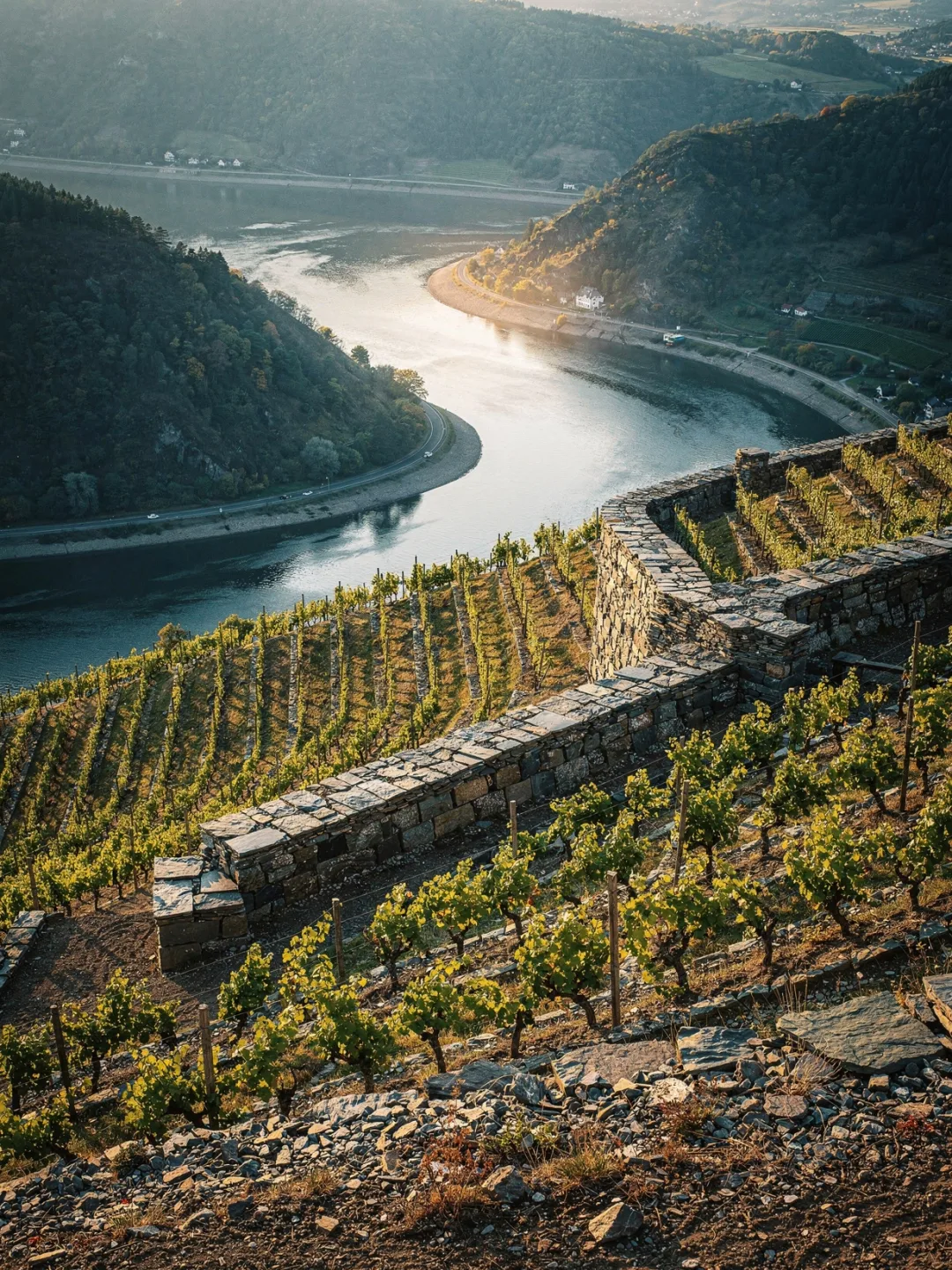
The River as a Heat Store
Climate
The Mosel lies far to the north, at the same latitude as Luxembourg and the Belgian Ardennes. On the map, this ought to be too cool for serious viticulture. That grapes have still ripened here for two thousand years is thanks to a narrow river valley that traps warmth instead of letting it pass through.
The river itself lends a hand. It winds in tight loops between the slopes, casting sunlight back onto the steep south-facing sites, almost like a second sky shining up from below. Add to that the water's role as a heat reservoir: it cools more slowly than air, softening frosts in spring and autumn, exactly when a young vine or a ripe grape is at its most vulnerable.
The second source of warmth lies in the soil. The dark slate on the steep slopes absorbs sunlight during the day and releases it slowly at night — a cycle that repeats daily. On hot September days, you can feel this simply by placing a hand on the stone, warm even hours after sunset, especially at extreme sites like the Calmont. This double source of warmth, river and stone together, explains why it's precisely the steepest, most inconvenient sites that yield the best grapes.
Even so, this remains a cool climate with a short growing season. Harvest often stretches into October, sometimes into November. This very length explains the wine's high acidity: what ripens slowly loses its acidity more slowly too. In some spots, a single hard winter cold snap is enough to allow grapes to be picked frozen — more on that under production.
Climate change has visibly pushed the harvest earlier over recent decades. In 2024, the Mosel saw its smallest harvest in fifty years, triggered by frost and fungal pressure during a wet spring. Winegrowers are responding with later pruning and more canopy work to shield against the sun — a balancing act in a region that has traditionally suffered from too little warmth rather than too much.