Steep Slopes & the Fuder
Production
Before wine can even be made on the Mosel, the grapes have to come down the slope. On extreme sites like the Calmont, this is pure manual labor, since machines can't cope with gradients over 30 percent, and a single hectare there demands up to 1,800 working hours a year. Since the 1990s, small monorail cars have carried the crates downhill. Before that, winegrowers hauled the harvest down on their backs, quite literally.
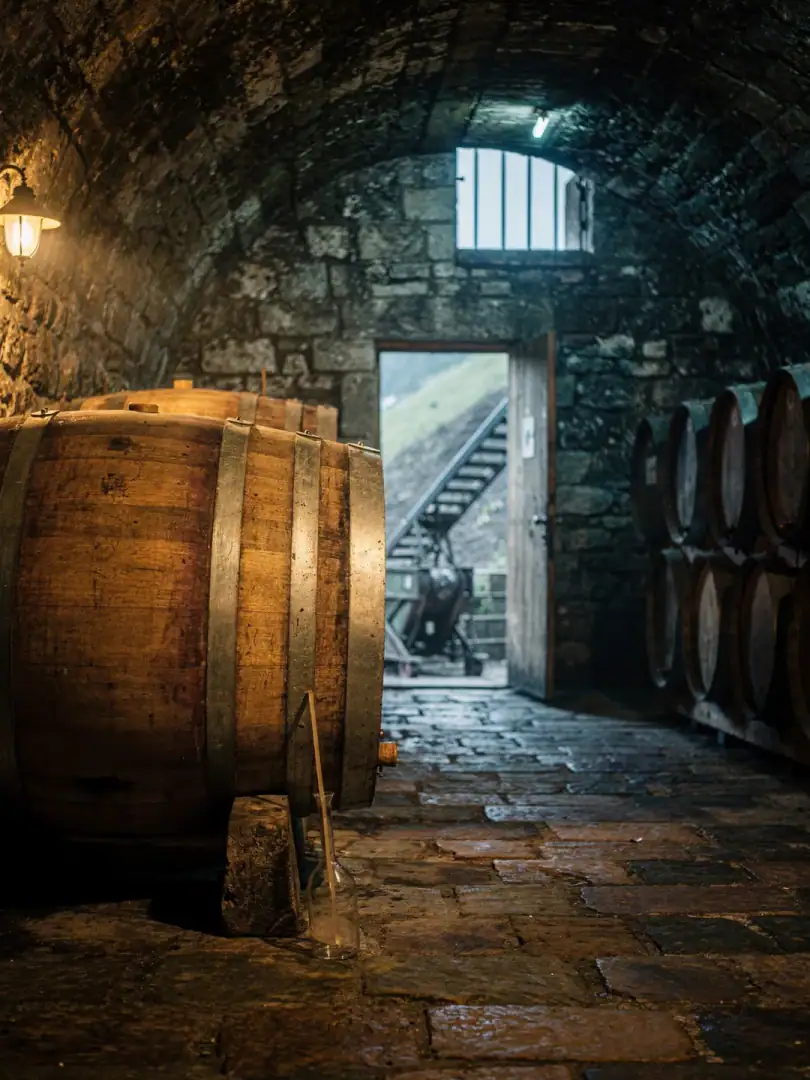
In the cellar, Riesling ferments slowly and coolly, often over several weeks at low temperatures, so the delicate fruit aromas don't escape with the fermentation gases but stay in the wine, where they belong. Many producers now use stainless steel tanks. Traditionally, the wine matured in a Fuder, a wooden cask holding exactly 1,000 liters on the Mosel, made of neutral, often decades-old oak. Unlike a new barrique, an old Fuder gives off almost no flavor of its own — it simply lets the wine breathe slowly.
How much sweetness ends up in the glass is decided as early as harvest. German Prädikat levels measure the sugar content of the grapes in degrees Öchsle, ranging from Kabinett through Spätlese to Auslese. Through the timing of the harvest, a winemaker controls how ripe, and how sweet, the finished wine will be. A VDP.Großes Gewächs, by contrast, must be dry, no matter how ripe the grapes were — the sweetness stays behind in the cellar, not in the bottle.
The riskiest form of harvest is Eiswein. The grapes hang on the vine well into winter, healthy and free of rot, until they freeze at a minimum of minus seven degrees Celsius. They're pressed while still frozen; the ice stays behind in the press, and only the highly concentrated grape sugar flows out as juice, with a must weight that has to be at least as high as that of a Beerenauslese. Not every year gets cold enough for it.
At the end of the chain stands the bottle, but the cask has its own rhythm too. A Kabinett often goes on sale as early as the spring after harvest. A Großes Gewächs typically ages for a year on the fine lees in the Fuder before bottling. It's exactly this time in old wood that rounds off the sharp acidity without robbing it of the tension that defines Mosel Riesling in the first place.