Riesling & Klebrot
Grape Varieties
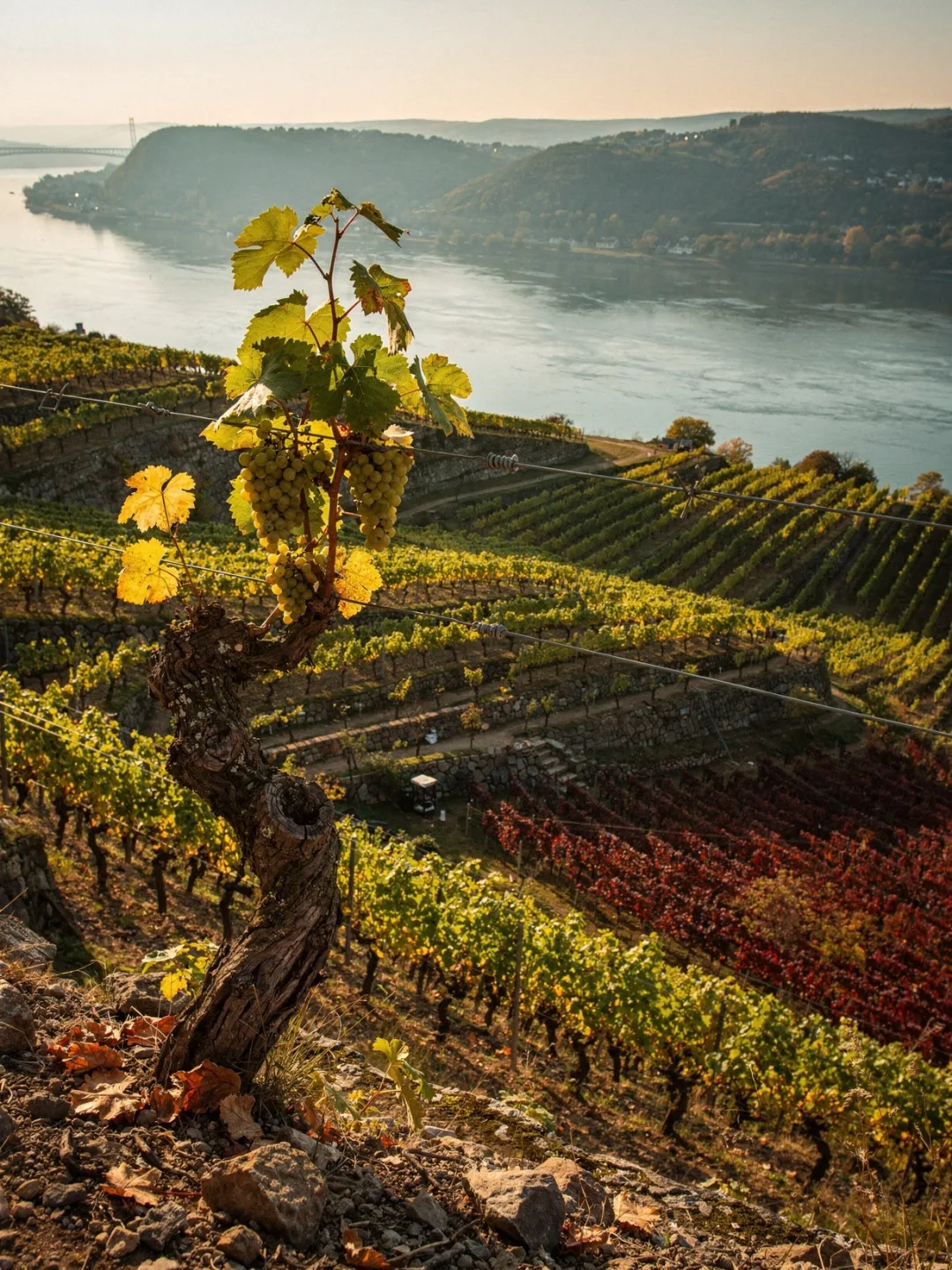
Three out of every four vines in the Rheingau carry the same variety. Of the roughly 3,100 hectares under vine, about 2,355 hectares were planted with Riesling in 2025 — around 75 percent of the total area, the highest share of any German wine region. The rest is divided mostly among a single other variety.
That other variety has its own island in the middle of a sea of Riesling. In Assmannshausen, at the western edge of the region, Spätburgunder has grown instead of Riesling for centuries. Here it was once called Klebrot or Roter Clevner, after its sticky, dark berry skin. A document from 1108 already mentions a vineyard on the Höllenberg, still the village's best site to this day. Over ninety percent of Assmannshausen's vineyard area is planted with red grapes. At around 75 contiguous hectares, it is Germany's largest single Spätburgunder site.
Riesling itself is a late bloomer. It buds late, flowers late, and ripens late, often not until October, when other varieties are long since in the cellar. That costs time, but it delivers acidity, more than almost any other white grape. It's precisely this acidity that keeps a Rheingau Riesling alive for twenty, thirty years, while other white wines have long since faded.
A small remainder is left over. It belongs to varieties that wouldn't exist at all without the Rheingau. At the research institute in Geisenheim, Hermann Müller crossed two grape varieties in 1882 and created Müller-Thurgau — today grown mainly in other regions, in the Rheingau itself now just a footnote alongside Riesling and Spätburgunder.
Why the region nonetheless never settled on a single variety becomes clear from the map. Downstream, west of Rüdesheim, the valley narrows, the river cools more strongly, and the slopes grow steeper. Under these conditions, Spätburgunder ripens well, while Riesling struggles. The Rheingau, then, is not a monoculture by accident, but by adaptation to what each individual slope can deliver.