Pinot Blanc & Müller-Thurgau
Grape Varieties
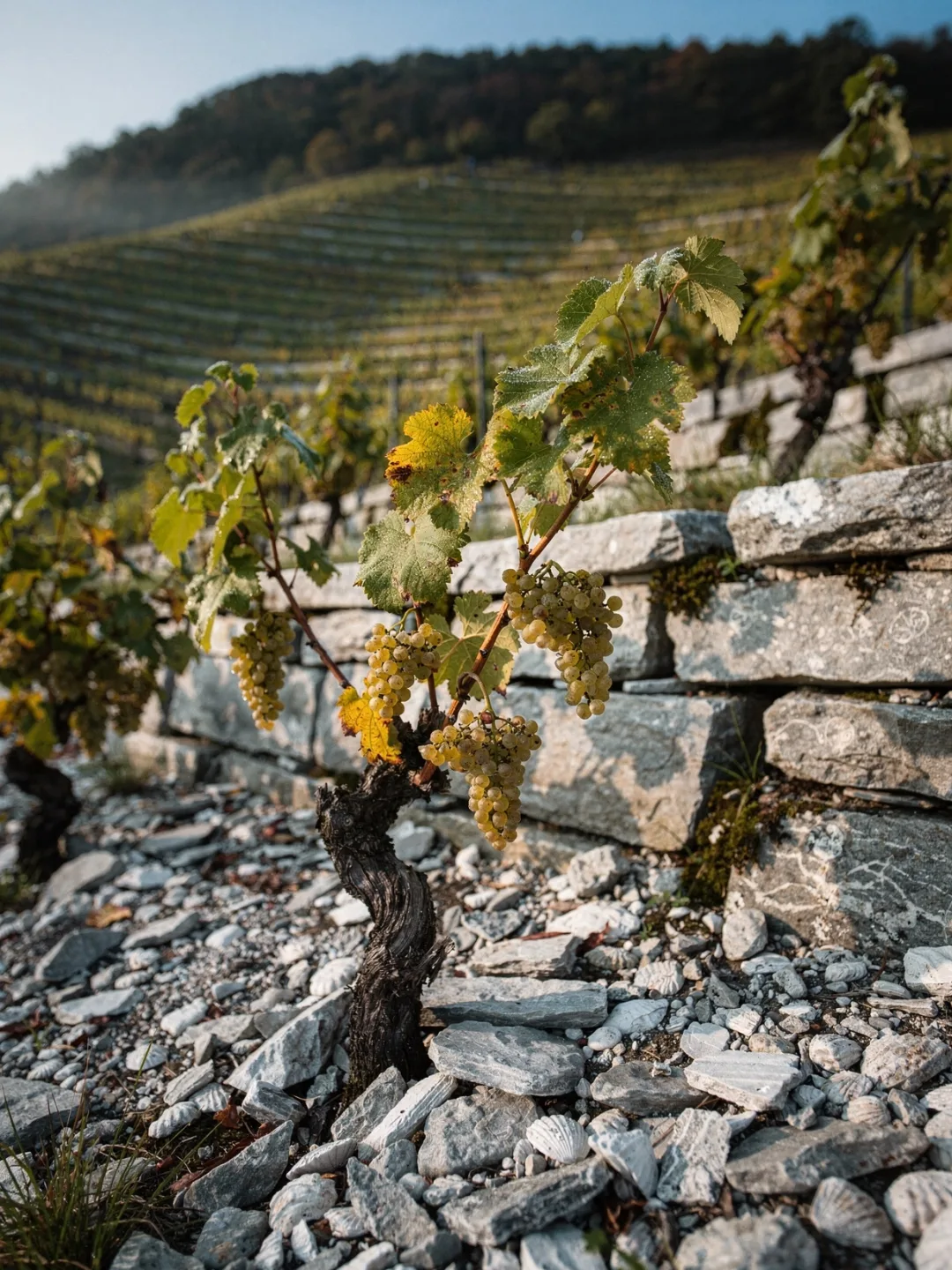
Two grape varieties now share the top spot, and that's a fairly recent development. Pinot Blanc now covers 116 hectares and has overtaken Müller-Thurgau, which held the number-one position for decades at 110 hectares. For a long time, Saale-Unstrut was practically synonymous with Müller-Thurgau.
The reason Müller-Thurgau dominated for so long is simple: it ripens early, tolerates short, cool summers, and delivers a reliable yield even after a late May frost has wiped out half the blossoms. Reliability trumped everything here. That was exactly what mattered in a wine region fighting for every ripe day at the 51st parallel.
Pinot Blanc needs more warmth than Müller-Thurgau. The fact that it has since overtaken it shows how the climate along the Saale and Unstrut has shifted over recent decades. A clear signal. Behind them come Riesling with around 70 hectares and Bacchus with about 53 hectares, plus Silvaner and the rare Kerner — over thirty grape varieties in total grow in the region's vineyards, more than in almost any other German wine region.
Red wine remains the exception. Only about a quarter of the area is planted with red grapes, led by Dornfelder at 49 hectares, followed by Blauer Portugieser, Zweigelt, and Pinot Noir. That's barely enough. For powerful, tannic red wine it's usually too cool here, so the red varieties tend to yield light, fruit-forward wines rather than heavy cellar-agers.
What all these varieties share is acidity. The short, cool growing season leaves the grapes little time to break down their acid, which is why even a mild variety like Pinot Blanc tastes crisper here than it would in the south. A Silvaner from Freyburg and a Silvaner from Franconia are botanically the same plant, yet in the glass they're barely recognizable as related.