Frost, Chalk, Sea
Climate
Hampshire sits at roughly 51 degrees north latitude, further north than all of Champagne. For a long time the county was simply too cold for serious viticulture. Only rising average temperatures over recent decades have turned a marginal case into a reliable growing region, one that now ranks among England's four largest wine counties.
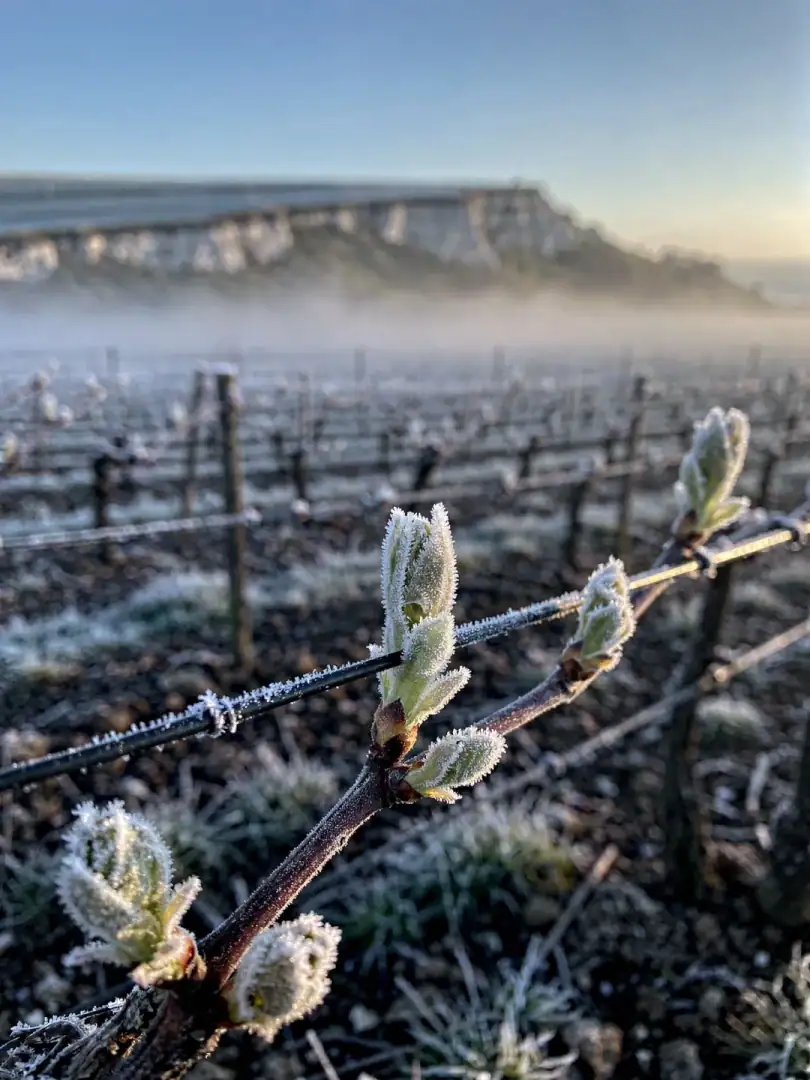
Even so, every spring remains a nail-biter. On April 27, 2017, the temperature on a Hampshire vineyard dropped to minus six degrees Celsius, while elsewhere in England entire harvests were wiped out by as much as eighty percent. A single cold morning can undo a whole year's work, since young shoots can barely withstand frost. That's why the best plots sit on gentle south-facing slopes of the South Downs, where cold air drains downhill at night instead of pooling.
The Solent, the strait between Hampshire's coast and the Isle of Wight, acts as a buffer, since water retains heat longer than land and cools more slowly. This softens temperature extremes near the coast, where frost stays rarer than twenty kilometers further inland.
The growing season itself is tight. Budbreak comes in April, harvest often not until early to mid-October, and in between there are noticeably fewer hours of sunshine than in any southern European wine region. Chalk makes up for some of that shortfall, since it stores daytime warmth and releases it again at night. Without that buffering effect, many grapes in lean years simply wouldn't ripen.
When ripeness still falls short, winemakers turn to a permitted remedy. They add sugar to the fermenting must to raise the alcohol level, a practice called chaptalization. English rules allow this only up to a certain limit, and only if the must already carries at least six percent natural alcohol by volume. It's not a trick, but a response to a climate that gives the vine little room to spare.