Granite & Limestone
Soils
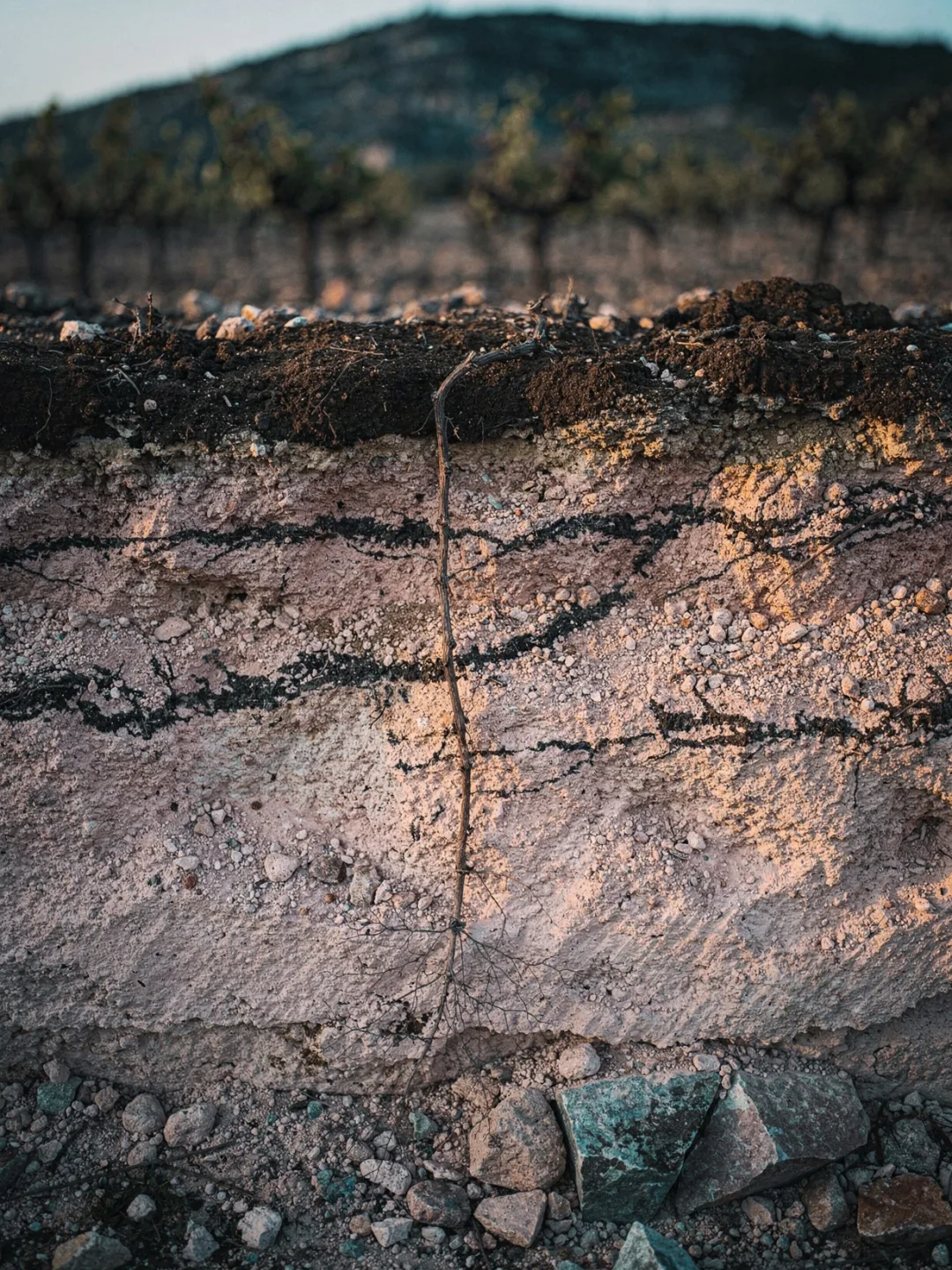
Dig a hole in a vineyard in the north of Beaujolais, say near Moulin-à-Vent. After just a few centimeters, the soil turns pink. Weathered granite crumbles there into sand under your fingers. That's the reason all ten crus lie in the north and not in the south. They sit on an old mountain massif millions of years older than the limestone farther down.
This granite is poor and free-draining. It holds almost no nutrients, and water runs straight through it. That's exactly what slows the vine down: less foliage, lower yields, but more concentrated berries. Around Moulin-à-Vent in particular, the weathered granite contains a striking amount of manganese, a trace element that stresses the vines even further — local winemakers joke that their wine already starts maturing in the soil.
Farther south, from roughly the level of Villefranche-sur-Saône, the rock changes completely. There lies limestone and clay from the Mesozoic era, a heavier, water-retentive soil on which Gamay turns out looser and more easy-drinking. This is the classic Beaujolais and Beaujolais-Villages, made for drinking, not for cellaring. Between the two zones there's no gradual transition, but a geological edge. At that edge, two entirely different wine styles begin and end.
A third zone breaks the rule. Around Mont Brouilly, the remnant of an extinct volcano, lies a bluish-shimmering rock the winemakers call pierres bleues — hardened diorite, formed roughly 380 million years ago inside a much larger volcano. Wine from these blue stones tastes bolder and spicier than any of its neighbors, and anyone who's tasted a Côte de Brouilly next to an ordinary Brouilly can taste the difference without any explanation needed.
A thin, sandy layer of weathered plant matter and fine granite grit. In the crus, often barely a hand's width deep.
The root: Only the fine feeder roots sit here, catching the first rain — and the first to dry out in hot summers.