Carbon Dioxide Instead of Crushing
Winemaking
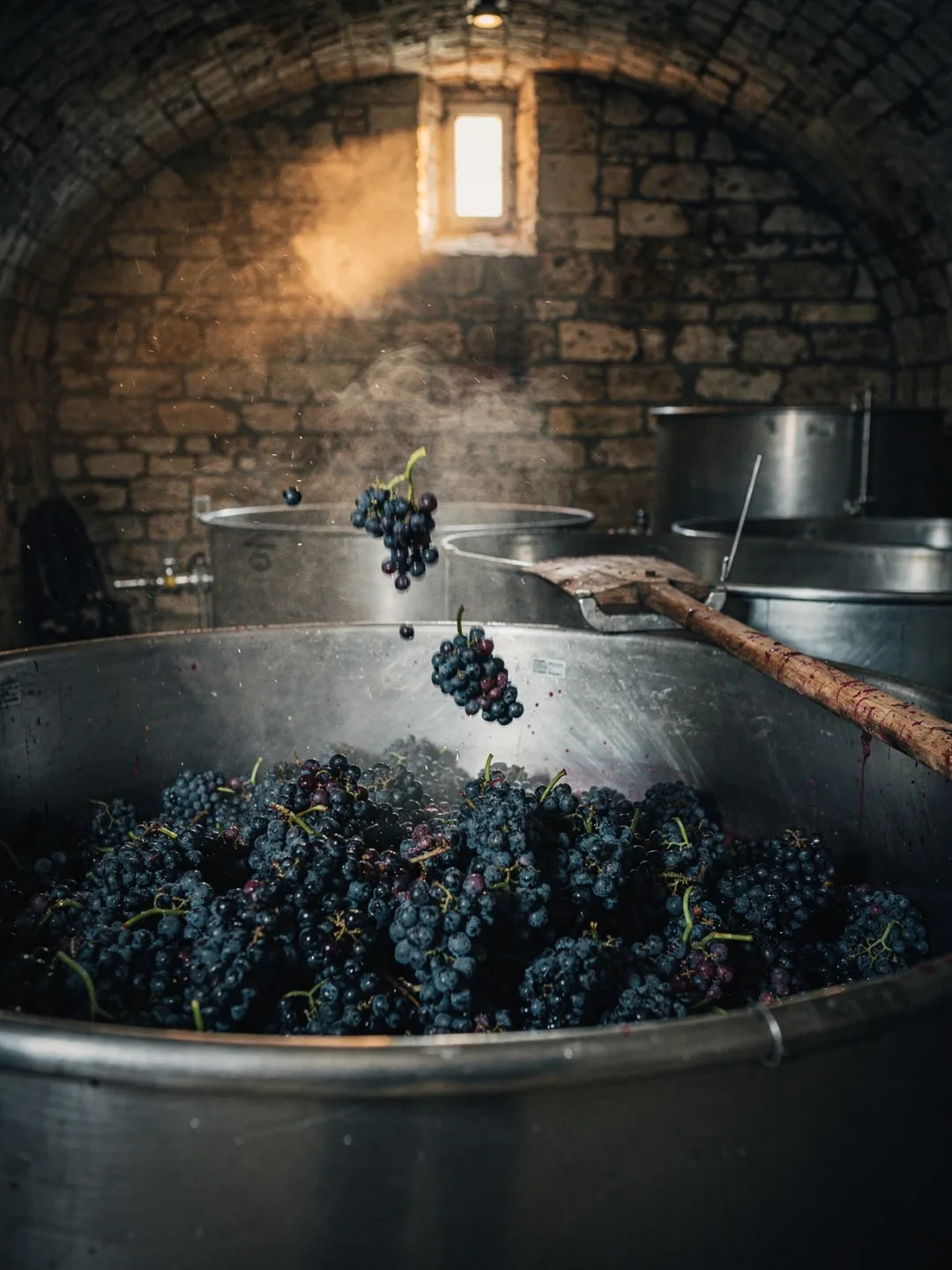
Red wine is usually made by crushing grapes and letting the skins ferment together with the juice. With Gamay in Beaujolais, it's often done the other way around: the grapes stay whole. They're poured, unbroken, into a closed tank filled with carbon dioxide. What happens next doesn't take place in the juice, but inside each individual berry.
Without oxygen, a fermentation begins inside the berry with no added yeast at all, triggered purely by the gas. The grape essentially ferments itself from within, producing a little alcohol and breaking down acid. In the traditional, semi-carbonic version, the necessary CO2 is generated right in the tank: the grapes at the bottom get crushed under the weight of those above, start fermenting normally, and their gas rises up to envelop the intact berries above them.
How long this takes depends on the tier the grapes are destined for. Beaujolais Nouveau needs just four days. A simple Beaujolais or Beaujolais-Villages takes six to eight. The ten crus, from Chiroubles to Moulin-à-Vent, take ten to fourteen days. The longer the grapes sit in carbon dioxide, the more color and tannin are additionally drawn from the skins — which is why a young Nouveau stays pale and soft, while a Moulin-à-Vent gains enough structure to age for ten years.
After that, the grapes are pressed, and only then does an ordinary yeast fermentation begin, converting the remaining sugar into alcohol. The brief carbonic phase leaves behind a characteristic aroma of banana and fruit candy, chemically mostly isoamyl acetate. In Nouveau, that's often the dominant aroma; in the longer-fermented crus, it's just a side note alongside cherry and spice. Aging then usually takes place in old, large wooden barrels or concrete tanks, which add no extra flavor to the wine, only letting air through slowly.
Hand harvesting isn't optional here — it's mandatory. Only intact, whole grapes deliver the sealed berries this method requires. A harvesting machine would tear open every berry and destroy the entire point of carbonic maceration. That's why the appellation rules explicitly state that only hand-picked, whole grapes may be used for this method of winemaking.