Gravel & Limestone Marl
Soils
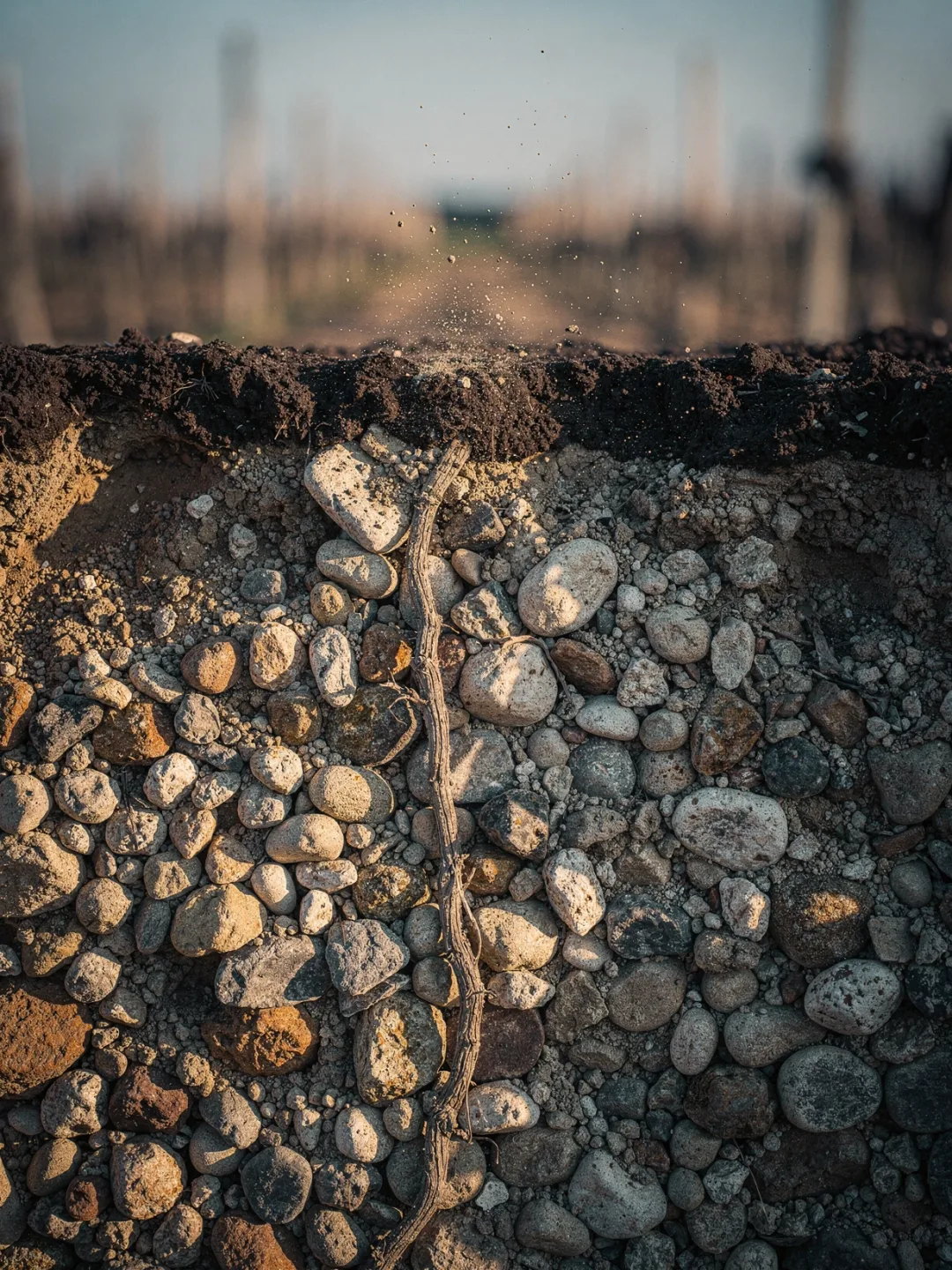
Dig a hole in a Médoc vineyard, deep enough for an adult to sink in up to the knee. Nearly everywhere you'll hit the same thing: round, pale, glistening pebbles, sometimes fist-sized, sometimes as small as a fingernail. This is graves, French for gravel, and it gave an entire sub-region south of the city its name.
This gravel is baggage carried here from the Ice Age. Millions of years ago, the Garonne carried rubble down from the Pyrenees and the Massif Central and deposited it in terraces, layer upon layer, each new meltwater period adding another level. Quartz, flint, smoothly worn limestone. Millions of years of transport work lie beneath every vine in the Médoc.
Water runs through this gravel almost unimpeded. The vine has to chase after it, deep — sometimes over six meters — until it hits damper ground below. This very stress produces small, thick-skinned berries packed with color and tannin — the foundation of the powerful, long-lived Cabernet Sauvignon that the left bank of the Gironde is famous for.
On the right bank of the Dordogne, the ground below tells a completely different story. Around Saint-Émilion lies a limestone plateau, formed from the shells of fossilized marine creatures, topped with thin, poor soil. A few kilometers further, in Pomerol, the subsoil shifts again. There, in places, lies a rare blue-gray clay called crasse de fer, which soaks up water like a sponge and releases it gradually during dry years.
So two completely different soils, just a few river kilometers apart — and that's why two different grapes grow here. The thirsty gravel of the left bank suits the late-ripening Cabernet Sauvignon. The water-retaining clay and limestone of the right bank suits the earlier-ripening, more delicate Merlot. No winemaker planned this. The soil chose the grape, not the other way around.
A thin, dark layer of decomposing leaves and roots, often barely a hand's width deep on the gravelly soils of the Médoc.
The root: This is where the fine roots sit, absorbing whatever the Atlantic rain has just brought.