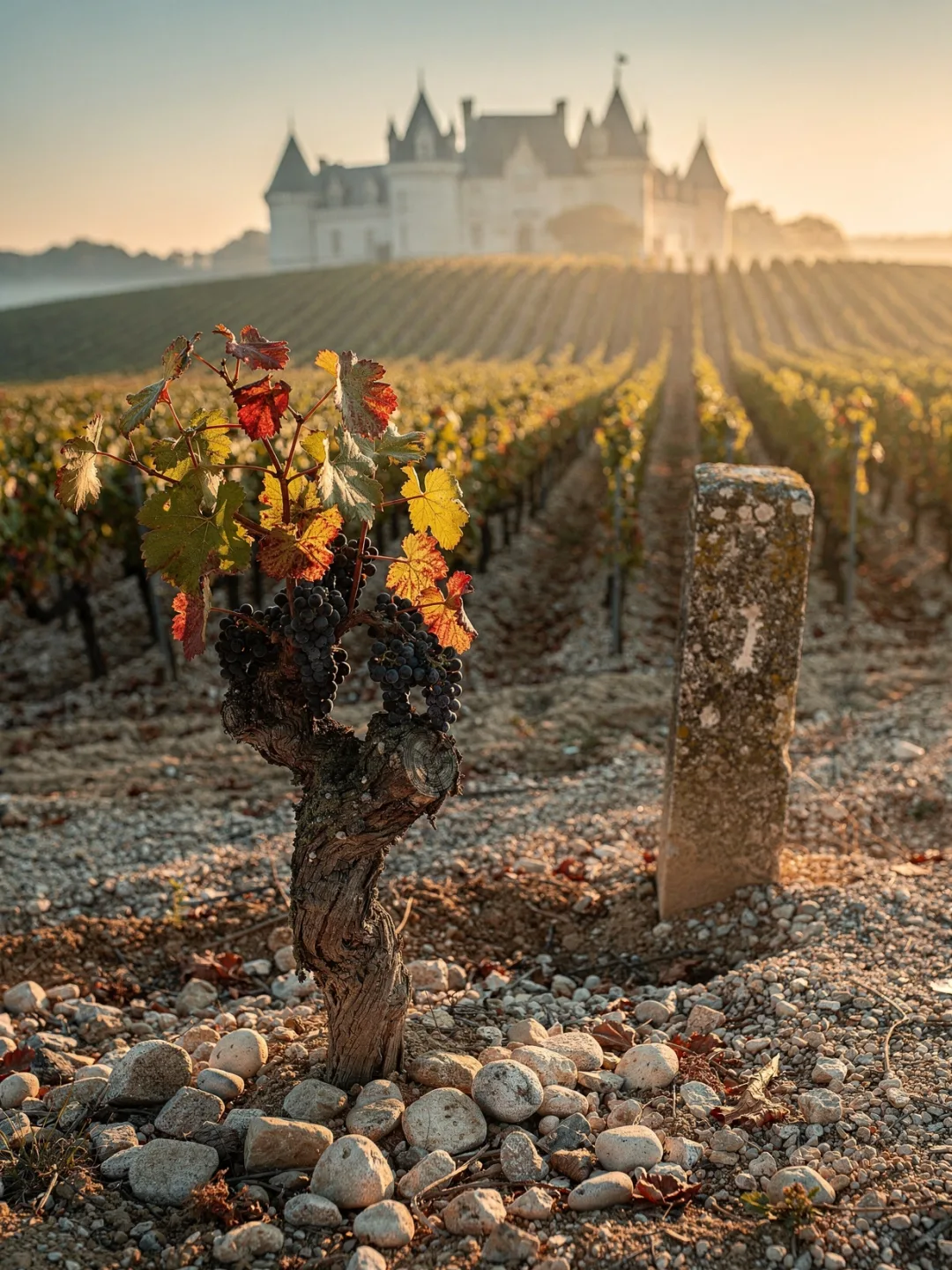
Merlot & Cabernet
Grape Varieties
No Bordeaux wine typically carries the name of a single grape variety on its label. Almost every red here is a blend of several grapes. Two varieties carry most of the weight. Merlot accounts for around sixty-six percent of the red vineyard area, Cabernet Sauvignon a good twenty-two percent, and the rest is split among Cabernet Franc, Petit Verdot, Malbec, and a touch of Carménère.
For a long time, growers themselves didn't know just how closely related these two main varieties are. It wasn't until 1997 that DNA analysis at the University of California, Davis showed that Cabernet Sauvignon must have arisen from a chance crossing of Cabernet Franc and the white Sauvignon Blanc, likely sometime in the seventeenth century somewhere in the Bordelais. A red grape and a white grape. A brand-new red classic. To this day, no one knows exactly where it happened.
Merlot buds early and ripens early. That's why it's mostly planted on the cooler, clay-and-limestone right bank of the Dordogne, in Saint-Émilion and Pomerol, where it turns soft and fruity. Cabernet Sauvignon needs more warmth and more time. It ripens late, and it's anything but thin-skinned: small, thick-skinned berries packed with tannin, which need the warm, gravelly soils of the Médoc and Graves on the left bank of the Gironde to ripen properly at all.
A third variety once carried far more weight here. A single cold snap in February 1956 destroyed nearly seventy-five percent of all Malbec vines in the Gironde. Afterward, many growers opted to replant with the hardier Merlot and Cabernet Sauvignon instead. Elsewhere in the Southwest, in Cahors, the same grape is still called Côt and remains the backbone variety there. In Bordeaux, it's now little more than a footnote.
Among the white grapes, Sémillon leads the way, thin-skinned and prone to noble rot. It's rounded out by the more aromatic, higher-acid Sauvignon Blanc and a touch of Muscadelle. Together they produce dry white wines from Entre-deux-Mers as well as the honeyed sweet wines of Sauternes, depending on whether the grapes are picked dry or left to wait for the fungus that shrivels them.