Pinot, Chardonnay, Aligoté
Grape Varieties
Two grape varieties carry almost all of Burgundy. They could hardly be more different. Chardonnay covers 57 percent of the vineyard area and makes the white Burgundies from Chablis to the Mâconnais. Pinot Noir accounts for 34 percent and supplies nearly every red wine between Dijon and Santenay. Together that's over ninety percent of the entire area, a concentration on just two varieties rarely found in any other major wine region.
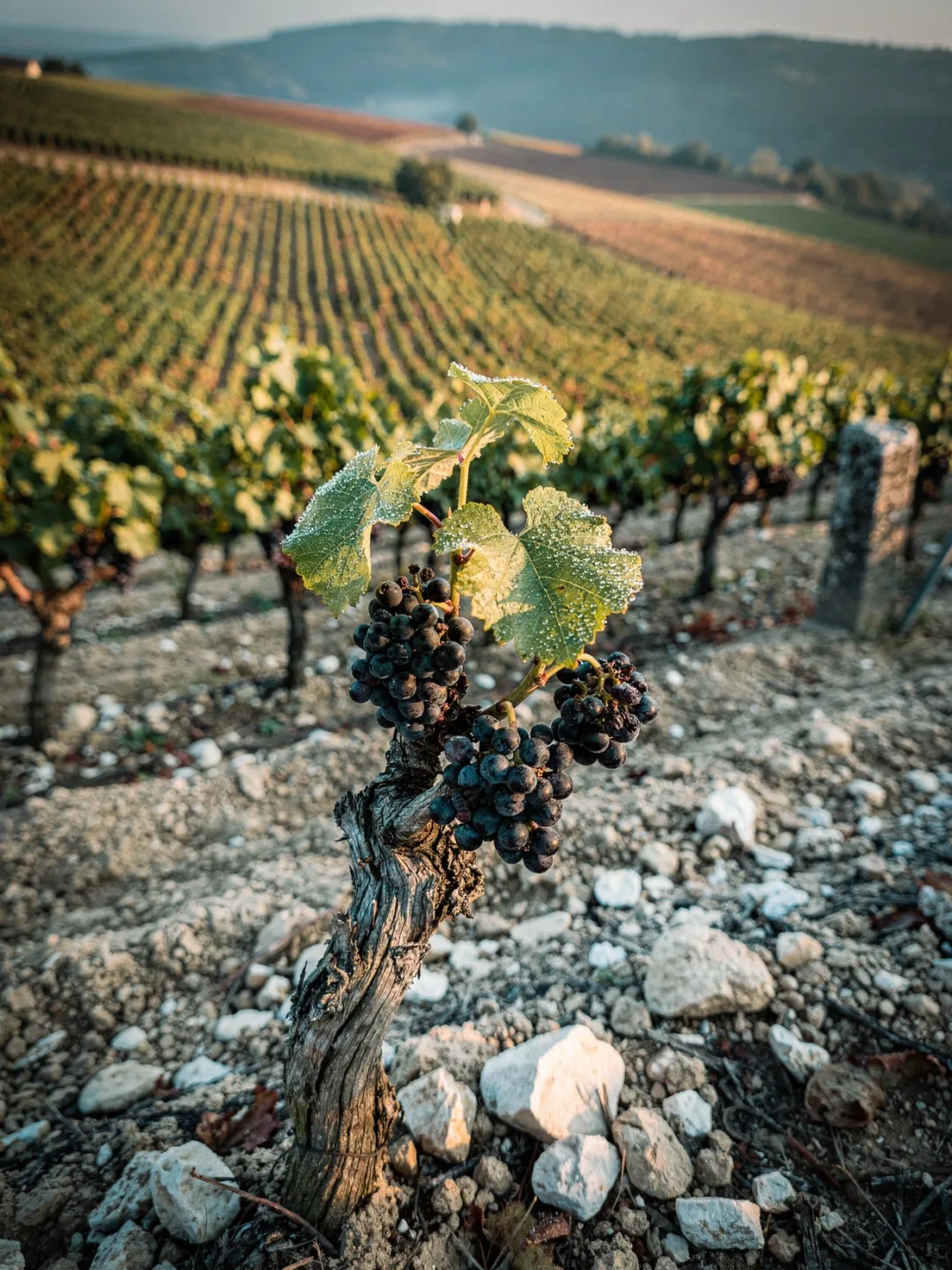
Pinot Noir is a difficult grape. Every winemaker in Burgundy will confirm this. Its skin is thin, its clusters are tightly packed, and rot spreads faster in damp weather than with almost any other red variety. But in return, it responds individually to every handspan of soil: the same clone, planted ten meters further along, can taste edgy and spicy in Gevrey-Chambertin and almost soft and floral in Chambolle-Musigny. It's precisely this sensitivity that makes it the ideal variety for a land that has broken its soil down into a thousand named parcels.
Chardonnay is often seen as a neutral variety without much character of its own. That's exactly where its Burgundian strength lies. It absorbs soil and climate more directly than more aromatic grapes like Riesling or Sauvignon Blanc, whose strong inherent scent can mask the sense of place. A Chablis from the cool north therefore tastes noticeably different from a Meursault from the warmer Côte de Beaune, even though both come from the same grape.
A third white variety leads a shadowy existence. It deserves more attention. Aligoté covers six percent of the vineyard area, is usually drunk young with plenty of acidity, and was long considered a simple everyday wine for an aperitif with a splash of cassis, until the village of Bouzeron proved otherwise. Since 1998, it has been the only village in France with its own appellation exclusively for Aligoté. Its wines show just how much tension the variety holds when taken seriously.
The rest, barely three percent of the area, belongs to outsiders. Gamay grows mainly in the southern Mâconnais. It may be blended with Pinot Noir in Bourgogne Passe-Tout-Grains, as long as the wine contains at least thirty percent Pinot Noir and at least fifteen percent Gamay. César is a rare red variety with thick tannin. It survives only around Irancy in the far north, where it may make up at most ten percent of the grapes. Both are a reminder: Burgundy's two-variety story doesn't come entirely without exception.