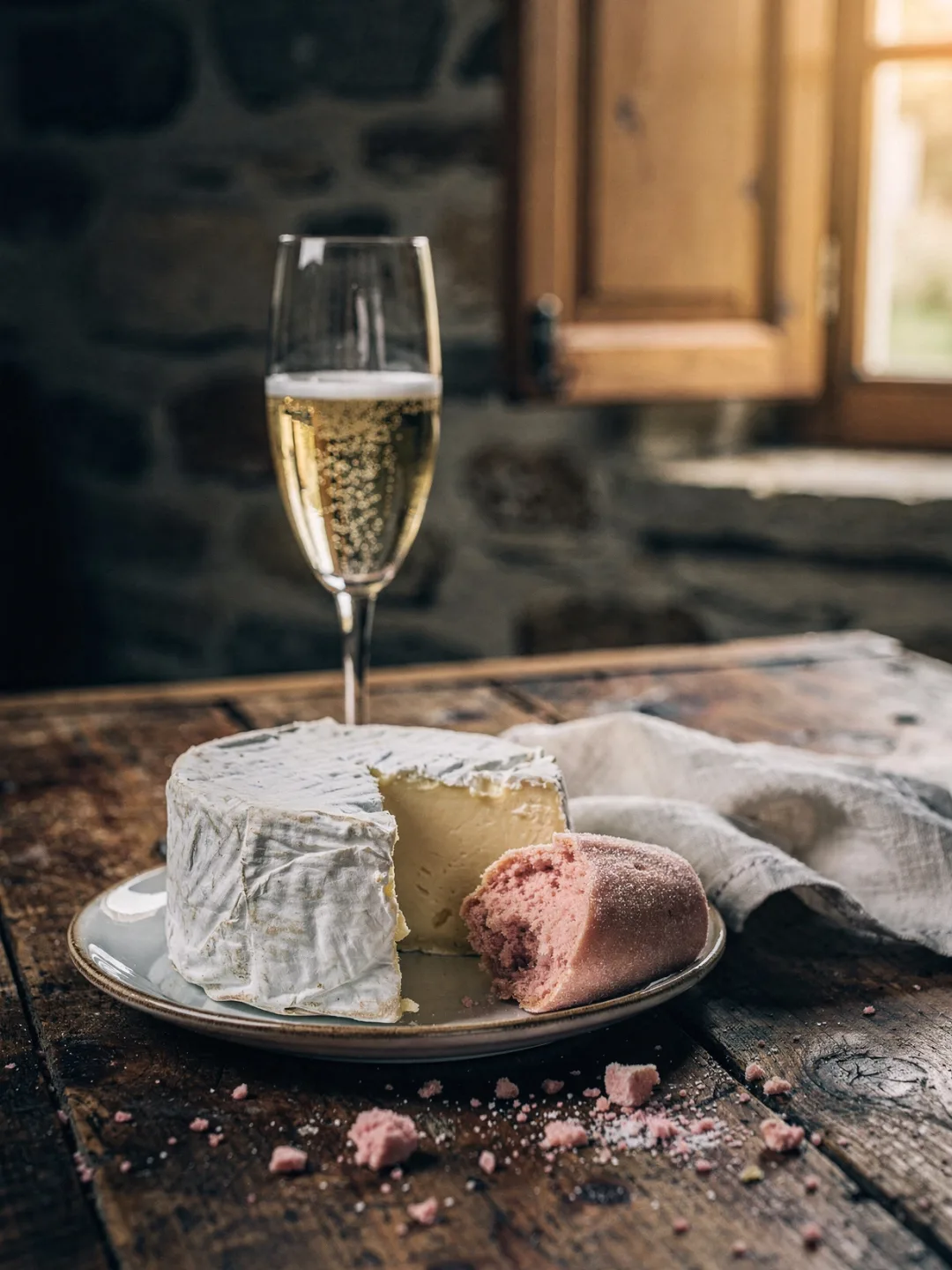
Chaource, Langres, Biscuit
Wine & Food
Many consider Champagne merely an aperitif, the first sip before the actual meal, but this does no justice to its acidity and carbonation. Both cut through fat like a knife. They rinse the palate clean between bites. That's why a dry Champagne can accompany an entire menu, not just the first course.
It pairs especially well with the region's cheeses. Chaource, a young, creamy-soft cheese from the Aube with a white mold rind, originates from the medieval monasteries of the area. Since 1970, it has held its own appellation. Its mild acidity and creamy core need a wine that brings its own acidity, otherwise the cheese quickly feels heavy in the mouth. That's exactly what a young Champagne from the Côte des Bar delivers, where Chaource traditionally makes its way to the table.
Langres, another cheese from the region around the town of the same name, is never turned during ripening. As a result, a small depression forms on its top, called the fontaine. Traditionally, this hollow is filled with a splash of Champagne or Marc de Champagne, briefly set alight, and the cheese is spooned straight out of the well. This ritual is found nowhere else in France. The wine thus becomes part of the dish, far more than just its accompaniment.
Things turn sweeter with the biscuit rose de Reims, a pink-tinted cookie. Bakers in the city invented it around 1690 to make a second use of the residual heat in their bread ovens. Hence the name: twice-baked. The Biscuiterie Fossier, based in Reims since 1756 and now the last of what were once fifteen producers, still makes it today according to the same basic recipe. Dipped into a glass of Champagne, usually a mild Demi-Sec, the cookie slowly dissolves on the tongue—one of the rare pairings where sweet wine and sweet pastry don't overwhelm each other, because the carbonation clears the palate in between.