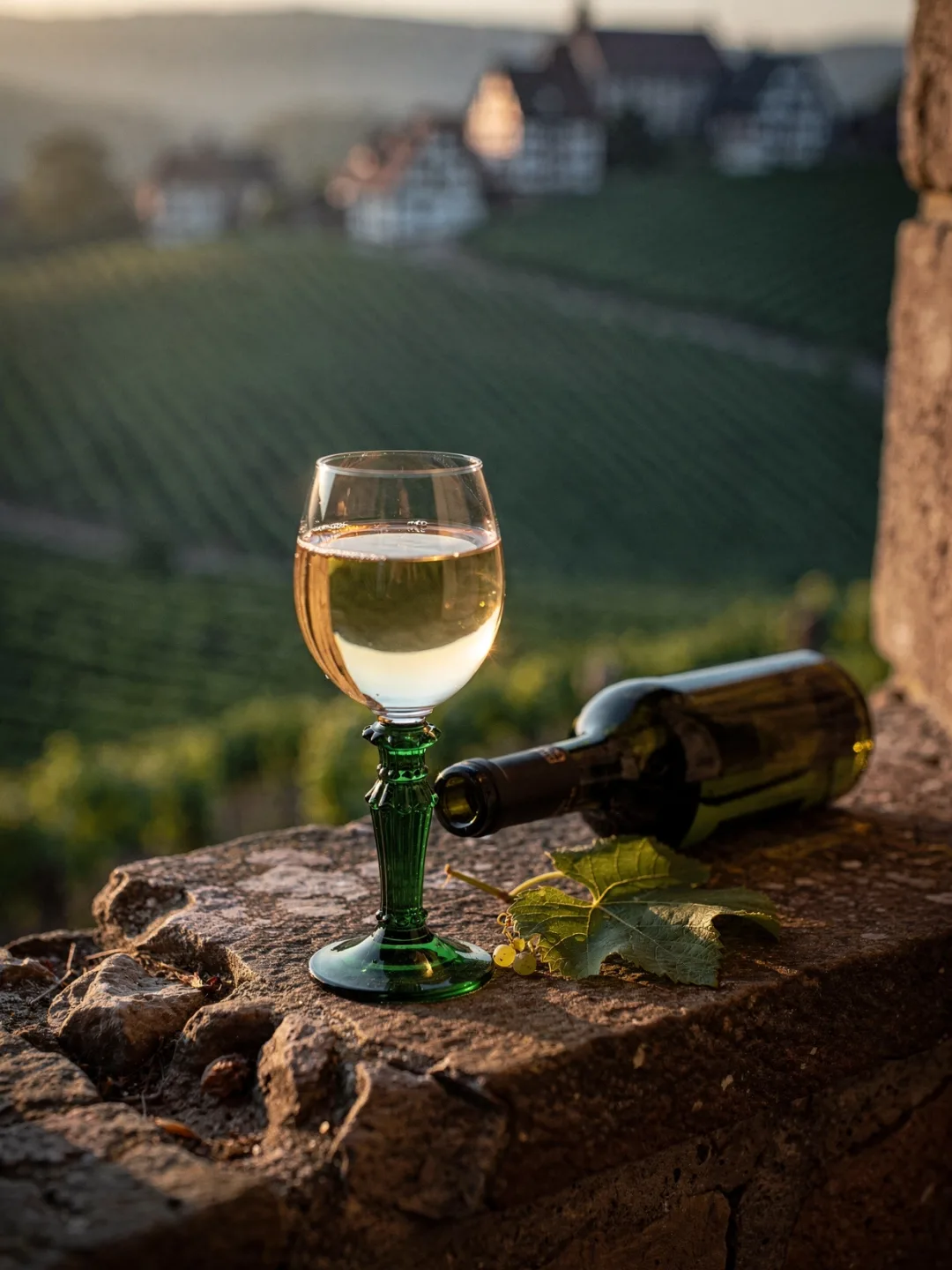
Roemer and tulip glass
Glassware
A glass with a green stem. That's the image most people have in mind when they think of Alsatian wine, the so-called Roemer glass, which emerged in the sixteenth century from greenish forest glass, with small studs on the stem so the hand wouldn't slip while drinking. It was common all along the Rhine, from the foothills of the Vosges to Holland.
It's poorly suited for the nose, though. Its round, bulging bowl barely captures the aroma, and anyone who wants to seriously taste Riesling or Gewürztraminer today reaches for the internationally standardized INAO glass, slender and tulip-shaped, the official French standard since 1970. You'll now find it in every wine shop between Colmar and Riquewihr. Its narrow opening concentrates whatever rises from the wine.
With Gewürztraminer, it becomes clear why shape matters so much. Its aroma of rose petals and lychee is so powerful that too narrow a glass practically forces it up your nose, making it overbearing. A slightly wider bowl gives it room. Just a finger's width more in diameter is enough for the aroma to unfold without overwhelming.
Riesling needs the opposite. Its acidity and its more restrained aroma of citrus and stone get lost in too wide a glass, so the narrow tulip shape remains essential here. It's served cool, at forty-six to fifty degrees Fahrenheit. Gewürztraminer and Pinot Gris prefer around fifty to fifty-four, and just a couple of degrees more can tip the aromas from floral to heavy.
A Vendange Tardive or Sélection de Grains Nobles calls for its own rule: a smaller glass, a smaller pour. These wines are highly concentrated and usually distinctly sweet, and for Sélection de Grains Nobles, the law requires a minimum sugar content equivalent to an alcohol potential above sixteen point four percent, and for Gewürztraminer and Pinot Gris even above eighteen. A small glass holding four to six centiliters is plenty.