Granite & Limestone
Soils
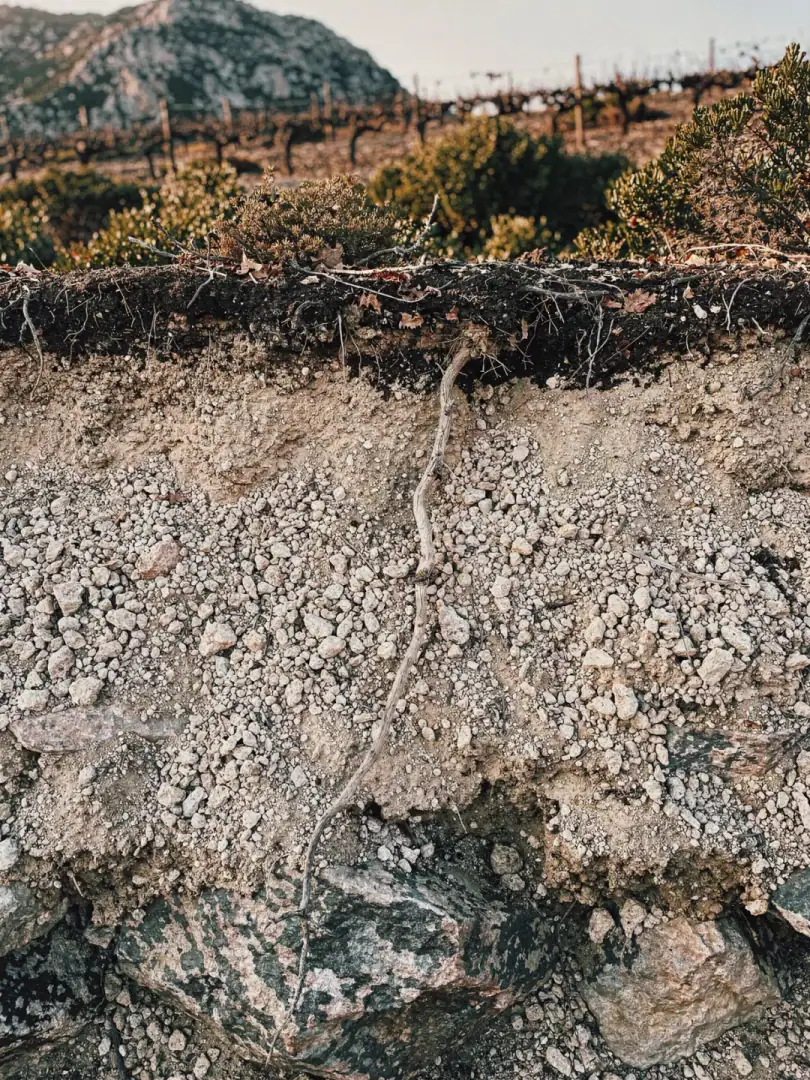
In a vineyard near Ajaccio, a single spade's depth is enough to hit pale, grainy sand within twenty centimeters: weathered granite, known locally as arène. Almost two-thirds of Corsica is made of exactly this rock. Geologists call it crystalline Corsica, an ancient bedrock underlying the west and south of the island. The northeast, by contrast, including Cap Corse, is younger and consists of schist, once seabed before it folded upward.
The granite sand itself is lean. It holds almost no water, letting it drain away quickly. What remains from the weathering of feldspar is rich in silica, potassium, and sometimes calcium, but poor in almost everything else a plant would need for rapid growth. Sciaccarellu loves exactly that. Its roots work their way down through the loose sand to the solid rock beneath, drawing out the last traces of moisture from a dry summer down there. The small, concentrated berries that result explain part of its power despite the pale color.
In the north, in the region known in Corsican as Nebbiu — literally 'fog' — the picture reverses. There the Patrimonio basin opens up. Instead of granite, there's a marly limestone here, argilo-calcaire as the appellation's official language calls it, growing increasingly schistous and stony toward the east. Limestone holds water better than granite sand, but also releases it more slowly. That's exactly what Niellucciu's roots prefer: a steadier supply, but stricter growth. An estate that owns both soil types can produce two entirely different wines from the same grape, without changing anything in the cellar.
Right in the east, on the plain near Aléria, lies a third world entirely. Alluvial deposits and marly sand were carried down from the mountains by rivers, fertile and flat. This is where the Pieds-noirs' bulk vines grew in the 1960s. Vines still stand there today, but hardly any whose yield would qualify for one of the island's nine appellations.
A thin, dark layer of decomposed maquis leaves and holm oak needles. In the summer heat, it's the first thing to dry out.
The root: Only the finest roots live here. At the first August heat, they're the first to give up.