Schist and Limestone Marl
Soils
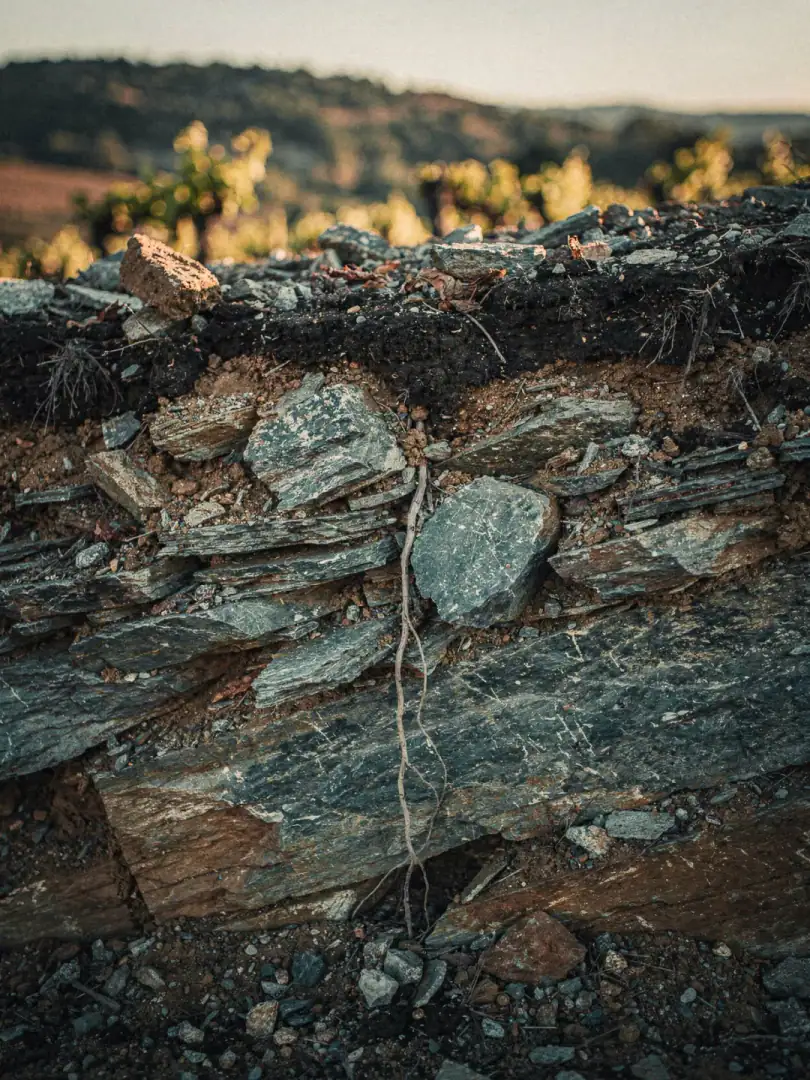
Dig a hole in a vineyard in Faugères. Almost immediately you'll hit rock that looks the same everywhere: schist, blue-gray to brownish, sometimes with a rusty red or violet sheen. Seven communes make up the appellation, and in all seven the subsoil is identical. Nowhere else in the Languedoc is an entire AOC built so uniformly on a single rock type.
The rock is ancient. It formed around three hundred and fifty million years ago, during the Devonian and Carboniferous periods, when mud at the bottom of a long-vanished primordial sea compacted into thin sheets. Today this schist breaks into sharp-edged layers that can be pried apart by hand like the pages of a book.
For the vine root, this is an invitation. It wedges itself between the layers, seeking out every crack. Because water and nutrients are so scarce here, it drives ever deeper, often down to seven or eight meters, where its finest tips have frequently been found in Faugères schist. That depth is the vine's insurance against the dry Languedoc summer.
The schist's dark color has a second, important effect. It stores heat during the day and releases it back to the grapes at night. This speeds up ripening and makes the wine denser than it would be on pale limestone soil. At the same time, rainwater drains instantly through the loose layers—waterlogging is virtually unknown on schist.
A few kilometers away, the soil looks completely different. In the Corbières and Minervois, limestone marl and clay dominate, hard and pale. It holds water longer than schist and makes the wines stricter and slower to mature. On the coast near La Clape, meanwhile, round river pebbles lie over limestone bedrock—the same stones that store heat in Châteauneuf-du-Pape. Three soils, one region—and you can taste the difference in the glass.
A thin, dark layer of decomposed garrigue scrub and lightly weathered schist grit. After heavy rain, it's dry again within hours.
The root: Only the finest roots reach here. They draw on whatever the rare rain brings and are the first to feel thirst.